A smaller expression of a classic moon-phase watch
Not every important luxury watch arrives with a larger case or a more elaborate complication. Sometimes the meaningful change is proportion: a watch that sits more naturally on the wrist and lets familiar elements speak more quietly. Jaeger-LeCoultre's latest Master Ultra Thin Moon takes that approach, introducing a 36-millimetre pink-gold case to a design language built around restraint.
The Swiss manufacturer announced the new reference on 19 October 2026, describing it as a tribute to the measured proportions of round dress watches from the 1950s. The watch combines a polished case in 18-carat pink gold with a silver-toned dial, a date and moon-phase display and an established in-house automatic movement. It is a new reference, not a claim that the moon-phase complication itself has just been invented.
Why the 36-millimetre case matters
The manufacturer specifies a diameter of 36 millimetres and a case thickness of 9.3 millimetres. Those measurements shape how the piece relates to the wrist and to a shirt cuff, but dimensions alone never tell the whole story. Curving lugs, the case profile and the way a strap meets the case can be just as influential in determining whether the watch feels discreet or prominent.
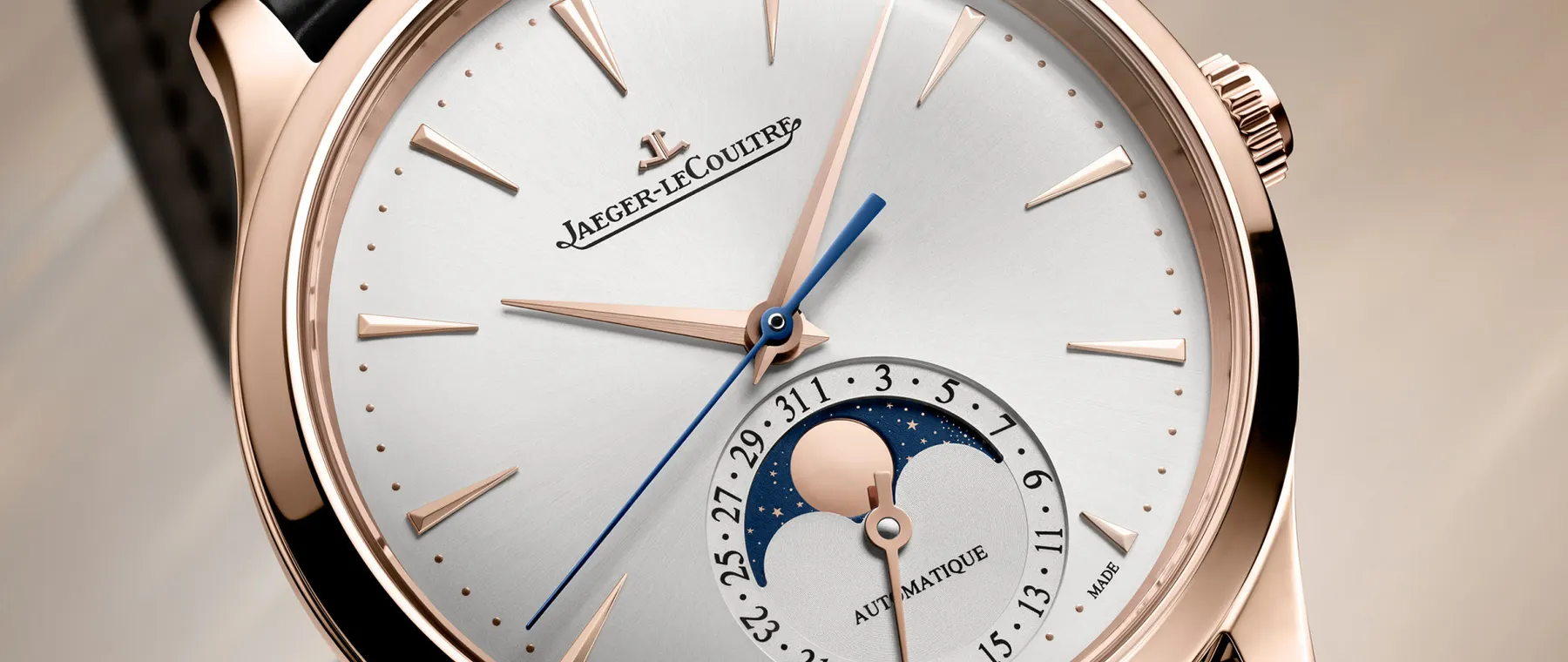
The fully polished pink-gold surfaces make light part of the design. Instead of applying colour to every component, the metal introduces warmth while the silvered dial provides a comparatively cool centre. Jaeger-LeCoultre uses gilt markers and faceted hands to connect the two materials without overwhelming the spare composition.
The choice is relevant to a broad range of wearers. Someone who finds modern sports watches too large may welcome a case that draws attention through finishing rather than sheer scale. Whether a 36-millimetre watch fits well still depends on personal preference and wrist shape, and a boutique fitting remains more informative than any universal sizing rule.
A dial built around balance
The centre of the dial is deliberately quiet, with elongated markers and Dauphine hands that have contrasting finishes on their facets. Jaeger-LeCoultre says one side of a hand is satin-brushed while the other is polished. This produces small changes in appearance as the wrist turns rather than relying on strong decorative patterns.
The moon-phase display and date are arranged together at six o'clock. The moon appears against a deep-blue starry background, while the calendar numerals sit around the aperture. This arrangement places the secondary indications beneath the primary time display and preserves an orderly relationship between the markers and the lower dial.
A moon-phase watch is as much a choice about how to experience time as how to measure it. Hours and minutes are needed throughout the day, but the changing image of the moon introduces a slower rhythm and an aesthetic reference to the sky. It is a poetic complication with a mechanical basis, provided owners set and maintain it according to the manufacturer's instructions.
Inside the Calibre 925
The watch is powered by Jaeger-LeCoultre's self-winding Calibre 925, a longstanding movement in the manufacturer's collection. For the new reference, the company states a power reserve of 70 hours and functions covering hours, minutes, seconds, date and moon phase. Those specifications offer a useful practical picture without inventing performance claims not contained in the official release.
The movement is visible through a sapphire caseback, where the maker highlights Geneva stripes, bevelled bridges and blue screws. An open-worked winding rotor made from 22-carat pink gold contributes a decorative element on the side usually hidden during wear. The appeal lies in careful finishing as well as the operation of the indications visible from the front.
Mechanical movements reward both admiration and appropriate care. Their power reserves describe an expected period of operation from a sufficiently wound state under specified conditions, not a promise that the watch will keep perfect time indefinitely without attention. A new owner should follow the manufacturer's instructions for setting the calendar and arranging service.
Materials, strap and daily use
Jaeger-LeCoultre pairs the pink-gold case with a black alligator strap and an interchangeable pink-gold pin buckle. The contrast of dark leather and warm metal is a traditional dress-watch arrangement that suits tailored clothing and formal occasions. It also allows the watch to occupy a different place in a collection from a steel bracelet sport watch.
The official technical specification lists water resistance at five bar. That is an equipment rating, not an invitation to assume the watch is suitable for diving or repeated exposure to sea water. Owners should follow the manufacturer's use and care guidance and consider a more purpose-built instrument when the day's activities involve swimming, paddleboarding or working on a wet foredeck.
Material descriptions are worth reading precisely. The case is specified as 18-carat pink gold, while the rotor is described as 22-carat pink gold; those are not interchangeable claims about every component. The strap material also carries different care considerations from metal, particularly in heat, humidity and environments where salt spray is common.
The heritage behind restrained proportions
The Master Ultra Thin family draws on a long tradition of slim mechanical watchmaking, and Jaeger-LeCoultre places the new 36-millimetre reference within that lineage. A smaller contemporary case can acknowledge earlier proportions without becoming an exact replica of a historic watch. Modern machining, contemporary movement construction and present-day finishing expectations remain part of the design.
That balance between familiarity and change is difficult to achieve. A watch may preserve a known dial arrangement but alter case metal, diameter and surface treatment enough to feel different when worn. The 2026 Moon shows how incremental changes can matter deeply to someone who values the tactile experience of a watch rather than only a list of complications.
The reference number, Q1242521, helps identify the specific configuration. It distinguishes this pink-gold 36-millimetre model from other Master Ultra Thin Moon versions with different materials, colours or dimensions. For anyone researching a purchase, the reference is often a more reliable starting point than a broad collection name.
A considered choice for a quieter luxury wardrobe
A dress watch earns its place by being useful on occasions when an oversized instrument might seem out of place. It can accompany a business meeting, a fine-dining evening or time spent ashore after a cruise without drawing every conversation towards its technical specifications. The best examples reward a closer look rather than demanding it.
Jaeger-LeCoultre's new Master Ultra Thin Moon makes its case through proportion, a warm precious-metal finish and a complication that is visually engaging without taking over the dial. The 70-hour movement, 36-millimetre case and documented construction provide substance behind that appearance. Prospective owners should verify current availability and pricing through authorised channels.
The October introduction is ultimately a reminder that refinement can be a form of progress. In a market often fascinated by extreme thickness records or enormous complications, a carefully proportioned 36-millimetre moon-phase watch makes a quieter proposal: to let craft, comfort and a modest view of the night sky be enough.