A familiar dial takes on a brighter personality
The most recognisable watch designs often depend on restraint: a clear dial, a distinct silhouette and almost no decorative fuss. Movado's Museum Dial is a good example, with its minimal composition built around a single emblematic dot. New York jewellery designer Stephanie Gottlieb has taken that quiet starting point in an unexpectedly colourful direction, introducing gemstone-centred watches that treat the wrist as a place for both precision and play.
The collaboration is presented by Movado and Gottlieb through their official collections, pairing the Swiss watchmaker's long-established visual language with the designer's approach to vibrant fine jewellery. The result is not a conventional sports watch or a complicated mechanical showpiece. It is a small, deliberately decorative timepiece intended to function as an accessory with an identity of its own.
Two sizes and two different moods
The joint collection offers jewellery-focused 25-millimetre watches as well as smaller 21-millimetre models on leather straps. On Gottlieb's official collection page, the gemstone-bezel designs are listed separately from the more restrained leather-strap pieces. Those sizes matter because the visual impact of a watch is shaped as much by scale and its relationship to the wrist as by the number of decorative details.
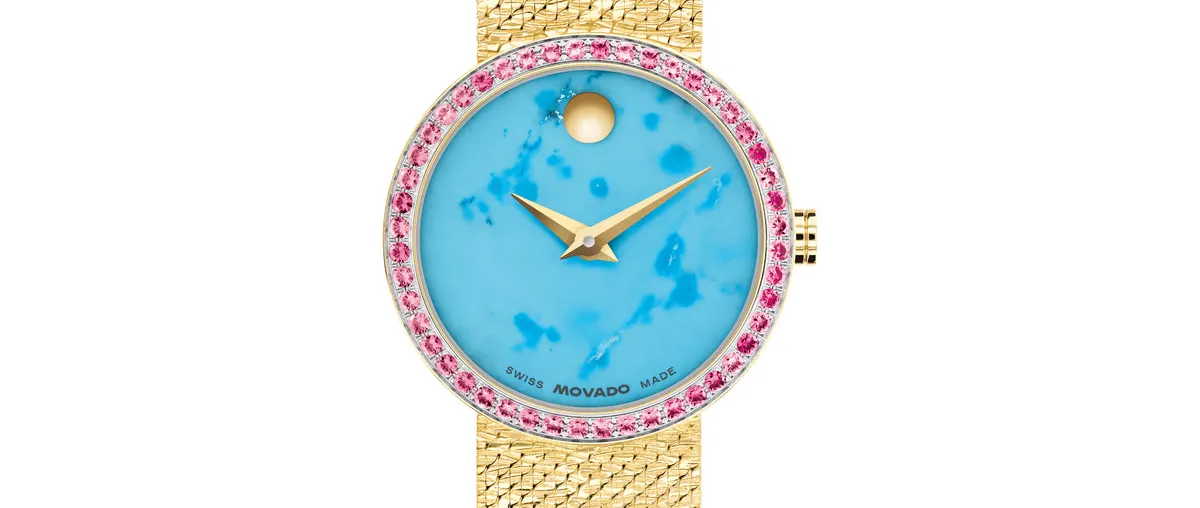
The 25-millimetre watches use colour combinations that link a stone dial to a contrasting gemstone bezel. One documented configuration has a turquoise dial surrounded by pink tourmalines, with a yellow-gold PVD case and matching Milanese mesh bracelet. Other products in the collection use different ornamental stones, creating a family resemblance without making every dial visually identical.
The 21-millimetre versions provide a simpler interpretation, with coloured dials and coordinated leather straps. A designer can use the same Museum Dial foundation to produce two distinct wearing experiences: one closer to jewellery, the other to an uncomplicated everyday accent. Neither approach has to be more prestigious to be the more successful design for a particular person.
Why natural stone creates an individual dial
Gemstone dials are not perfectly uniform printed surfaces. Gottlieb's official product description emphasises that natural variation in semi-precious stone means each dial has its own pattern and intensity of colour. In the turquoise example, the point is not to disguise that variation but to make it part of the object the wearer receives.
That quality changes the way the watch is evaluated. A photograph can demonstrate the broad design, but it cannot guarantee the precise veining, shade or markings of an individual piece. A buyer who cares about a particular stone pattern should therefore ask to see the actual watch, or confirm the seller's process for presenting variations, rather than assume a catalogue photograph is an exact promise.
The setting also gives the traditional Museum Dial idea a different kind of depth. The dot and hands remain watchmaking elements, but the surface around them becomes more tactile and less visually predictable. It is a useful example of how jewellery design can change a familiar watch without requiring a new case architecture or an entirely new movement.
Gold-toned hardware and the pleasure of contrast
The Gottlieb turquoise-and-tourmaline model uses a yellow-gold PVD finish rather than a claim of solid-gold construction. That distinction is material, especially when comparing jewellery watches at very different price levels. The colour of the metal frames the stones and bracelet, while the product specification describes the actual case finish rather than leaving readers to infer it from a photograph.
A Milanese mesh bracelet gives that example a continuous decorative line around the wrist, contrasting with the more casual character of a leather strap. Such choices can determine whether the watch sits comfortably alongside other bracelets, works with evening clothing or provides a small colour accent to a simpler daytime outfit.
The palette is consciously optimistic, but it is more controlled than an indiscriminate mix of gems. A watch with a turquoise dial and pink bezel creates a strong contrast through two dominant colours, while a gold-toned case acts as a consistent frame. The pleasure lies in the restraint of the arrangement despite the brightness of the ingredients.
The Swiss movement beneath the ornament
Gottlieb's product description specifies a Swiss-made movement for the gemstone 25-millimetre model. The broader collection includes quartz watches, so the appeal is not built around the spectacle of an exposed tourbillon or an unusually complex set of functions. Instead, reliable time display supports a piece whose leading features are composition, material and wearability.
That is not a deficiency when the object has been conceived primarily as a jewellery watch. A thin, discreet timepiece can suit an intimate dinner, a gallery opening or an evening ashore without demanding the prominence of a large instrument watch. The choice also leaves the exterior design more room to communicate without mechanical spectacle competing for attention.
Owners should still treat the watch as a precision object rather than a casual bracelet. Gemstone settings, surface finishes and strap materials can require care appropriate to their construction. Before swimming or boating, check the water-resistance rating and care instructions for the exact reference; a decorative watch photographed beside the sea is not automatically suitable for immersion.
How the collaboration reflects luxury today
Cross-disciplinary collaborations work best when both creative voices are visible. Movado brings a recognisable minimal dial and a history of Swiss watchmaking, while Gottlieb contributes the combination of bright stones and fine-jewellery styling for which her collection is known. The result could not be understood fully as either a standard Movado with a new strap or a bracelet with a clock face attached.
The design also reflects a shift towards collecting pieces for their personal expression rather than only their specifications. Case diameters, power reserves and materials remain useful facts, yet their emotional effect depends on proportion, colour and the occasions in which the owner chooses to wear them. An accessory that gives joy each time it is fastened may be as convincing to its wearer as one advertising technical achievement.
That does not turn every limited partnership into a collectible investment. The official product pages establish design features and listings, not future resale values. Anyone considering a purchase should assess personal taste, authenticity, warranty terms and the condition of the actual piece without expecting an editorial story to predict the secondary market.
A small statement for life beyond the marina
For luxury travellers, the appeal of a compact jewellery watch becomes clear when a day moves between several settings. It can complement relaxed tailoring at lunch, add a colour note to a dinner outfit or stand alone when more elaborate jewellery would feel excessive. The small size helps maintain that versatility, while the stones keep it from fading into the background.
The Stephanie Gottlieb x Movado collection is also a reminder that watch design need not choose permanently between minimalism and decoration. Here, a historically spare dial remains legible within a lively frame of natural colour. The watch stays recognisably a timepiece, yet speaks in the vocabulary of jewellery.
The specific turquoise-and-pink-tourmaline product is documented on Gottlieb's official website, and the broader collection appears on the designer's and Movado's own channels. Availability may vary by reference and over time, so prospective buyers should verify current information directly. What remains relevant is the design decision itself: using colour and natural material to refresh one of watchmaking's simplest signatures.