Two hand-wound Navitimers join Breitling's regular range
Breitling has added two historically inspired, manually wound chronographs to its permanent Navitimer collection: the B09 Chronograph 41 and the B02 Chronograph 41 Cosmonaute. Both revive the visual language of the brand's 1960s instruments while allowing buyers to purchase them as regular models rather than waiting for a commemorative limited edition.
The distinction is significant in a watch category that frequently relies on short production runs and anniversary releases. These are designed to be wearable interpretations of historic aviation timepieces, with modern movements and construction, but with an unusually direct connection to the hand-wound chronographs that helped establish the Navitimer name.
The B09 offers the classic twelve-hour display
The Navitimer B09 Chronograph 41 is the more familiar of the pair to anyone accustomed to a conventional twelve-hour wristwatch. Its 41-millimetre steel case encloses a black or blue dial with contrasting white registers, a layout often described as reverse panda. A circular slide rule surrounds the dial and can be turned with the bidirectional bezel.
Breitling traces the collection to the original 1952 instrument made for the Aircraft Owners and Pilots Association. The new B09 draws particular inspiration from the Navitimers associated with racing drivers Jim Clark and Graham Hill, both of whom were also pilots. The gold-coloured Twin Jet emblem references the civilian logo used on Navitimer watches from the mid-1960s.
The in-house B09 movement requires manual winding and offers approximately seventy hours of power reserve. It beats at 28,800 vibrations per hour and controls chronograph timing with thirty-minute and twelve-hour elapsed-time registers. Breitling's official product page quotes USD 7,900 for the black-dial variant on its leather strap, excluding US sales tax.
The Cosmonaute tells time on a twenty-four-hour dial
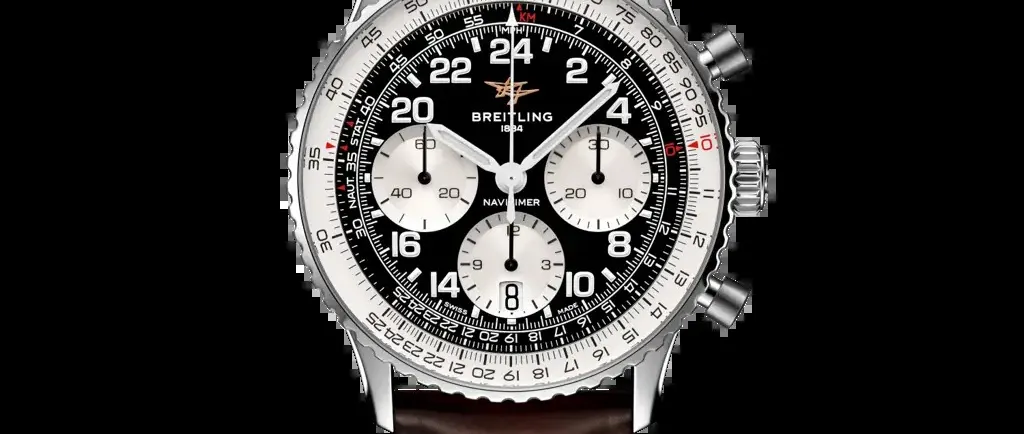
The B02 Chronograph 41 Cosmonaute looks broadly related but uses a twenty-four-hour main time display. Rather than completing two revolutions in a day, the hour hand moves once around a full twenty-four-hour cycle. That approach links the model to astronaut Scott Carpenter, who wore a Breitling Cosmonaute during his Mercury-Atlas 7 flight on 24 May 1962.
For an astronaut, a distinction between morning and evening remains useful when orbital sunrises and sunsets do not follow familiar terrestrial patterns. On a wristwatch, the arrangement creates a fascinatingly different reading experience. It may take time for someone accustomed to a conventional twelve-hour dial to interpret quickly, especially when concentrating on several instruments during travel.
Breitling says the current Cosmonaute is fitted with its manually wound manufacture calibre B02, developed specifically for this family. It retains a chronograph and an approximately seventy-hour reserve, with a date indication placed discreetly in a subdial. The official US page lists the steel model with leather strap at USD 10,600 before applicable sales tax.
Shared architecture and practical limits
Both watches measure 41 millimetres across and 13 millimetres in thickness. They use cambered sapphire crystals with glare-reducing treatments, hand-wound manufacture movements and a rotatable slide-rule bezel. The familiar Navitimer scales are part of the watch's instrument heritage, although operating one correctly is a learned skill rather than an automatic calculation.
Breitling specifies a water-resistance rating of three bars, expressed as 30 metres, for both models. That should not be understood as approval for diving or repeated immersion in salt water. For the owner of a luxury motor yacht or dayboat, these are watches for travel, social occasions and shore-side wear, not replacements for marine navigational electronics or a purpose-built dive watch.
The maker offers gradient calf-leather straps with folding clasps and steel bracelet variants. Leather may be attractive with formal or casual clothing, but prolonged exposure to salt spray or wet decks would be unwise. Wearers should follow Breitling's published care instructions and obtain the appropriate service advice when needed.
Why manual winding still appeals
Most modern luxury chronographs use automatic winding so that ordinary wrist movement replenishes the mainspring. A hand-wound watch introduces a deliberate daily or periodic interaction with the mechanism. The wearer feels the resistance of the crown, checks reserve and participates directly in keeping the watch running.
That small ritual will not suit everyone. People moving quickly between airport lounges, marinas and yacht decks may favour something less demanding, and someone who uses a watch only occasionally will need to reset it after the power has run down. For collectors, however, the deliberate mechanical experience can be precisely the attraction.
Both models are recognisably technical objects yet avoid the substantial dimensions associated with some contemporary specialist watches. Their combination of chronograph registers, fine scales and a historical emblem provides visual complexity without requiring the case to grow to an extreme diameter.
Choosing between the Navitimer and the Cosmonaute
The B09 is likely to appeal to someone who wants a historically styled Breitling that can be read in the normal way throughout the day. Its two dial-colour choices and conventional time indication offer more flexibility, while the hand-wound movement maintains the connection with earlier racing and aviation chronographs.
The B02 Cosmonaute is more distinctive: the twenty-four-hour display connects directly with the original space-flight use case, and the layout is likely to prompt conversation. Its higher published price reflects a different calibre and presentation, but suitability will ultimately depend on how comfortable the owner is reading a twenty-four-hour dial.
Availability and the choice of strap or bracelet should be confirmed through Breitling because the advertised models and prices vary by market. Luxury-yacht travellers should also remember that the rotating Navitimer bezel is an analogue calculation aid, not a certified navigation instrument; electronic chartplotters and seamanship procedures remain the relevant tools at sea.