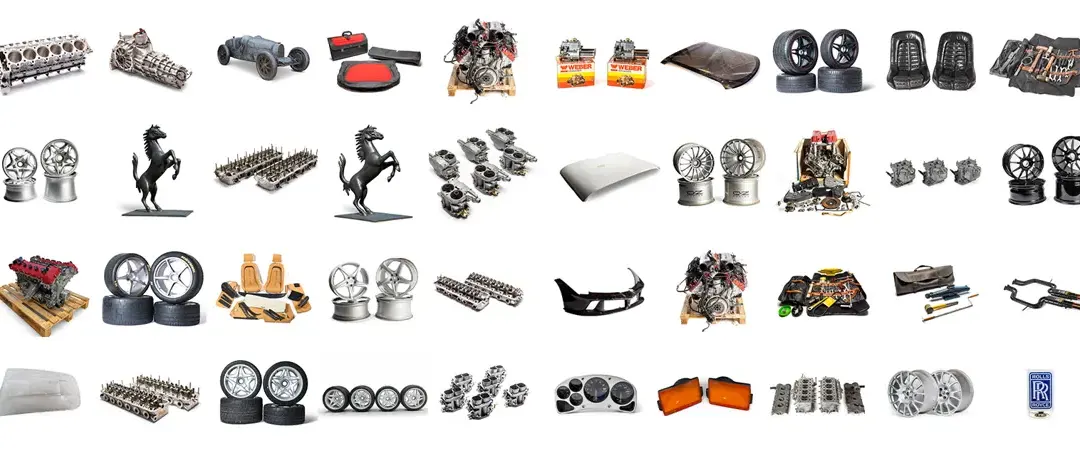
Italian collector-car culture extends far beyond the cars themselves, as RM Sotheby's latest online sale makes clear. The Red Catalogue opened for bidding on 22 October 2026 with almost 300 items spanning more than half a century of Italian automotive heritage. Its focus is on parts, mechanical components and automobilia, offered without reserve, rather than simply another line-up of complete road-going supercars.
The official auction preview highlights LaFerrari bodywork, Ferrari 348 engines, racing suits and scooters. Together they represent a varied world of objects that can appeal to workshop historians, design collectors, Ferrari specialists and enthusiasts who want a tangible connection to motorsport culture. The online sale starts closing lots on 29 and 30 October, giving potential buyers a short window to study individual descriptions, provenance and the costs of taking delivery.
A different sort of Italian collector sale
The centre of gravity in a traditional motor auction is the complete vehicle: the rare chassis, documented mileage, factory specification and possibility of driving history home. The Red Catalogue takes a different route by offering the material culture that builds the surrounding story. RM Sotheby's says the selection stretches over more than fifty years of Italian automotive excellence and includes almost 300 pieces of parts and automobilia. It is a format for enthusiasts whose collecting interests extend to the workshop, the paddock and the architecture of a car as well as its finished silhouette.
That distinction gives the sale a broad potential audience. A collector of full-sized Italian classics may want a period-correct component or a dramatic display piece for a private garage, while a smaller-scale enthusiast might begin with literature, clothing or memorabilia rather than a car purchase. An engine and a race suit do not serve the same purpose, but they can both convey a sense of marque history. As with art, meaning often lies in a documented connection to a particular model, period or manufacturing tradition.
From LaFerrari components to period machinery
RM Sotheby's identifies LaFerrari bumpers and Ferrari 348 engines among its headline examples, alongside racing suits, scooters and other objects associated with Italy's performance-car culture. The auction house's broader preview also refers to an Alfa Romeo GTA 1300 Junior race car in the selection, giving the collection a bridge between mechanical objects and a complete historic competition machine. The appeal is not simply that a famous badge appears on an item. It is the chance to examine engineering artefacts that are ordinarily hidden underneath body panels or dispersed through specialist workshops.
A Ferrari engine outside the vehicle for which it was designed invites a close look at packaging, casting and component layout in a way an installed powertrain rarely permits. A bumper from the LaFerrari era can also serve as a sculptural reminder of the interaction between aerodynamics and design. None of this makes the item immediately suitable as a spare part for a road car. Authenticity, condition, compatibility and its actual legal or practical use have to be established through the individual lot description and independent checks.
Why the no-reserve approach attracts attention
One notable element of the auction's format is that RM Sotheby's describes every lot as being offered without reserve. In auction terminology, that means there is no confidential minimum seller price at which bidding must reach before a lot can sell. It can make bidding feel more open, particularly when an unusual item has few exact comparables. Yet it does not promise bargains, because an enthusiastic group of bidders can still drive the hammer price far above a casual observer's estimate.
Buyers should also distinguish the hammer price from the total transaction cost. The auction house's published bidder conditions and fee information govern any premium, taxes, payment deadlines, collection and shipping arrangements. A bulky engine or fragile piece of bodywork can bring transport requirements that dwarf those of a framed photograph. The sensible approach is to review an individual lot's description and full costs before deciding how much to bid, and to avoid assuming that 'without reserve' means without obligations.
The auction calendar and how it works
Bidding opened online on Thursday, 22 October 2026, according to the official schedule, and the catalogue's lots are set to start closing on 29 and 30 October. RM Sotheby's lists the opening and closing times in Eastern Daylight Time, an important detail for collectors participating from Europe, Asia or the Middle East. Online bidders should use the auction's own time display and terms, since lots can have different closing schedules and an internet countdown is less forgiving than a printed date on an invitation.
The online format is particularly well suited to components and memorabilia spread across different categories. It removes the need for every bidder to attend a major saleroom simply to compete for an object intended for a study, workshop or display area. But remote access makes inspection discipline more—not less—important. Ask for additional images and condition information where required, verify the extent of what the lot actually includes, and work out the logistics of collection before making an irrevocable commitment.
What to look for in an exceptional automotive object
At this level of collecting, provenance is often the dividing line between an attractive decorative object and a historically meaningful acquisition. For a competition-related item, a documented link to a car, team or event can materially change how collectors view it. For a mechanical component, serial numbers, markings, factory documentation and evidence of originality may matter. The existence of an item in an auction catalogue is not a substitute for inspecting that evidence, especially where a buyer expects a specific vehicle connection or plans to use a component rather than simply exhibit it.
Preservation raises a different set of questions. A display engine may need professional mounting and careful attention to leaked fluids, sharp edges or exposed fittings. Historic leather, paper and textiles can be more vulnerable to light and humidity than polished metal. Even a seemingly robust body panel can distort if supported incorrectly. The lesson is familiar to anyone with a private automotive collection: the decision to acquire an artefact should include a credible plan to conserve and display it, rather than simply finding room for it on arrival.
Collecting beyond the complete automobile
Italian automotive history has always been shaped by networks of engineers, designers, suppliers, race teams and workshops, not only by the finished cars that appear on concours lawns. A sale of components, tools and memorabilia can bring that wider network into view. It may also offer a point of entry for younger collectors who are passionate about an era or marque but not yet ready to own and maintain a complete historic vehicle. The emotional value of a carefully selected object may be independent of whether it will ever be assembled into a running car.
The Red Catalogue's unusual concentration on Italian material is therefore best understood as an invitation to explore the culture around the automobile. It sits apart from RM Sotheby's more conventional London car auction scheduled for 31 October at The Peninsula London, with its own online timetable and assortment of lots. Buyers who appreciate both events should treat them as separate consignments with separate conditions. For the serious collector, the interesting question is not merely what an artefact costs, but what authentic part of automotive history it allows them to preserve.