A significant result during Hong Kong Luxury Week
Christie's Magnificent Jewels auction in Hong Kong on 24 November 2026 realised HK$536,886,800, equivalent to approximately US$68.5 million at the auction house's published conversion. The company reported that 91 per cent of lots sold and that the total hammer price reached 125 per cent of the aggregate low estimate. These figures place the sale among the more significant recent jewellery market events in Asia, but they require careful interpretation. Auction-house sales totals include buyer's premium, whereas a hammer-to-estimate comparison uses a different calculation. They should not be combined into a single measure of appreciation. The results nevertheless offer a timely view of how bidders responded to exceptional coloured diamonds, signed jewels and rare stones during a week of concentrated luxury auctions.
The Pink Petal dominates the evening
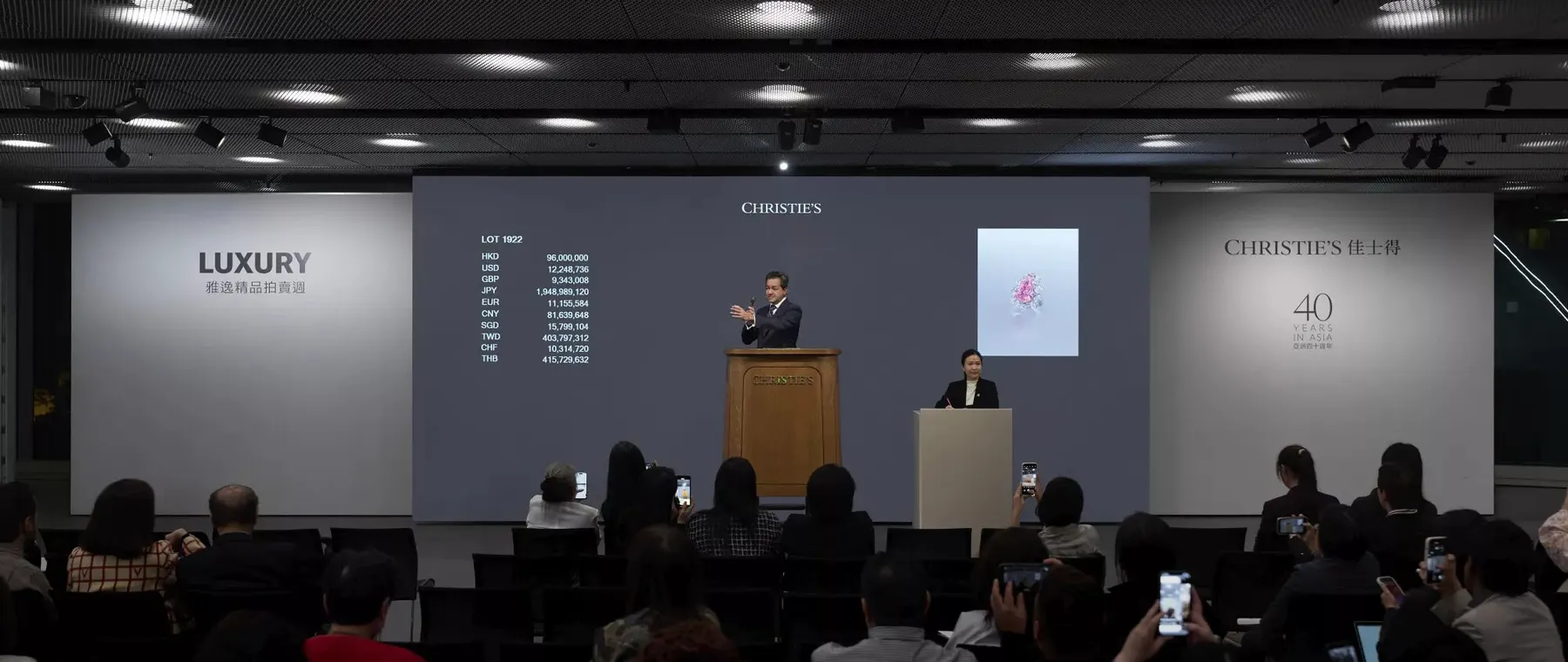
The leading lot was The Pink Petal, an 8.41-carat fancy vivid purple-pink diamond ring with VS1 clarity and Type IIa classification. Christie's said bidding continued for nearly 15 minutes before the ring achieved HK$115,500,000, or approximately US$14.7 million. This is a striking individual outcome, but it does not mean every pink diamond of similar size has an identical value. Colour saturation, distribution, cut, clarity, origin information where applicable, provenance and market timing all matter. The published classification helps explain why the stone attracted attention: a vivid hue is relatively unusual among diamonds, and a substantial natural example can become the central narrative of an international sale. The realised price is an observed auction result, not a universal valuation formula.
What the overall total actually tells us
An auction can achieve an impressive sale total through a combination of widely distributed bidding and a small number of exceptionally expensive objects. The Hong Kong result appears to involve both. Christie's reported 57 per cent of lots selling above their high estimates, in addition to the 91 per cent sold-by-lot figure. These percentages describe different dimensions of performance and should not be treated as interchangeable. The sale's comparison against the low estimate indicates strength relative to presale expectations, but it does not reveal the confidential reserves, transaction history or financial position of individual bidders. Nor does a strong week provide enough evidence to forecast the entire global jewellery market. A sound interpretation stays close to the specific auction and the mix of objects on offer.
A Cartier ruby brooch draws attention
One of the important supporting results was a 10.10-carat Burmese ruby Art Deco brooch by Cartier, described by Christie's as having a pigeon's blood colour classification. The piece achieved HK$53,360,000, approximately US$6.8 million. For a collector, the interest lies in the conjunction of gemstone quality, a recognised jewellery house and a design identity connected to a historical period. An Art Deco jewel is not simply a stone mounted in a neutral setting. Its proportions, craftsmanship and relationship to the aesthetic language of its era can be integral to its appeal. Bidders may place considerable weight on documentation and the history of the piece, but those factors should be established through specialist records rather than inferred from the catalogue headline alone.
A sapphire beyond the hundred-carat mark
The auction also included a 100.16-carat Burmese royal-blue sapphire and diamond pendant, which realised HK$42,380,000, approximately US$5.4 million. Christie's said the result doubled the lot's low estimate, an example of a particular object drawing bidding beyond its presale range. The stone's large weight is clearly notable, but size alone cannot determine beauty or price. Important sapphires are assessed through colour, transparency, treatment disclosures, cut, provenance and relevant laboratory reports. Readers should not confuse descriptive terms in auction marketing with an independent gemmological conclusion unless the documentation is available. The auction result is an established monetary fact; understanding the reasons behind it requires closer examination of the individual lot.
Kashmir sapphire adds another layer
A 21.05-carat Kashmir sapphire and diamond ring by Cartier achieved HK$38,110,000, or approximately US$4.86 million. The combination of a historically prized source designation with a distinguished jewellery maison brings several strands of collecting together. Geography may be relevant to gemstone rarity and market perception, while the designer's work determines the jewel's visual identity and historical context. As with other coloured stones, treatment status and laboratory documentation are essential for informed evaluation. A description such as Kashmir should not be used casually to confer a premium on an unrelated blue sapphire. What the result demonstrates is that the sale's appeal was not confined to one leading pink diamond; different categories of gemstone and signed jewellery attracted substantial prices.
The importance of the signed jewel
The results remind collectors that jewellery can be evaluated through more than the weight of the principal stone. A signature, period, design configuration, workmanship and provenance may affect how a piece is positioned in the market. Cartier's presence among the leading lots illustrates the interaction between a gem's material characteristics and the identity of the maker responsible for its setting. Yet it would be misleading to suggest that a famous signature automatically guarantees an investment return. Condition, authenticity, alteration history and demand for the particular form remain relevant. For experienced collectors, the discipline is to understand why a piece matters on its own terms rather than assuming that a prestigious name removes the need for research.
Participation extended beyond one region
Christie's described participation from collectors in 30 countries across four continents. The house also reported that 71 per cent of new buyers were millennials or younger, a notable data point in the context of changing collecting habits. These numbers come from Christie's own sale report and are not an independent census of the entire high-jewellery market. They do, however, suggest that the audience for significant jewellery events can extend beyond the familiar image of a narrow group of established bidders. Online research, digital catalogues and international exhibition programmes may make it easier for younger buyers to engage with the category. Whether those newcomers develop sustained collections cannot be concluded from a single auction's participation data.
Forty years of Christie’s in Asia
The 2026 Hong Kong programme also forms part of Christie's 40th anniversary in Asia. The auction house has used the occasion to present a year-long series of art and luxury events, highlighting the development of its regional presence and client relationships. That history is relevant, because a strong local platform can connect international sellers and regional collectors in ways that do not depend solely on occasional travelling sales. At the same time, a commercial anniversary is not proof of market dominance across every category or year. The jewellery result should be assessed against its own published figures, while the broader anniversary explains why Hong Kong Luxury Week was presented as a particularly significant point in the company's calendar.
What the online follow-up means
Christie's Magnificent Jewels: Online sale was scheduled to remain open for bidding until 27 November 2026, following the live auction. The distinction between live and online sales matters. They may feature different objects, rules, viewing opportunities and bidding schedules, even when they share an event theme. Results from the 24 November live sale should not be presented as final outcomes for the still-open online component. A potential buyer also needs to check conditions of sale, buyer's premium, taxes, shipping, insurance and eligibility to bid before treating a displayed estimate as the full expected outlay. These practical considerations are central to sophisticated collecting, where the transaction itself can be more complex than the headline hammer price.
Jewellery on yachts and in private life
Important jewellery may be worn during travel and aboard private yachts, but transport and custody require planning proportionate to the value and fragility of the pieces involved. A collector should consider secure storage, specialist insurance terms, customs obligations and documentation when moving high-value jewels between jurisdictions. Exposure to saltwater, cosmetics, cleaning products and physical knocks may create risks, depending on the material and setting. These are general issues rather than advice about a particular ring or brooch that has not been inspected. The glamorous image of jewellery at sea can obscure the practical responsibility that accompanies ownership. A thoughtful acquisition plan considers care and legal movement as part of the purchase, not as questions postponed until after an auction.
Why sale results are not a price index
It is tempting to take a striking coloured-diamond result and use it to predict values across a broad market. That would overstate what the data support. Auctions are selective and unusual objects often attract a concentrated audience. The price realised may reflect competing collectors, exceptional rarity or the specific appeal of a jewel's design and history. A particular result also incorporates the conditions under which it was sold, including the house's fee structure. Market research requires comparable transactions with relevant gemmological specifications, provenance and condition, ideally observed over time. Even then, uncertainty remains. The Hong Kong figures are valuable evidence of what happened on 24 November, not a promise that similarly described jewellery will sell at the same levels elsewhere.
The balance between beauty and documentation
Collecting jewellery successfully requires a dual perspective. The object must have an aesthetic or personal appeal to its owner, but that emotional response should be supported by reliable documents and a clear understanding of its physical qualities. Rare gemstones can be spectacular in photographs, yet lighting, camera processing and display conditions can alter how their colour is perceived. It is also important to examine repairs, stone security and any alterations to historically significant settings. A competent specialist can explain the available laboratory and catalogue records without pretending that every desirable attribute is measurable. The Hong Kong sale brings these issues to the fore because its leading results combine exceptional stones with the prestige and complexity of signed jewellery.
A measured reading of a strong week
The 24 November Magnificent Jewels event shows strong demand within the particular group of lots Christie's offered: HK$536.9 million in sales, 91 per cent sold by lot, a hammer total above the aggregate low estimate and several significant results for coloured gemstones. Those are verified auction-house figures. They do not establish undisclosed buyer identities, post-sale intentions or the profitability of individual collections. The most useful editorial conclusion is that knowledgeable bidders were prepared to compete for stones and designs perceived as exceptional, while the market's longer-term direction remains a separate question. Hong Kong's role as a luxury collecting centre is clearly visible in this event, but its significance is best described through documented transactions rather than inflated predictions.
The primary results and next observations
The figures in this report come from Christie's 24 November 2026 Hong Kong Magnificent Jewels sale announcement. The original report identifies the Pink Petal diamond, Cartier ruby brooch, Burmese sapphire pendant and Kashmir sapphire ring among the notable results. It also distinguishes live sales from an online component continuing through 27 November. No unverified lot estimates or buyer claims have been added to the published numbers. For yacht owners, collectors and jewellery enthusiasts, the event is a reminder that the best luxury-market reporting combines appreciation of rare craftsmanship with a clear account of what the evidence actually proves.