Membership reflects changing expectations
Yacht Trace has joined British Marine and Superyacht UK, a move announced by the trade association on 10 November 2026. The British technology company develops monitoring equipment for tenders, chase boats and personal watercraft, placing the emphasis on detecting developing problems rather than merely recording a vessel's position. The membership brings a specialist supplier into a wider network of builders, dealers, operators and service companies. For owners and captains of luxury yachts, the announcement is relevant because the smaller craft associated with a main yacht can represent substantial value, yet may operate away from the supervision and communications available on the primary vessel. A location dot on a chart is useful, but it may not reveal whether a battery has deteriorated, a bilge is filling or a towed tender has begun to move unexpectedly. Yacht Trace's proposition is to address that gap with additional sensing and communications.
The difference between a tracker and a monitoring system
The company describes sensors capable of monitoring bilge levels, battery condition, pitch, roll, movement and the separation distance between a tow and the towing yacht. Each of those data points can become important in a different operational situation. A bilge alert may identify unwanted water ingress before it is visible to crew; low battery voltage can warn of an electrical problem; and changing pitch or roll may suggest that an unattended vessel is moving in a way that deserves investigation. This does not mean that every alert establishes the cause of a problem, or that the system can eliminate the need for physical inspections. Rather, it supplies information intended to help crew decide when closer attention is needed. A well-designed installation should distinguish meaningful changes from conditions that are normal for the craft and location.
Communications independent of familiar networks
British Marine's release says Yacht Trace uses two-way encrypted radio communications that can work independently of AIS, mobile phone networks and onboard Wi-Fi. It also refers to Iridium satellite capability for tracking across wider areas. Those distinctions should not be compressed into a claim that every installation offers permanent coverage everywhere. Radio range depends on equipment, antenna positioning and conditions, while satellite service involves its own hardware and operational arrangements. Owners and captains should ask which functions remain available in each mode, how alerts are delivered and what happens when a connection is interrupted. The point of independent communications is resilience: a tender may be beyond the practical reach of a marina's Wi-Fi and may not be equipped with the same communications systems as a large yacht. A dedicated link can provide a useful alternative channel for status information.
Towed tenders present distinctive risks
The technology originated from the risks of towing valuable tenders behind larger yachts, according to the company's account. Towing introduces a relationship between two moving vessels whose separation, relative motion and condition require attention. The tender may be out of direct sight during darkness, poor visibility or difficult sea conditions. A system monitoring its position and movement can add information, but it cannot replace a suitable towing arrangement, appropriate lookout, safe speed or crew procedures. Monitoring should therefore be understood as an additional layer rather than an assurance that towing is risk-free. The company's development from a towing-specific application into wider monitoring also reflects a practical reality: the same tender may be under tow on one day, operating independently on another and lying unattended at a marina for an extended period.
Information on a familiar bridge display
An announced integration with TimeZero chart-plotting systems allows fleet positions to be viewed through equipment that crews may already use on the bridge. This is potentially valuable because every separate monitoring application introduces another screen, account and alerting process. Integration can reduce the effort required to maintain awareness of several associated craft. Nevertheless, owners should confirm the versions, hardware, licensing and data fields supported by a particular implementation. A compatible chart plotter may show position information without reproducing every sensor function. Similarly, status information presented in one system should be cross-checked against normal navigation and watchkeeping practice. The fundamental objective is to give crew a clearer picture of their fleet rather than create a false sense of certainty from a single digital representation.
Real-world passages cited by the company
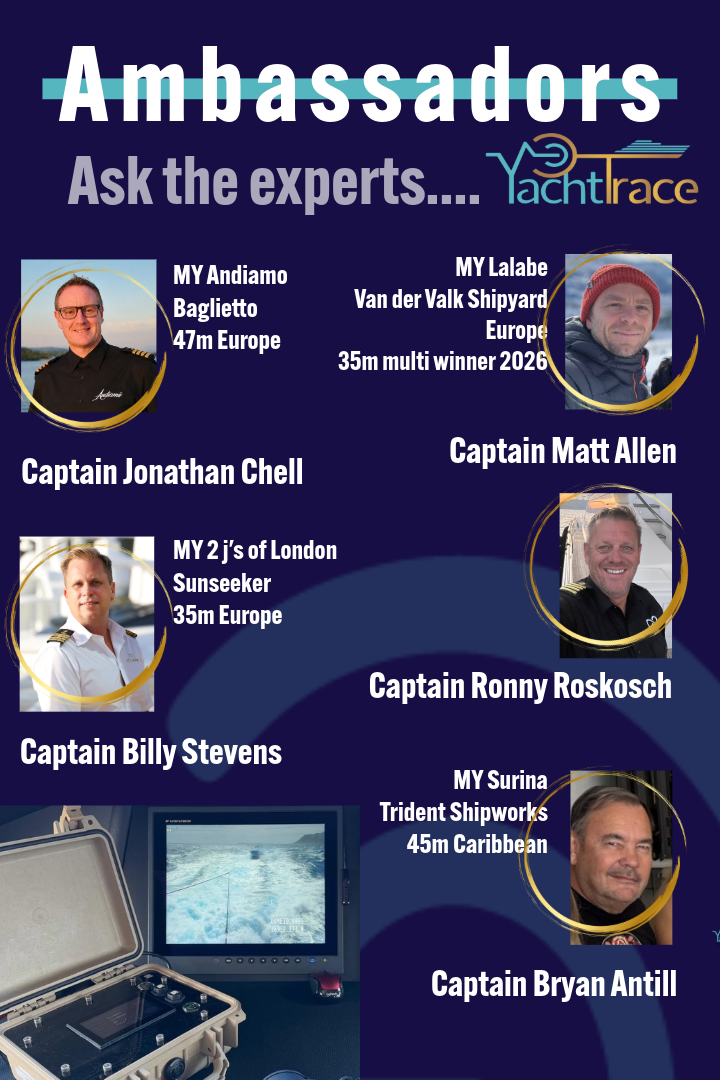
The trade association's announcement points to a 900-nautical-mile passage by the motor yacht Andiamo and a Pacific towing operation of approximately 4,000 nautical miles involving a 48-foot Viking tender. These are case studies supplied in the company's industry communication, not independently reconstructed voyage reports. Their significance is that the company is presenting operational use beyond laboratory testing or a marina demonstration. At the same time, one successful deployment does not establish a universal performance guarantee for other types of tender, weather conditions or installation arrangements. A captain considering the equipment should ask what was monitored during such passages and whether the tested configuration resembles their own vessels. Field evidence is most useful when the actual operating circumstances, equipment configuration and maintenance procedures are understood.
Insurance interest and loss prevention
British Marine reports that Yacht Trace systems have attracted recognition from marine insurers and that co-founder Dr Dan Rogers spoke at the Joint Hull Committee Yacht Forum at Lloyd's of London in October 2026. The focus was on tender losses, insurance risks and preventative monitoring. Those issues matter because insurance claims can involve both the direct value of a craft and the disruption caused to a yacht's operation. Electronic monitoring may make a risk more visible, but a manufacturer announcement should not be treated as proof that an insurer will automatically offer a premium reduction or accept a particular installation as satisfying policy requirements. Owners should discuss equipment and operating procedures directly with their insurer or broker. Clear documentation of installation, alerts and crew responses may be useful, but actual coverage and obligations remain matters for the relevant insurance contract.
Beyond leisure craft: wider technical applications
Yacht Trace says it is extending its work into prop-shaft monitoring, lithium battery safety and scientific applications associated with The International SeaKeepers Society and Seabed 2030. These developments show that the underlying concept extends beyond a simple tender-tracking product. A sensor and communications platform can be adapted to different problems where early awareness of changing conditions is valuable. The requirements, however, differ considerably. A battery-monitoring function should be assessed against the electrical system in which it operates, while a scientific data-gathering installation may have different priorities for accuracy, power supply and transmission frequency. The announcement establishes areas of development, not a claim that every proposed application is fully available to customers. Procurement decisions should therefore be based on the demonstrated capabilities of the specific product and software version.
A practical checklist for yacht managers
Before selecting a monitoring system, operators should identify the exact assets and risks they want to supervise. A yacht carrying a single small tender has a different requirement from one with multiple chase boats, a RIB and several water toys. Useful questions include which sensor types can be installed, how they are powered, whether the system tolerates prolonged periods without charging, and how alerts are escalated when the primary crew member is unavailable. Crew training is particularly important. Unclear alert thresholds can create nuisance notifications; thresholds that are too broad may miss developing problems. The team should also understand data retention, access permissions, encryption and the procedure for replacing or servicing components in distant ports. None of these questions is answered simply by identifying a respected brand or a trade association membership.
What membership adds to the industry
Joining British Marine and Superyacht UK gives Yacht Trace access to an established industry network and provides an opportunity to engage with operators, boatbuilders and service businesses. It is a commercial development rather than an independent technical certification. The company's founders, Deborah Fry and Dr Dan Rogers, are positioning the business as a specialist in preventive marine monitoring, and the trade association release supplies examples of applications and operational experience. For the luxury-yacht sector, the underlying trend is important: the small craft accompanying a yacht increasingly warrant connected monitoring practices comparable to those used for larger onboard systems. The most successful technology will be the kind that informs crew decisions without interfering with them, delivering timely and interpretable information while leaving responsibility for safe operation where it belongs.
Sources and image credits
Reporting based on British Marine and Yacht Trace first-party member announcement, 10 November 2026.
Lead photograph: Yacht Trace monitoring equipment illustrated in its original company press announcement. Photo: Yacht Trace monitoring equipment illustrated in its original company press announcement. Original officially distributed company press photo; not taken at METSTRADE unless otherwise identified. Original official image source.