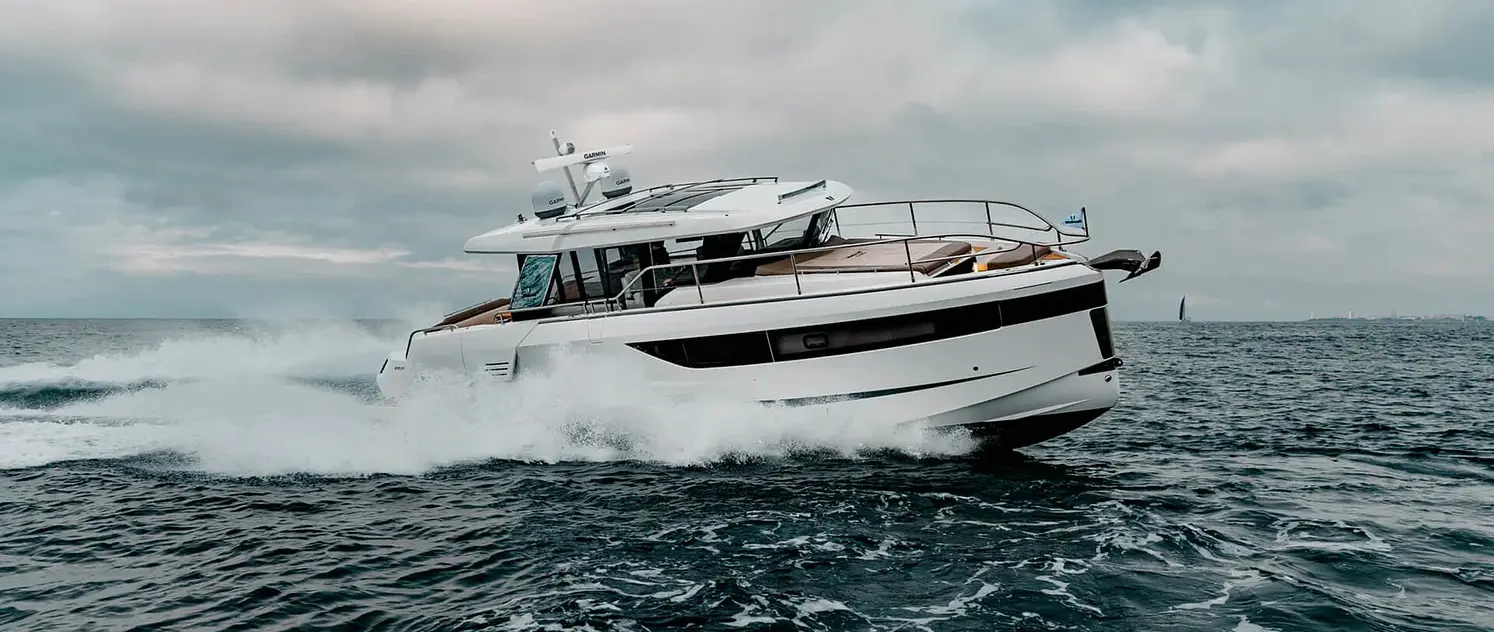
An explorer-style layout at 13.40 metres
Wellcraft's 44 Explorer is a useful example of how the modern fast cruiser is moving beyond the traditional division between an open sports boat and an enclosed family motor yacht. At 13.40 metres overall with a 3.82-metre beam, it is designed to provide a protected wheelhouse without turning the aft cockpit into a small afterthought. The manufacturer places particular emphasis on secure movement around the boat, combining high freeboards, substantial handrails and carefully organised side decks. This is a layout intended to be used in changeable conditions, not merely admired in a fair-weather anchorage.
The straight bow gives the boat an instantly recognisable profile, while the aft cockpit is described as adaptable for fishing, entertaining or relaxing. Fold-down side terraces are included in the deck arrangement, extending the social area once the boat is stationary. Such features broaden the potential uses of a relatively compact platform, but they also create more mechanisms and joints that deserve inspection over time. Practical owners will ask how quickly the terraces can be secured, whether their seals are accessible and how the cockpit drains during heavy rain.
One of the more significant choices is the asymmetric deck layout, which makes room for a secure passage on the starboard side. Circulation is a genuine concern on an offshore-capable cruiser, where crew may need to reach a line or fender while the boat is moving. The manufacturer also lists a side gate, forward sunpad with an adjustable backrest, and a cockpit seating arrangement that can be configured for different tasks. The result is a fairly direct connection between working-deck practicality and leisure use.
Outboard power with protected visibility
The 44 Explorer's official layout shows three Mercury Verado V10 outboards at 350 horsepower each, giving a maximum stated engine installation of 1,050 horsepower. Wellcraft publishes that maximum in its specification, but it is important not to turn an engine rating into a claimed top speed or assured range. Load, propeller selection and conditions can affect both. Buyers interested in offshore cruising should ask for verified speed and fuel-use figures under representative loading rather than calculating a theoretical passage time from engine power alone.
At the helm, a sheltered wheelhouse gives pilot and co-pilot dedicated seats and a panoramic outlook. Wellcraft highlights 360-degree visibility, which is especially valuable when manoeuvring at close quarters or keeping watch during a longer coastal leg. A side sliding door allows movement between the wheelhouse and the exterior deck without forcing the helmsperson to walk through the aft social area. That apparently modest feature can reduce unnecessary detours during berthing and improve communications between the person driving and the crew handling lines.
The published fuel capacity is 1,290 litres, complemented by a 250-litre freshwater tank. These numbers provide a starting point for voyage planning but do not, on their own, establish a specific range or duration of self-sufficiency. Reserve policy, generator use, passenger count and how the boat is driven all matter. The hull is credited to naval architect Michael Peters, with design work by Garroni Design, a collaboration reflected in the emphasis on seaworthiness and purposeful exterior styling.
Two cabins and a galley linked to the cockpit
Below deck, the builder specifies two separate cabins and four berths, giving a couple or family options for overnight stays. Its current descriptive material also refers to capacity for up to five people, so prospective buyers should confirm the precise configuration and legal sleeping arrangements of an individual hull. The overall concept includes two bathrooms with separate showers, an uncommon level of privacy for a boat primarily marketed around outdoor activity. Such details can make a long weekend significantly easier when several guests are aboard.
The interior design aims to combine tough, serviceable finishes with a more welcoming residential atmosphere. That is a difficult balance to strike on any boat expected to handle fishing equipment, wet clothing and salt water while still accommodating friends for dinner. Sensible questions include whether fabrics can be cleaned easily, how luggage is stowed without blocking access and whether ventilation remains adequate when everyone retires below at night. Long-term satisfaction tends to depend on these small realities as much as on the immediate impression of the saloon.
A fully equipped galley occupies the deck-level living area and communicates with the aft cockpit. This keeps food preparation connected to the main social zone, rather than sending the host down a companionway whenever guests ask for a drink. The wheelhouse also incorporates a three-seat sofa and removable stool in the published layout. Together, these elements create a flexible shelter for conversation and meal preparation when the weather turns, although the aft cockpit will inevitably remain the preferred gathering place on a fine summer afternoon.
How to judge the Explorer's practical promise
The strongest argument for the 44 Explorer may be its combination of enclosed steering, open social space and straightforward outboard propulsion in a size that does not require the infrastructure of a much larger yacht. Its role is not identical to that of a full-displacement passage maker. Owners who expect repeated long-range voyages should examine fuel consumption, noise at cruising speed, safety equipment and service support with the same care they give to the interior. The word 'Explorer' is a design statement; practical capability must always be matched to an intended route.
Wellcraft includes electric folding terraces, cockpit rails, a swimming ladder and electronic systems in its published standard-equipment list, while also warning that regional or model-specific configurations may differ. This caveat matters when buyers compare dealer advertisements or boats photographed at a show. A feature visible in a gallery is not automatically standard across every specification. The most reliable buying exercise is to obtain a written equipment list for the precise hull, check it physically and establish who supports its systems locally.
For a family that wants to make passage in the shelter of a wheelhouse, anchor in a secluded bay and still enjoy generous outdoor living, the Wellcraft 44 Explorer represents a credible configuration. The two-cabin layout preserves some independence below deck; the terraces make the stern inviting at rest; and the side passageways acknowledge that offshore boating remains a working activity. Those features make the 13.40-metre design worth considering on its merits, without assuming that every claim about expedition capability applies equally to every voyage or every skipper.