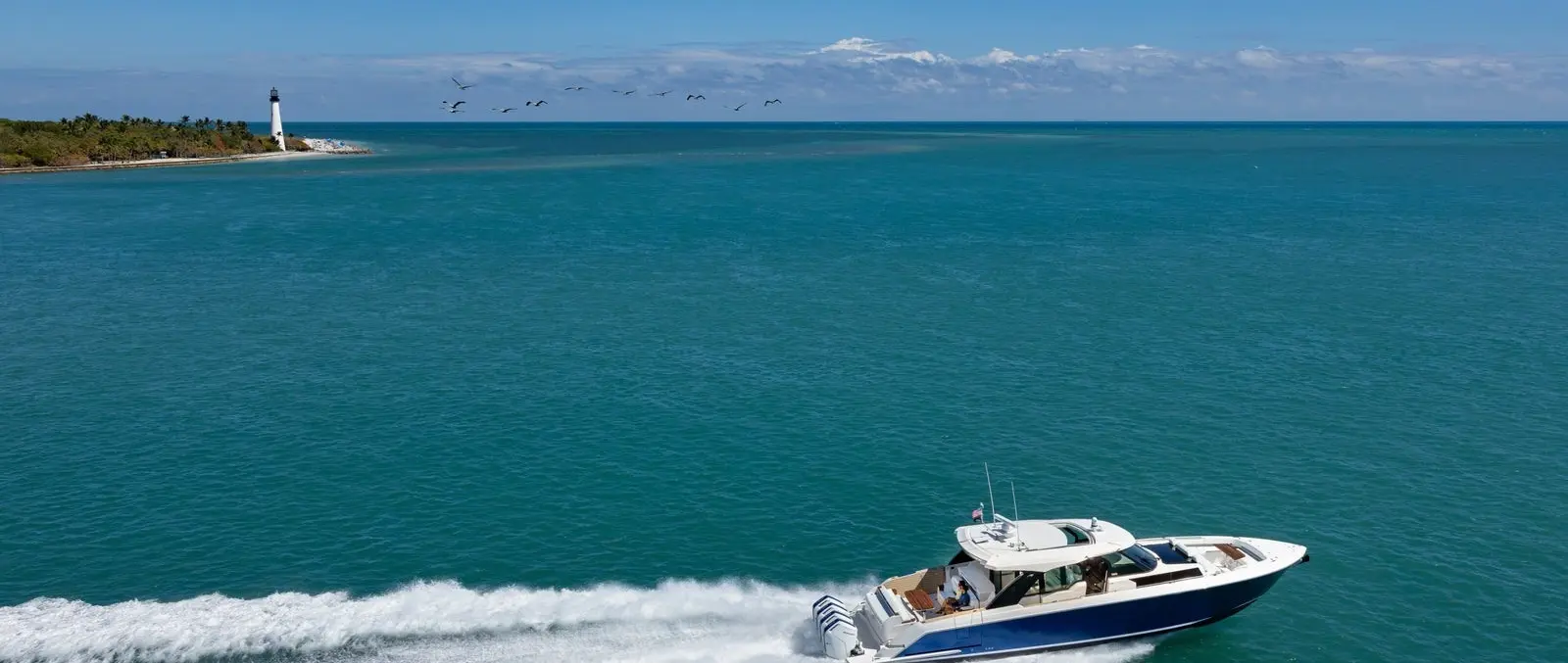
A larger interpretation of the luxury sport boat
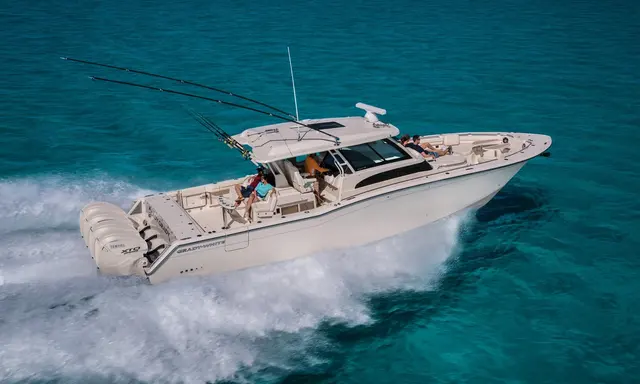
The Tiara 56 LS is a striking illustration of how far the American luxury sport category has expanded. Measuring 56 feet 2 inches overall, approximately 17.12 metres, the model places extensive entertaining space around an outboard-powered hull while still providing comfortable private accommodation below. Tiara describes it as the largest outboard-powered vessel in the company's history. The proportions explain why: this is not merely a dayboat with extra seats, but a substantial cruiser intended to keep guests outdoors for much of the day without requiring them to return to shore after sunset.
The yacht's 16-foot beam, roughly 4.88 metres, allows a broad main deck with separate spaces for movement, dining and relaxation. Full walk-around access helps passengers move forward rather than treating the bow as an isolated destination reached through narrow side passages. Pilothouse doors to port and starboard of the helm improve access to the surrounding decks. Those circulation routes matter during routine docking, at anchor and when several people aboard want different places to spend their time.
A striking feature is the use of twin terraces alongside the cockpit. Extending the entertaining area towards the water changes how the aft deck feels when the boat is stopped in suitable conditions. This is a layout aimed at social cruising, swimming and waterside leisure rather than maximum enclosed interior volume. Owners should nonetheless investigate the operation, maintenance and safe stowage of any opening terraces, because the most inviting features in harbour have to remain secure and practical at sea.
Four V12 outboards at the transom
The manufacturer specifies four Mercury Verado V12 outboards rated at 600 horsepower apiece, bringing installed nominal output to 2,400 horsepower in the stated configuration. The engine package is a defining part of the 56 LS design, but it should not be confused with a guaranteed cruising speed or range. Published engine output tells only part of the story: sea conditions, loading, propellers and the owner's chosen operating profile determine what happens on the water.
Tiara integrates Garmin navigation electronics at the helm and emphasises refined control and reduced noise in its propulsion presentation. Buyers should review the precise displays, systems and control options installed on an individual boat. A full handover should include safe engine operation, manoeuvring in crosswinds, identification of alarms and service routines. With four substantial outboards, maintenance scheduling and access to qualified technicians deserve as much attention as the sound of the engines on a demonstration run.
The published fuel capacity is 1,000 US gallons, around 3,785 litres, while the freshwater tank holds 150 US gallons, roughly 568 litres. Neither number establishes range or endurance without measured consumption and an understanding of how the boat will be used. Short, fast passages between restaurants and anchorages can produce a different cost and fuel profile from long journeys at a more measured pace. Prospective owners should ask for performance information tied to the actual power and equipment package.
The hull's stated draft is four feet, approximately 1.22 metres, and Tiara quotes a transom deadrise of 21 degrees. These figures are useful for evaluating berthing and operating environments, but a pilot cannot assume every shallow anchorage is suitable. Draft changes with load and conditions, and outboard clearances must be considered carefully. Owners familiar with smaller centre consoles may find the yacht's beam, displacement and propulsion arrangements demand a different approach to marina planning.
Two staterooms beneath an expansive social deck
Below deck, Tiara provides two separate staterooms and two private bathrooms, with accommodation promoted for four people. That makes the 56 LS suitable for an owner couple travelling with family or another couple, rather than attempting to sleep all of its day guests. Private facilities in each cabin can make longer stays more comfortable. The actual experience depends on storage, ventilation, cabin access and the use of the yacht with the intended number of people aboard.
The main deck contains a fitted galley and multiple social zones, allowing meals and refreshments to be served where guests spend most of their time. This arrangement suits warm-weather cruising when conversation flows between helm, cockpit and forward lounge. It also asks the owner to think carefully about sun protection and ventilation during the hottest parts of the day. A boat that excels at outdoor entertaining should remain manageable when conditions drive everyone towards the sheltered areas.
Tiara offers alternative aft-cockpit arrangements, including an adventure-oriented module and layouts better suited to entertaining or fishing. The options make the 56 LS more personal than a model built around one fixed activity. They can also change the way the cockpit is used and the amount of usable deck area left for guests. Buyers should examine the precise arrangement, confirm what is standard and decide which activities genuinely deserve permanent space.
Terraces, walk-around decks and the art of spending a day aboard
A wide aft cockpit and an accessible bow lounge encourage people to spread out instead of concentrating in a single seating circle. The yacht is therefore capable of hosting several social rhythms simultaneously: guests at the waterline, people enjoying a quiet conversation forward and the crew attending to navigation. The opportunity to reach the bow by walking around the helm is more than an aesthetic feature. It can improve onboard circulation and make routine tasks less disruptive when entertaining.
The opening side terraces create especially close contact with the sea while the vessel is suitably secured or at anchor. Such features can help a family use the boat for swimming and relaxing in sheltered water, but they are not substitutes for approved boarding procedures or responsible supervision. Owners should verify the operating limitations and locking arrangements with the builder. A sophisticated mechanism is most valuable when every regular user understands exactly how and when it can be used.
At this scale, luxury is partly about eliminating small frictions from a day on board. Convenient movement between the helm and decks, seating with good sightlines and sufficient space around the galley can matter more than a single spectacular photograph. The 56 LS's layout suggests an owner who enjoys active participation in the day rather than retreating behind closed doors. It offers a different proposition from a traditional enclosed flybridge cruiser, and that difference should be tested during a realistic sea trial.
The owner who will get the most from a 56 LS
The 56 LS is likely to attract buyers who want an open, socially oriented cruiser but also expect real overnight accommodation and extensive onboard systems. Four large outboards and a nearly 4.9-metre beam introduce operating requirements that should be costed carefully. Fuel, mooring, routine service, access to technicians and insurance are essential parts of any ownership calculation. A prospective buyer should also consider whether the home cruising area offers enough suitable berths and convenient support facilities.
The yacht's strongest appeal is its combination of scale and easy access to outdoor living. A crew can set up the cockpit for guests, make use of the terraces in sheltered conditions and still find privacy in two cabins later in the day. The layout is designed to maximise the pleasures of being outside rather than pretending to replicate a much larger displacement yacht. For the right owner, that is a persuasive form of luxury.
This is a closer look at Tiara's current 56 LS and its published equipment, not an assertion that the model was first launched in October 2026. Its 17.12-metre length, quad-V12 propulsion and versatile social deck make it a significant choice for buyers looking beyond compact dayboats. Before specifying one, the important task is to decide how much of the year will be spent entertaining, travelling or enjoying water sports, then select the modules and equipment that serve that use.