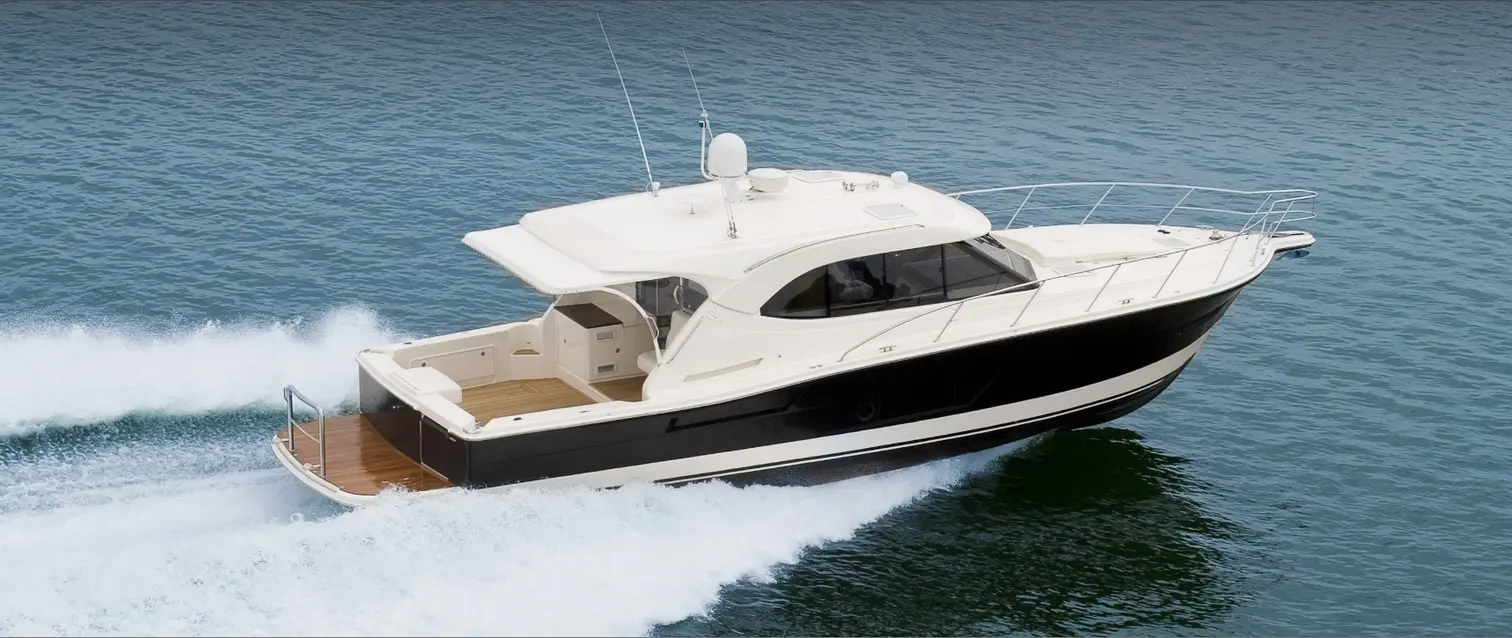
A blue-water cruiser with an open-cockpit philosophy
Riviera's 445 SUV combines two strands of Australian boatbuilding: the practicality of an open offshore cockpit and the comfort of a protected saloon motor yacht. The model measures 14.56 metres overall, including the swim platform and bowsprit, while the hull itself is 13.61 metres long. Those dimensions place it firmly within luxury owner-operated cruising. It is a boat designed for families who might fish in the morning, swim after lunch and sit down to dinner in a sheltered interior when the evening breeze rises.
The manufacturer describes the arrangement as one-level living, meaning the cockpit and saloon work together as a connected social space. Instead of restricting guests to a small aft platform or separating entertaining spaces by a substantial staircase, the yacht makes the transition from outside to inside a central part of its appeal. A broad saloon view and easy cockpit access help it serve both the adventurous owner and passengers who simply want somewhere comfortable to watch the coastline.
The published beam is 4.57 metres, with a maximum draught including propellers of about 1.16 metres. The breadth creates valuable space for accommodation and social areas, but it should prompt questions about the home berth and local manoeuvring room. This is a substantial vessel rather than an oversized runabout. Buyers need to plan maintenance access, fuel requirements and marina arrangements before deciding that the yacht's open-deck freedom is the correct fit.
Twin IPS diesels and integrated navigation
Riviera specifies two Volvo Penta D6 IPS 600 diesel engines, each rated at 440 horsepower. Inboard Performance System propulsion is a key element of the ownership proposition, particularly when combined with joystick manoeuvring and integrated helm electronics. The boat has control positions in the main saloon and cockpit, an arrangement intended to give the skipper better options when berthing or working around the aft deck. Responsible handling still requires familiarity with the system and attention to nearby vessels, people and weather.
The builder publishes a diesel capacity of 2,000 litres and a freshwater capacity of about 460 litres. These are useful figures for planning a weekend or longer coastal stay, but they should not be converted into an estimated range without verified consumption data. Speed, sea state, the number of people aboard and the power demands of the equipment can all make a substantial difference. A buyer should request performance information for the exact specification under consideration and preserve sensible operational reserves.
Digital technology extends beyond the engines. Riviera refers to Volvo Penta's Glass Cockpit navigation system and CZone switching for managing onboard equipment. Such features can simplify monitoring and reduce the number of separate controls a skipper must consult. They also deserve a proper handover: owners should understand alarms, routine checks and what to do if an electrical or display component becomes unavailable during a passage.
Riviera has also thought about maintenance access. The published design includes an electrically actuated cockpit-floor section that raises to reveal the machinery area, potentially making inspection more straightforward than crawling through narrow access hatches. This is a practical luxury often overlooked during a first viewing. Owners should check clearances and service routes themselves, because access that remains convenient after years of regular use can influence the real cost and pleasure of ownership.
Two staterooms beneath the saloon
The accommodation deck provides two staterooms and two bathrooms, with the manufacturer's stated sleeping capacity extending to six people. That makes the 445 SUV suitable for a couple wanting substantial private quarters while still offering room for family or friends. The precise sleeping arrangements should be checked on board, however. A nominal berth count is less important than whether the layout comfortably suits the people who will actually travel together.
Longer stays reveal the difference between an attractive cabin and a practical one. Owners should examine accessible storage, ventilation, the position of reading lights, bathroom usability and the ease of moving between cabins when the vessel is not perfectly level. Riviera presents this space as a restful retreat after an active day, and the two-bathroom arrangement could reduce competition for facilities when guests are aboard. Comfort is most convincingly assessed during a realistic walkthrough, not from a single promotional photograph.
Upstairs, the single-level saloon becomes a protected gathering place with extensive glazing and a connection to the cockpit. This has particular appeal in changeable coastal weather, when passengers want broad views without remaining outside. It also helps with serving meals and supervising younger guests, since the people using the different social areas remain relatively close. The arrangement offers an alternative to flybridge yachts whose entertaining spaces may be separated vertically.
Cockpit and bathing platform built for changing plans
The open cockpit is designed to accept several types of use. Riviera highlights fishing, diving and general entertaining, with an aft mezzanine lounge that offers an alternative place to rest. A boarding platform with swimming ladder gives guests a practical route back from the sea, while the cockpit layout allows occasional furniture to be introduced when entertaining takes precedence. That flexibility is valuable to an owner who does not want the yacht dedicated to a single activity.
A sheltered bar and servery brings refrigeration and working surfaces close to the outdoor seating. Riviera also describes an optional barbecue installation that replaces part of the transom storage. These details sound modest compared with major engineering specifications, but they can determine how often the outside space is actually used. A sensible buyer should examine drainage, ventilation, cleaning arrangements and access around the barbecue before deciding which options fit the family's routine.
The foredeck can also be equipped with a double sunpad, adding a further place to relax at anchor. In a boat of this size, distributing guests across several areas can make the whole vessel feel more generous. The safety rules for moving forward at sea remain important, however, particularly during passage-making. Handholds, weather and operating guidance must take priority over the tempting impression of a continuous sun terrace.
Who will enjoy the 445 SUV most
The Riviera 445 SUV is likely to suit owners whose time afloat moves easily between active outings and comfortable accommodation. It may also appeal to experienced powerboat owners moving into a more substantial yacht who want sophisticated docking support but prefer to remain closely involved in operating the vessel. Insurance, training, maintenance, engine service and the demands of the home marina should all be discussed during purchase planning.
Its defining achievement is less about one dramatic feature than about a coherent arrangement. Two cabins, twin IPS diesels, an accessible cockpit and a light-filled saloon allow a broad range of days at sea without asking the family to choose between leisure and adventure. This is an examination of a current Riviera model, not a claim of a new October 2026 launch. The most important question for an owner is whether that balance reflects how the yacht will really be used.