Why the deck plan matters more than its dramatic outline
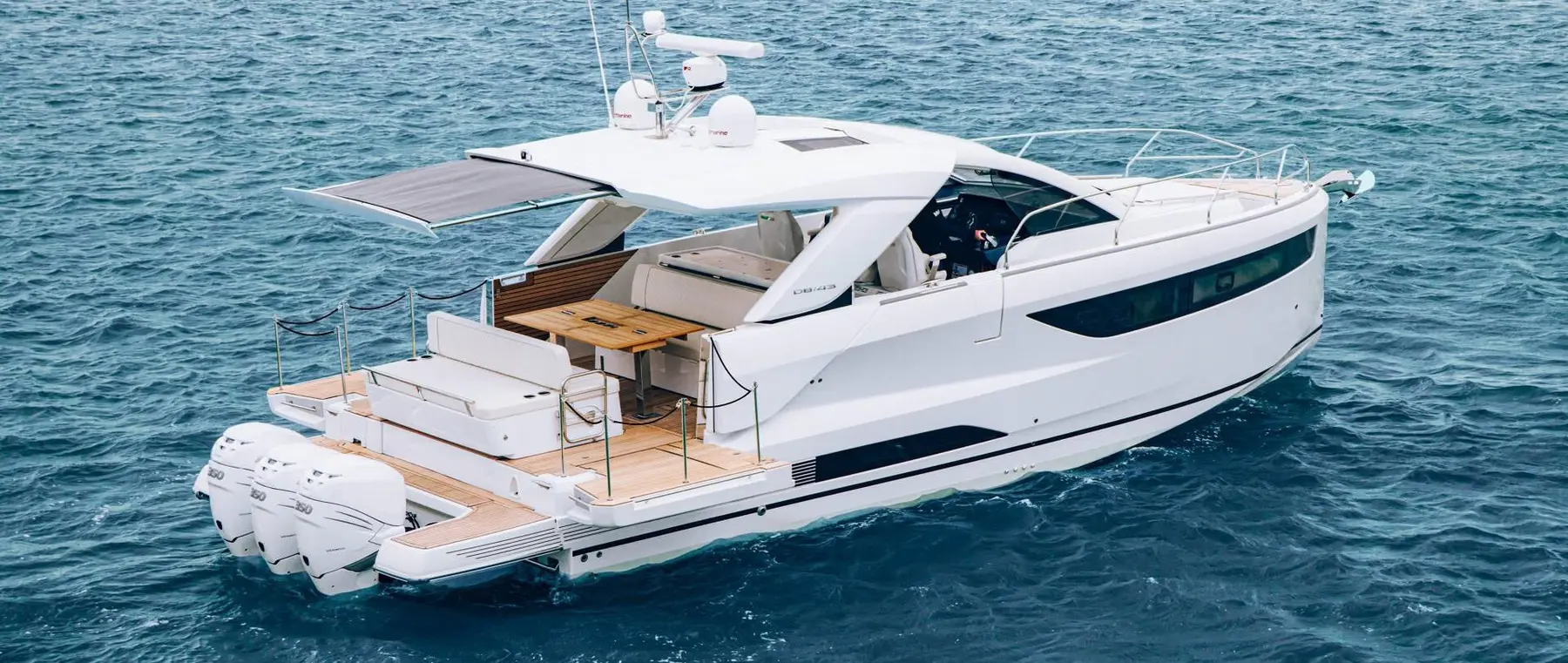
Jeanneau's DB/43 Outboard is a substantial dayboat, with an overall length of 13.94 metres and a hull beam of 3.82 metres according to the builder's current specification. Its assertive profile is easy to notice, yet the more important design decision is the way passengers occupy the deck at anchor. Two opening side terraces can turn the aft area into an unusually broad platform for people who spend their afternoons swimming, relaxing or moving between the boat and the water. That is a more meaningful proposition than treating every available square metre as a place for permanent furniture.
The side terraces are intended for stationary enjoyment rather than making the boat appear wider under way. Once opened, they extend the useful footprint beyond the ordinary hull outline and alter how people gather around the cockpit. Owners should nevertheless think about where a tender or watersports equipment will be kept and how access is managed when children or inexperienced guests are aboard. An inviting terrace is best enjoyed with clear rules about movement, swimming and the operation of powered mechanisms.
The deck layout brings its social functions together. Jeanneau describes an aft saloon that can accommodate up to eight around a modular table, alongside a central island galley designed for food preparation and informal service. This arrangement helps explain why the DB/43 has a different personality from a conventional sport cruiser with a narrow passage to the stern. The chef or host need not disappear below deck to prepare a simple lunch, although weather exposure and storage remain practical questions to ask during a viewing.
Outboard propulsion and the Michael Peters hull
The Outboard designation is fundamental to this model, because Jeanneau also sells an inboard DB/43 with a related but different set of proportions. The manufacturer gives the outboard boat a length overall of 13.94 metres, while its inboard sibling is listed at 13.03 metres. Combining their published measurements in a single description would mislead prospective buyers comparing berth fees or marina restrictions. A purchase specification should always identify the propulsion variant before discussing performance, tankage or the arrangement of the stern.
Jeanneau credits the hull design to Michael Peters Yacht Design and describes speeds approaching 40 knots for the DB/43 OB. That is a manufacturer's performance claim, not the result of an independent sea trial in particular conditions. Actual speed depends on engine specification, loading, hull condition and the state of the water. The appropriate question for an owner is what cruising pace feels comfortable with guests aboard, and whether the vessel can maintain it without making conversation or movement unpleasant.
Design responsibilities also include the work of Camillo Garroni, whose studio is credited on Jeanneau's official specification. The deck's muscular yet continuous lines are intended to convey the boat's athletic character, while the hull must balance pace with enough composure for a predominantly outdoor seating plan. Handling claims should always be tested in person if possible. A model can look purposeful in photographs, but spray control, sightlines from the helm and ease of docking only become clear during a properly arranged demonstration.
Two cabins distinguish a true weekender from a dayboat
Although the DB/43 Outboard makes its first impression on deck, Jeanneau gives it two enclosed cabins below. The manufacturer's material highlights a light-filled owner's cabin and a full-beam guest cabin, separating overnight accommodation from the high-activity cockpit above. That distinction matters for couples travelling with children or friends: people can withdraw to rest while others remain outside. In a market full of entertaining platforms with minimal sleeping arrangements, the existence of a defined guest cabin widens the range of realistic itineraries.
Two cabins do not automatically transform a 14-metre cruiser into a long-range motor yacht. Storage volume, ventilation, fresh-water capacity and the comfort of the heads still shape how many nights a family will want to spend aboard. A sensible viewing should include opening wardrobes and lockers, testing access to each berth and considering how bags and wet towels would be managed. Buyers who expect frequent overnight stays will find those details more revealing than a quick glance at upholstery colours.
The transition between day and night is where the deck-and-cabin formula becomes most useful. Friends can enjoy lunch around the large cockpit table before heading ashore, leaving an owner and partner the privacy of the principal cabin for an evening aboard. On a longer weekend, the second cabin offers additional flexibility without requiring every seat in the saloon to convert into bedding. That makes the DB/43 relevant to owners who want a lively social platform without surrendering the possibility of quieter, more independent coastal cruising.
The choices behind an open-air ownership experience
An open-dayboat layout places a premium on the management of sun, wind and spray. The DB/43's outdoor galley, cockpit lounge and side terraces can make an anchorage feel like a floating beach club, but they also invite practical questions about shade at midday and securing cushions when the weather changes. It is worth walking through the deck with the seating occupied rather than judging the arrangement empty. The difference between generous space and a smooth guest experience often lies in the routes people take between individual zones.
Sea access deserves equally close attention. Fold-down terraces create an enjoyable interface with the water, yet owners need to understand boarding arrangements, the movement of anyone using the aft platform and how to reconfigure the deck before departure. A model that encourages frequent swimming must also make it straightforward to supervise guests and bring them safely back aboard. The attraction is not simply its expanded beam at rest, but the ability to organise the whole day around the water instead of treating swimming as an occasional interruption.
The Jeanneau DB/43 Outboard is therefore best understood as a premium social cruiser with credible weekend accommodation and a performance-oriented hull. It is not presented here as a newly launched 2026 boat: Jeanneau's own product information identifies the DB/43 OB as a 2023 model that remains within its published range. What deserves renewed attention is the way it combines side terraces, a central galley, two cabins and outboard propulsion. For buyers weighing up a large open cruiser, those interlocking decisions are more useful than another superlative about speed.