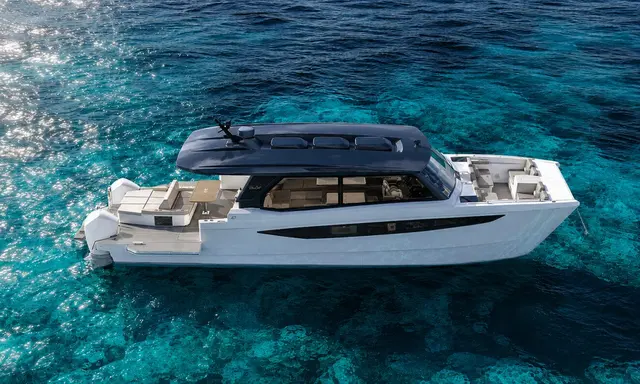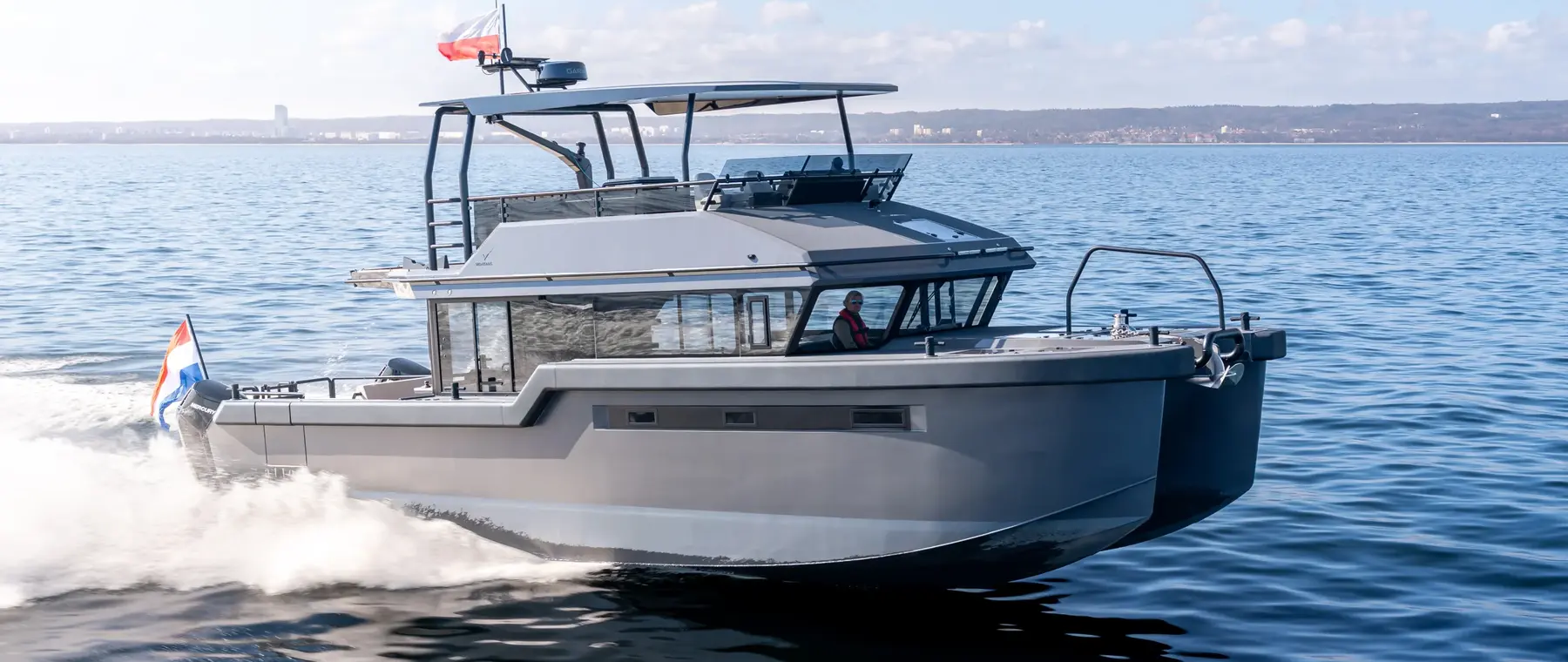
Vandal Marine is advertising a Vandal 50 appearance at the Newport International Boat Show from 17 to 20 September 2026, giving US visitors an opportunity to inspect an unconventional offshore-cruising catamaran. The builder's own website names the event and identifies dock M-15 for private viewings, while a Newport new-model preview lists the Vandal 50 among the power cruisers being displayed. This is a show-appearance story, not a claim that the vessel was first invented or launched in Rhode Island.
The manufacturer's specification gives a length overall of 15.17 metres, a five-metre beam and a hull draft of about 0.80 metres. These figures place the boat squarely within Luxury Yacht Guide's 12.00-to-23.99-metre scope and describe a wide but relatively shallow-draft platform. Prospective owners should verify actual draft and overall dimensions with their chosen equipment package before booking berths or planning shallow-water access.
A fixed foil supplements the catamaran hulls
Vandal describes the boat as foil assisted, using a fixed foil between the hulls to improve its running behaviour. The manufacturer's account says the foil can contribute to ride comfort and efficiency when the vessel is operating on plane. That language should not be confused with a verified claim that the entire boat rises free of the water like a fully flying hydrofoil.
The company identifies stainless steel SAF2205 as the material for the fixed element between the hulls and promotes its strength and resistance to the marine environment. The arrangement has no active foil controls for an operator to learn according to the builder's description, although an owner should still ask about inspection intervals, grounding risk and the repair arrangements associated with any underwater structure.
Aluminium construction changes the design choices
Vandal states that its range is built in 5083 aluminium rather than moulded glass-reinforced plastic. The builder cites strength, impact behaviour and potential recyclability as reasons for the material choice, alongside the ability to customise individual builds without new mould tooling. These are manufacturer arguments that need to be balanced against the workmanship and protection systems on the actual yacht.
For a prospective buyer, metal construction makes corrosion protection, electrical bonding, isolation and inspection documentation particularly important. The material itself is not a shortcut around maintenance; good welding, coating systems and correct installation of dissimilar metals matter throughout ownership. Those are practical questions to raise during a Newport inspection rather than performance claims drawn from photographs.
Twin V12 outboards provide 1,200 horsepower
The published Vandal 50 drivetrain specifies two Mercury V12 600hp outboard engines, producing 1,200hp combined. The builder quotes a cruise around 28 knots and a maximum speed of 45 knots, with a cruising range of approximately 300 nautical miles under its stated conditions. These are manufacturer-provided figures and not a result independently recorded by Luxury Yacht Guide.
Vandal lists 2,000 litres of main fuel and 150 litres of diesel capacity, together with a separate six-kilowatt diesel generator. Engine and generator arrangements should be checked on the individual yacht to understand power-system separation, servicing access and redundancy. Actual fuel burn and attainable range will vary with load, sea state, hull condition and speed.
Shallow draft widens potential destinations
A published hull draft of 0.80 metres gives the Vandal 50 a different operating profile from deeper-keeled displacement motor yachts in the same length class. The company also markets the range for adventurous cruising and mentions the possibility of beaching under appropriate conditions. Those claims do not establish that every coastline, anchorage or bottom type is safe for contact with the hull.
Owners should inspect the exact underwater configuration, including engine lower units, foil and any other protrusions, before treating the published hull-draft figure as a clearance limit. Local tidal range and seabed material remain relevant. The route or shallow beach suitable for an aluminium catamaran is not automatically suitable for the same boat at full cruising weight.
Deck and cabin layouts can be customised
The manufacturer presents several interior plans on the Vandal 50 model page, including alternatives for cabin and head arrangements. It also shows flybridge, main-deck and lower-deck layouts that can be assessed against an owner's requirements for passage-making, storage and accommodation. The existence of multiple drawings does not guarantee every combination can be installed on any yacht without design review.
At five metres wide, berth availability and marina beam limits deserve attention even if the boat's length is comfortably below 24 metres. Owners should ask for dimensions of the particular configuration, bridge-clearance information and boarding arrangements as well as an accurate loaded weight. These practical details often determine how readily an adventure-oriented yacht can be used at ordinary marinas.
Espen Øino is named as designer
Vandal's official specification credits designer Espen Øino for the 50-foot model. The company's brand material positions the range around durable construction, accessible onboard systems and a modern expedition aesthetic, with an emphasis on long-distance destinations. Designer attribution confirms the stated design collaboration but does not alone provide evidence about independently measured speed, comfort or offshore suitability.
The boat's 15.17-metre length and five-metre beam yield a comparatively broad footprint. Buyers considering the 50 should test the balance between the advantages of multihull deck area and the implications for marina access, handling in crosswinds and servicing twin engines. A test run in realistic conditions is the clearest way to assess the builder's stated comfort objectives.
Newport offers a direct inspection opportunity
The official Vandal website invites visitors to book a private showing at Newport's dock M-15 during the 17–20 September exhibition. That is a practical confirmed invitation, distinct from speculation about order books, future sales or whether a particular hull has already been delivered. No new commercial contract was identified in the show notices reviewed.
For Luxury Yacht Guide, the news is the advertised appearance of a verified sub-24-metre foil-assisted aluminium yacht with a published specification. Further independent sea-trial and owner-use reports could provide the evidence needed to assess the company's performance claims more fully, but those findings should not be invented before they exist.