A bluewater departure from a sailing name
Oyster Yachts has built its reputation on serious long-distance sailing, so its new P60 power catamaran represents a meaningful change in the way the British builder approaches ocean cruising. The 60-foot design brings the company's emphasis on engineering, supported ownership and liveaboard comfort to a twin-hull motor yacht. Its stated purpose is not merely to cross a bay quickly, but to support an owner who wants to stay aboard and travel much farther.
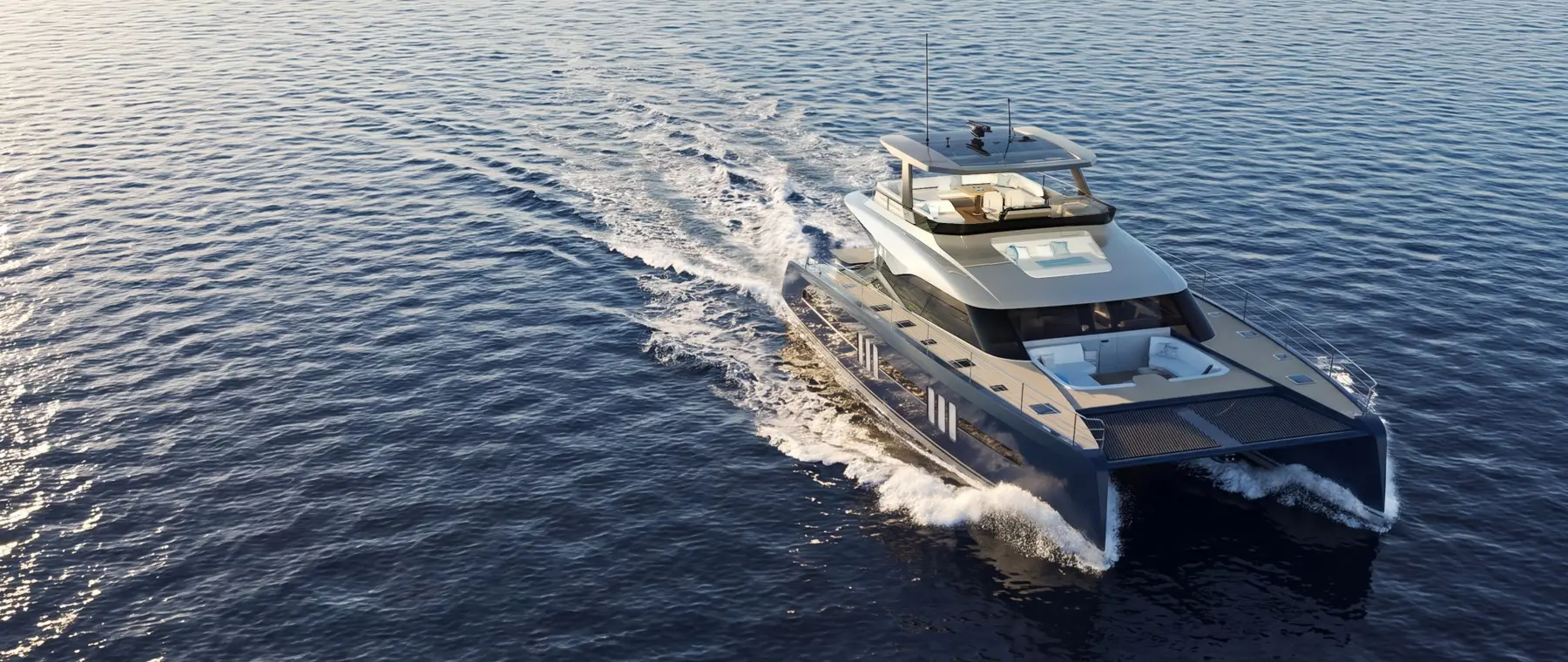
Oyster says the P60 has been developed with multihull specialists Berret-Racoupeau. The design combines wide social decks with comparatively narrow, efficient displacement hulls, an arrangement intended to make passage-making and time at anchor equally important. The early published figures are design targets rather than evidence from completed ocean trials, a distinction that prospective owners should preserve when comparing it with established production powercats.
The long-range claim needs context
The builder specifies a target range of up to 3,500 nautical miles at eight knots with 6,000 litres of fuel. Oyster notes that this figure is intended to cover the longest passage in its World Rally, from the Galápagos to the Marquesas. The comparison is useful because it frames the design around actual offshore geography instead of an undefined promise of global capability. The target would, if achieved in the intended conditions, make route planning more flexible.
Range remains conditional on displacement, loading, sea state, reserve policy and final machinery specification. Owners should request a fully defined test basis before treating 3,500 nautical miles as a guaranteed delivery performance. The P60's design story is strongest when the target is read alongside service access, fuel capacity, weather limits and the human demands of a long passage. A reliable ocean yacht must solve all of those problems together.
Broad beam changes the social layout
At 9.35 metres across, the P60 has a naturally wide platform for accommodation and entertaining. Oyster quotes 121 square metres of social living space and divides much of the outdoor programme between a 33-square-metre flybridge and a 40-square-metre aft cockpit. The flybridge places a central helm close to a bar, lounge and raised daybed, allowing the person steering to remain part of the social atmosphere when conditions permit.
The aft deck is designed to change character with the activity: shaded dining, a sea-facing lounge or an area that supports fishing and other water-based pursuits. A hydraulic tender platform can carry the tender underway and descend to provide a platform close to the sea at anchor. This configuration is especially relevant to extended cruising, where owners alternate between formal entertaining, working with equipment and simply enjoying a secluded anchorage.
Spaces for privacy and practical living
The P60's saloon spans the main deck and uses extensive glazing to connect the indoor living area with the forward and aft cockpits. The builder positions an approximately 18-square-metre owner's cabin near the centre of the boat, seeking a separate retreat without forcing every guest into the same shared circulation zone. The forward cockpit offers another place for breakfast or quiet observation away from the busier aft social areas.
The choice of finish and furniture will matter over years of use, but access behind those visible surfaces is just as important. Oyster emphasises machinery accessibility, robust construction and components selected for maintainability. An owner planning remote cruising should ask about inspection routes, redundancy, spares and service procedures. A beautiful interior is sustainable at sea only when crew or technicians can reach the systems that keep it comfortable.
Power management in a quiet anchorage
Oyster proposes optional solar panels on the flybridge working with a substantial lithium battery bank, intended to reduce generator hours and improve comfort at anchor. Solar contribution depends on shading, latitude, weather and load, so equipment capacity and real-world daily energy use will determine the benefit. The design also uses relatively high freeboard, open foredeck trampolines and up to a metre of bridgedeck clearance to address ocean-going multihull behaviour.
A motor yacht's endurance is more than its diesel range. Owners may need air conditioning, refrigeration, communications and water production for many consecutive days without a marina visit. The P60's large platform provides possibilities for those systems, but detailed electrical budgets and equipment redundancy should form part of every serious specification discussion. The attractive prospect is a comfortable passagemaker that is not forced to run a generator constantly.
Where the P60 sits in the market
The proposed 60-foot package sits between smaller owner-operated holiday catamarans and considerably larger crewed expedition yachts. Oyster appears to be addressing owners who appreciate the independence of its sailing heritage but want a power yacht's route choices and on-board layout. Its wide beam will create impressive living areas but must also be considered when selecting berths, haul-out facilities and narrow marina approaches.
For now, the compelling facts are the manufacturer's design numbers, Berret-Racoupeau collaboration and bluewater brief. Final performance and delivery particulars should be confirmed directly with Oyster as the programme develops. The P60 is a notable new direction for the yard because it treats power cruising as a serious long-range pursuit, not simply a motorised variation of a sailing yacht's social spaces.
For the wider current yachting calendar, see our Fort Lauderdale International Boat Show 2026 event listing. Confirm the particular model and any viewing appointment with its builder.