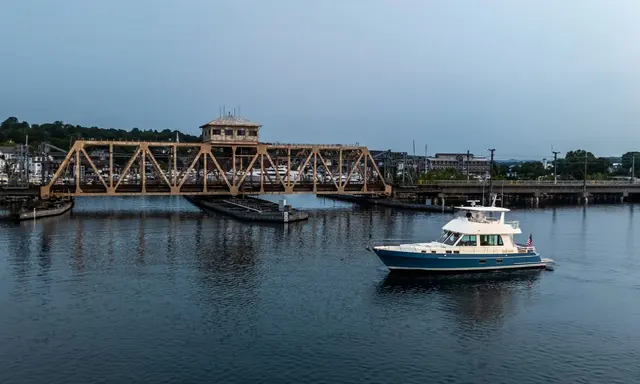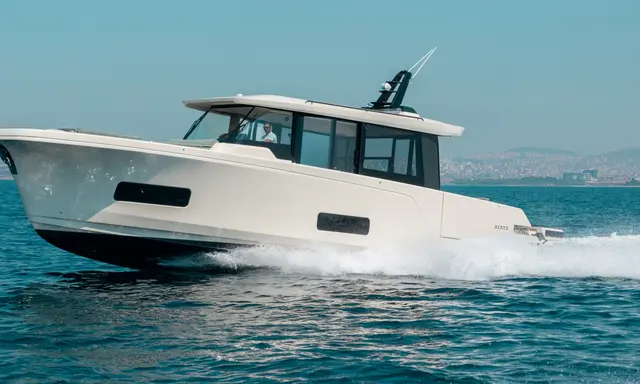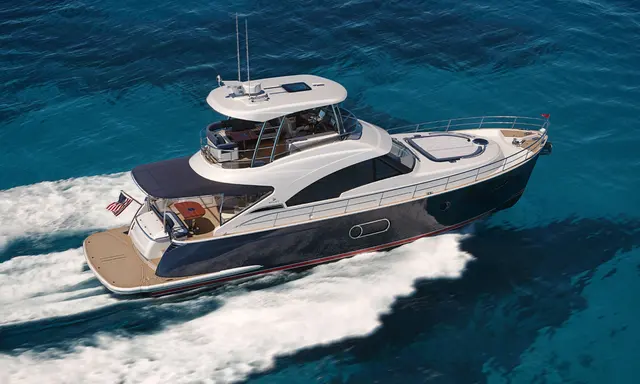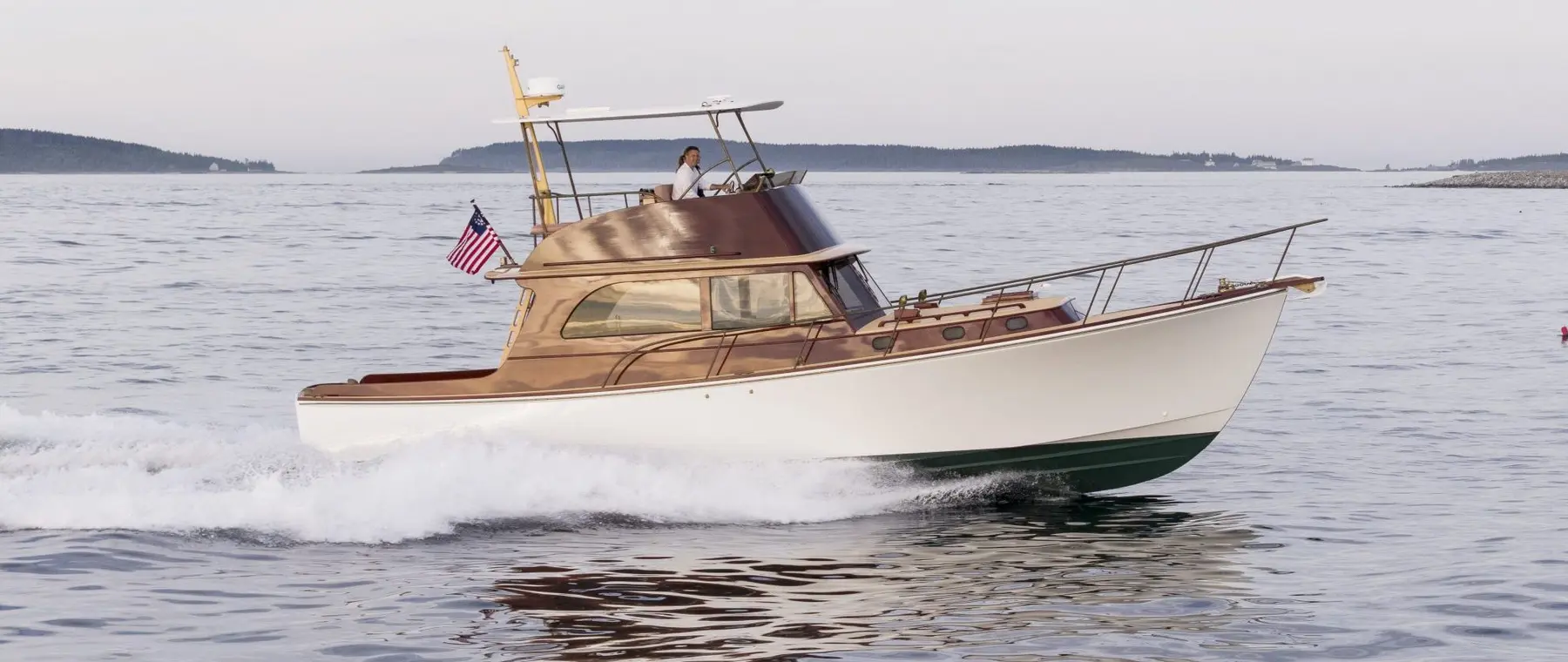
Lyman-Morse Boatbuilding's Hood 42 LM is due to be displayed at the Newport International Boat Show from 17 to 20 September 2026, providing a public opportunity to inspect a yacht whose first hull was already launched earlier in the summer. The builder's launch announcement appeared in July and a subsequent official release identified Newport as the forthcoming show venue. Describing the September appearance as the initial launch would repeat an older milestone inaccurately.
The yacht measures 42 feet overall, roughly 12.8 metres, keeping it inside Luxury Yacht Guide's 12.00-to-23.99-metre remit. Built with C.W. Hood Yacht Design, the flybridge cruiser combines a classic New England exterior with contemporary propulsion and cold-moulded composite construction. Its first example is an individually specified owner's boat rather than a generic showroom interior that every future hull must share.
Newport follows the earlier yard launch
A release distributed by Lyman-Morse and carried by Powerboat World on 18 July reported that the first Hood 42 LM had been launched. An additional August communication described the completed first hull and confirmed plans to put the boat on display at Newport between 17 and 20 September. These dated steps establish a credible event timeline without treating the same yacht as newly launched twice.
The show offers a different kind of news from the construction milestone. Visitors can examine how the finished cockpit, flybridge, joinery and below-deck spaces work together rather than relying exclusively on shipyard photographs. Anyone travelling specifically for this yacht should confirm access and appointment arrangements with Lyman-Morse before arriving.
C.W. Hood styling draws on New England traditions
The design takes cues from classic Wasque-style motorboats, with low, balanced exterior lines and extensive use of finely finished timber. Lyman-Morse credits C.W. Hood Yacht Design for the yacht and positions the model alongside the existing Hood 35 LM and Hood 57 LM collaborations. That lineage is relevant to the appearance and design philosophy, not proof that every new project shares the same hull characteristics.
The builder's first-hull release describes varnished mahogany detailing, bronze accents and a carefully proportioned superstructure. Such features demand close examination of finish quality and future maintenance requirements. A traditionally styled boat can still use modern systems, but the degree of ongoing cosmetic care depends on the particular coatings and usage pattern.
Cold-moulded construction underpins the hull
Lyman-Morse identifies the hull as a cold-moulded wood-composite build using Douglas fir and Western red cedar with composite reinforcement. The yard says the method is intended to combine strength, stiffness and a quieter ride with traditional craftsmanship. A buyer should seek construction drawings, coating details and survey access rather than treating any material description as a substitute for a condition assessment.
Cold-moulding is distinct from a conventional production glassfibre mould and gives the yard scope to finish the vessel to a specific owner's brief. It also makes documentation of the build particularly valuable for later resale, repair and insurance discussions. The actual yacht's construction record is more useful than a general assumption that one material always outperforms another.
Main-deck living is arranged on one level
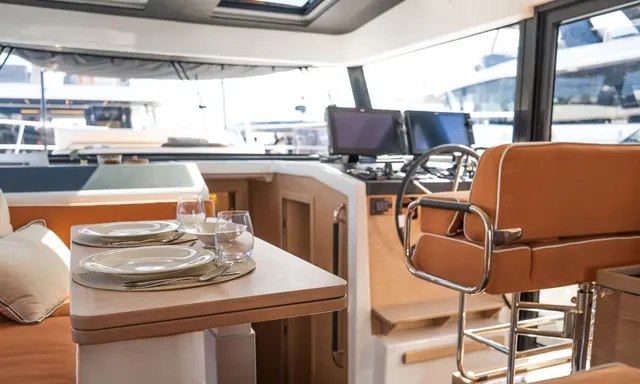
The builder places the lower helm, galley, saloon and entertaining space on a connected main deck, using large windows and opening arrangements to keep the interior bright. It describes electrically operated saloon glazing with integrated screens among the first hull's detailed features. This layout aims to make movement between steering, food preparation and social spaces more straightforward while cruising or at anchor.
The first yacht's arrangement reflects owner input, and the builder makes clear that future customers may choose different configurations. Buyers should assess headroom, helm visibility and access routes on the completed example, but should not assume its precise cabin or equipment inventory is standard on every Hood 42 LM. Written build specifications remain decisive.
A single owner cabin occupies the lower deck
The first hull includes an owner's stateroom forward, enclosed head, separate shower and substantial storage. That is a deliberate owner's layout rather than a stated two- or three-cabin arrangement. Lyman-Morse says alternative accommodation options and sedan or flybridge configurations can be considered for future examples, subject to individual design and specification.
The decision to prioritise one principal cabin gives the yacht a different brief from an equal-length family cruiser with several compact guest rooms. Whether that suits a purchaser depends on how many people regularly stay aboard and whether the boat is intended chiefly for couples, short trips or longer passages. The Newport display should make this trade-off easier to evaluate in person.
Volvo diesel power and published estimates
The yard's specification table lists twin 440hp Volvo Penta D6 engines and twin Volvo DPS drives, with a quoted cruising speed of 30 knots and a maximum of 39 knots. These are published builder figures rather than independent sea-trial measurements. The underlying release also describes a mid-30-knot operating brief, so buyers should request the actual speed-and-fuel curve and clarify the exact installed drive specification.
The declared beam is 13 feet and draft around 3 feet 4 inches, with approximate full displacement of 21,000 pounds. As on any bespoke build, tank loading, owner equipment and final propeller selection can influence performance. An owner's trial under the load expected in normal service offers stronger evidence than one headline maximum-speed number.
First show appearance is the fresh development
The July launch and August presentation established the Hood 42 LM as a completed new model before the Newport show. September's news is the opportunity to inspect the first example at a major in-water event, not a second launching ceremony or a new specification published without verification. The distinction helps avoid unnecessary repetition in a newsroom covering yacht-building milestones closely.
Lyman-Morse's Newport showing provides a practical setting to examine an uncommon 12.8-metre owner-configured cruiser. The next independently useful information would be an on-water test or documented subsequent build, while this report confines itself to the confirmed show itinerary, construction details and published model specification.