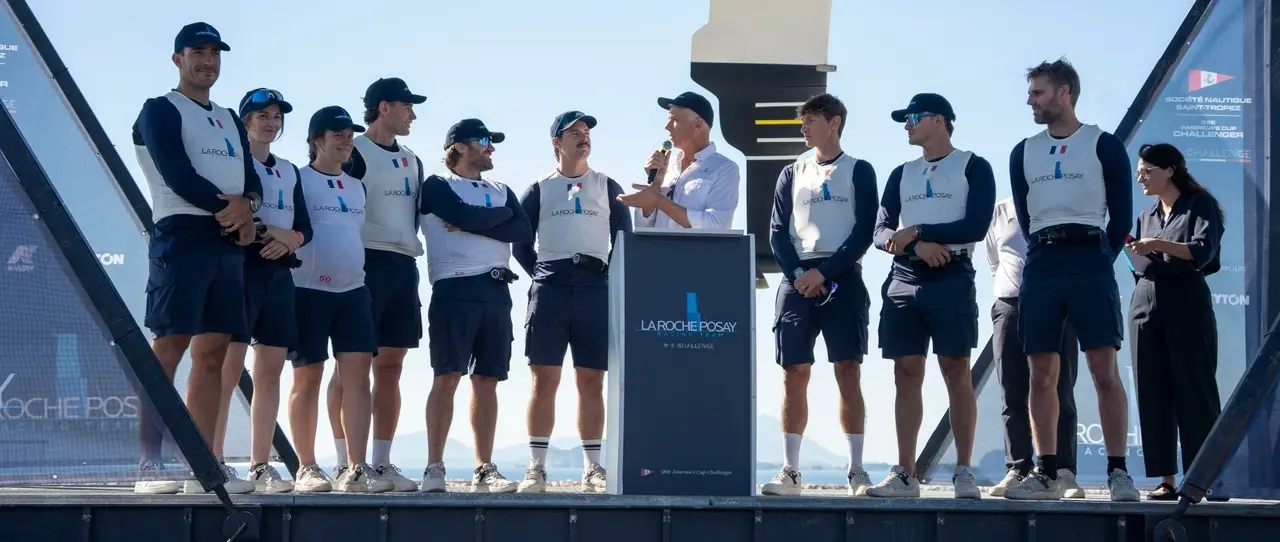
French team begins work on the host waters
La Roche-Posay Racing Team launched and sailed its AC75 on the Bay of Naples on 19 October, making it the first campaign to do so during the current America's Cup cycle. The French challenger represents the Société Nautique de Saint Tropez and has established its new base in Bagnoli.
The milestone comes as the teams prepare for the Louis Vuitton 38th America's Cup, with the challenger selection scheduled to begin in May 2027. Getting afloat on the host waters provides practical training time rather than an automatic competitive advantage.
A contrasting start to the last campaign
The French syndicate was one of the last to launch during the previous event in Barcelona, creating intense pressure to prepare its boat before racing began. In Naples, its early arrival reverses that position and gives the crew a longer opportunity to understand local conditions.
The team has stressed that additional time is useful only if it is matched by structured practice. Every outing can provide feedback on handling, equipment and communication aboard the highly specialised foiling yacht.
Training in Lorient before the move
The yacht spent the summer training in Lorient in northwestern France before being transferred to Italy. Several transportation methods were considered, including air carriage, before the team chose an overland journey and a barge transfer.
A complex racing yacht is not comparable to a conventional vessel that can simply sail under its own power to a new base. The mast, foils and supporting equipment require deliberate preparation before the boat can be recommissioned.
From Sète to Bagnoli
The AC75 was moved by exceptional road convoy to the port of Sète on France's Mediterranean coast, then carried by barge to Naples. It arrived at Bagnoli before the September preliminary activity and was subsequently fitted out at the new headquarters.
This sequence demonstrates the logistics involved in establishing an international racing campaign. Shore teams must coordinate transport, lifting operations, workshop systems and local access alongside the sailing programme.
A yacht with championship lineage
The French vessel is a sister ship to Taihoro, Emirates Team New Zealand's winning AC75 from the previous America's Cup. Its underlying platform gives the team an established starting point while still requiring detailed preparation for the present competition.
The regulations and development programme shape what can be changed between cycles, so familiarity with the platform remains important. Teams will test setup, control systems and crew processes under real sailing conditions.
A specialist sailing line-up
Skipper Quentin Delapierre and co-helm Diego Botín form part of the sailing leadership, supported by a team including Jason Saunders, Leigh McMillan, Florian Trittel and Maëlenn Lemaitre. Team coach Philippe Presti is overseeing the programme and its transition to the host venue.
The team combines experience from different high-performance sailing disciplines, which can help it address the AC75's demanding operation. Success will depend on efficient coordination between sailors, design staff and shore technicians.
Why the Bay of Naples matters
Naples provides the real race environment in which the crews will compete in 2027, including local winds, swell patterns and changing sea conditions. Early practice can reveal differences that are difficult to reproduce using simulations or training waters elsewhere.
Observation and repetition are especially important for foiling craft because small changes in handling can have substantial performance consequences. Teams will still need to adapt to daily weather variations rather than rely on one standard setup.
A public milestone at the base
The launch was attended by local dignitaries and figures involved in developing the America's Cup facilities in Naples. For the city, the appearance of an AC75 marks a visible stage in preparing the waterfront for an event of international importance.
The Bagnoli district is also undergoing broader regeneration work associated with the competition. The race preparation and urban development are connected projects, although progress on one does not guarantee a specific completion date for every other element.
The road to the Louis Vuitton Cup
The challenger competition is due to begin on 22 May 2027, leaving months for training and refinement. The French team can now use that period to develop consistent performance and improve its handling of the powerful foiling yacht.
Early time on the water is valuable, but it is not a prediction of the final racing order. Rival teams are preparing their own programmes, and performance comparisons will become more meaningful once fleets compete together.
A fresh chapter for French sailing
The confirmed news is the French team's first sail on the host waters and its operational establishment in Naples. The launch provides a strong symbolic start, supported by the practical work of moving and readying the AC75.
For followers of racing yachts below 24 metres, the campaign is an example of advanced materials, foiling design and crew coordination. Further sailing results and competitive performance will require separate verification as the 2027 event approaches.