A 30-metre flagship with a different power strategy
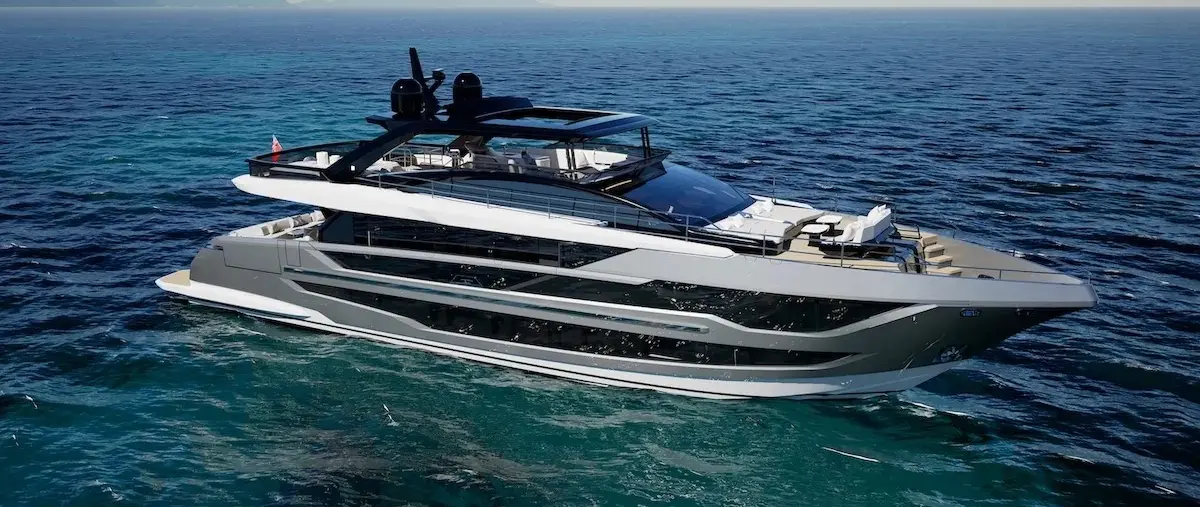
Pearl Yachts is bringing its new Pearl 100 Hybrid to the 2026 Fort Lauderdale International Boat Show, where the builder plans a world premiere for its largest yacht yet. At approximately 29.43 metres, the raised-pilothouse motor yacht introduces hybrid propulsion to the Pearl fleet and expands the brand beyond its familiar smaller models. Its arrival at the show follows initial sea trials, but independent measurements of the complete vessel's efficiency have not been published with the available promotional specifications.
The yacht combines an exterior and naval-architecture programme from Dixon Yacht Design with an interior developed by Kelly Hoppen. The project seeks to make a compact superyacht feel residential without losing the practicality of a serious cruising platform. Five guest cabins, a private owner's terrace and a substantial flybridge are among the features intended to distinguish it from a conventional open-deck motor yacht.
For buyers, the important development is not simply a larger model. Hybrid propulsion creates new possibilities for managing sound and power demand in harbour, at anchor and under way. It also adds control, storage and service considerations that should be understood before interpreting the term as a guarantee of lower fuel consumption in every operating condition.
How the hybrid propulsion system is arranged
The Pearl 100 Hybrid uses an e-Motion arrangement with twin MAN V12 diesels rated at 2,000 horsepower each, paired with electric motors in a twin-shaft drivetrain. The system offers several operating modes, including electric movement at low speeds and diesel propulsion for conventional passages. The electric machinery and control software are intended to allow owners and captains to choose a suitable mode for different parts of a voyage.
An associated power pack is also designed to support the onboard hotel loads without continuously running generators. This can be particularly appealing during quiet evenings at anchor, when guest comfort is affected by vibration and machinery noise as much as by the external environment. The actual duration of silent operation will depend on the available stored energy and how much power is demanded by air conditioning, cooking and other equipment.
Yacht owners considering hybrid systems should ask for specific performance data rather than relying on a broad environmental claim. Electric cruising range, charging strategy, battery capacity, operating temperature and service requirements are important questions. A system may offer significant benefits in one operating pattern but be less useful in another. The initial trials are an important milestone, not a substitute for a documented cruising profile.
Two principal suites and five-cabin accommodation
The guest layout includes five en-suite cabins. Pearl places a full-beam owner's suite on the main deck, with direct access to a private foredeck terrace, giving the owner a separate outdoor retreat rather than only a larger cabin. A second full-beam suite is situated amidships on the lower deck, while other accommodation includes a forward double and two twin cabins. This is intended to give families and groups considerable flexibility over who occupies which level.
Two substantial suites can be especially useful when a yacht regularly carries multiple generations of one family. They allow guests different degrees of independence without forcing everyone to share the same prime accommodation. Nevertheless, the practical experience depends on the details of circulation, sound insulation and crew access. These are matters for an onboard inspection rather than conclusions drawn from deck plans alone.
Separate crew accommodation is planned for approximately four or five personnel, depending on the arrangement. A yacht of this size still requires careful operational organisation, particularly when the owner expects extended passages and a demanding level of hospitality. Crew space, storage and service corridors influence guest comfort indirectly, making them just as important as the scale of the principal suites.
Dixon and Hoppen's design priorities
Dixon Yacht Design has shaped the exterior profile and overall layout, using a raised pilothouse to balance the bridge's practical needs with accommodation and outdoor living. Fold-out wings extend the aft deck towards the sea, while a connection between the extended flybridge and foredeck creates additional circulation. This arrangement offers more than an attractive silhouette: it affects how guests move between private and social spaces during a day afloat.
Kelly Hoppen's new Monochrome interior scheme is being introduced with the flagship, alongside other décor choices in Pearl's existing design range. The approach allows buyers to select an interior identity without necessarily embarking on a fully bespoke build process. Prospective owners should still establish the scope of changes that are possible and their effect on delivery scheduling, particularly if requesting modifications to storage or the use of a cabin.
Pearl's ambition is to offer a degree of semi-custom flexibility within a defined platform, combining well-known designers and a practical production programme. Owners should compare the actual fit and finish of the debut yacht with the design material and ask how optional equipment is accommodated. The best design solution is not necessarily the one with the longest list of extras, but the one that suits how the yacht will be used.
What the Fort Lauderdale debut should reveal
The Pearl 100 Hybrid is planned to be presented during the Fort Lauderdale show from 28 October through 1 November 2026, with the main launch event identified for 30 October. The show gives prospective buyers an opportunity to examine the first completed vessel and ask the builder about commissioning, support and operating modes. Technical questions that seem abstract in an early announcement can become easier to assess when equipment spaces are visible on board.
The new model sits at the upper end of Pearl's range and will be compared with both other compact superyachts and larger production motor yachts. Its key distinction is the combination of five guest cabins and integrated hybrid power within a roughly thirty-metre length. Buyers should compare available guest space, crew requirements, machinery access and operating costs instead of treating overall length as the only relevant measure.
The first Pearl 100 Hybrid therefore represents a meaningful expansion of the British builder's technical and design ambitions. The decisive evidence will come from confirmed performance and the experience of operating the yacht after delivery, rather than from the world-debut presentation alone. For now, the official layout and propulsion description provide a substantial starting point for owners exploring quieter and more flexible motor-yacht operations.