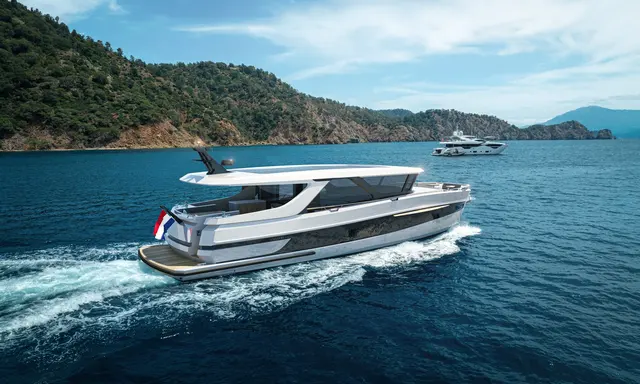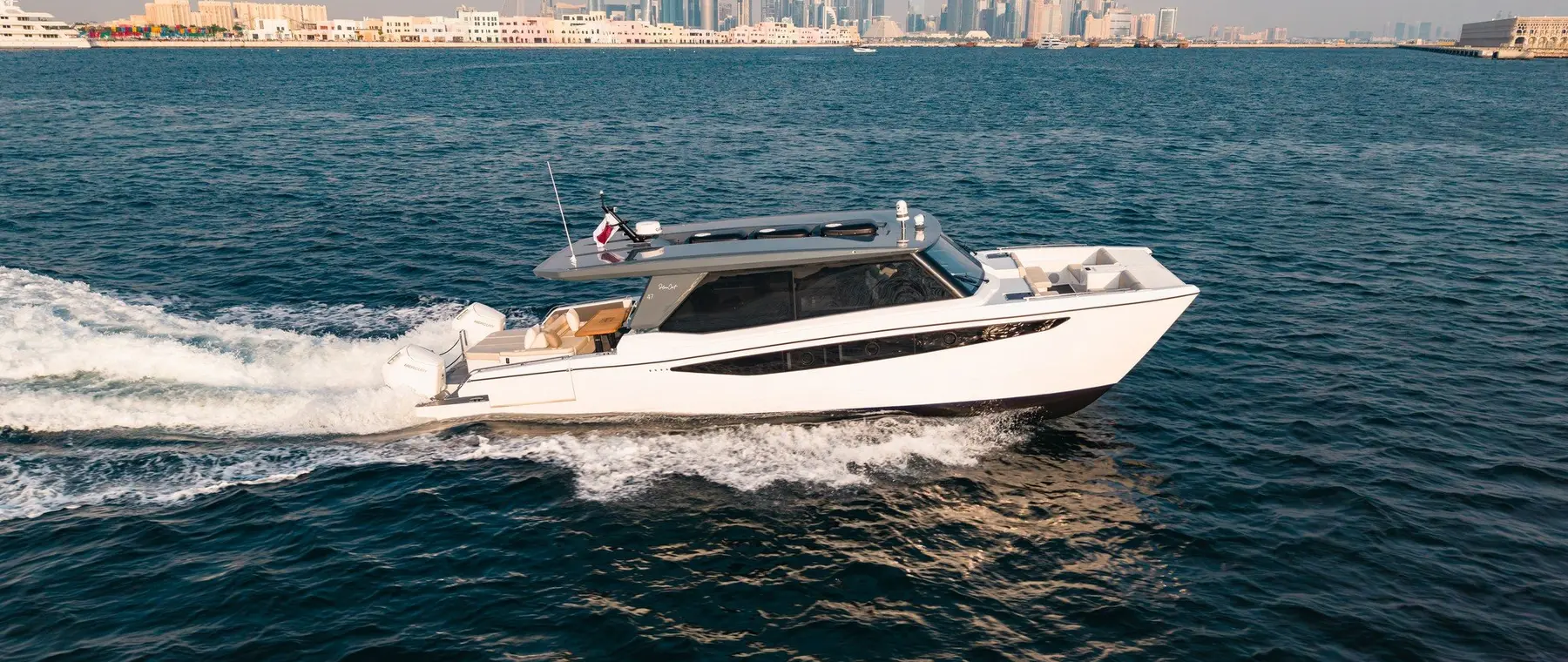
SilverCat's new 47 Family power catamaran enters its official launch window at the Dubai International Boat Show, which runs from 25 to 29 November 2026. Gulf Craft Group, the UAE manufacturer behind SilverCat, identified the Family and Offshore versions of the 47 as previews at the earlier Qatar event and said their official launches would follow in Dubai. The Family model is specifically aimed at longer periods aboard, with two cabins, broad indoor and outdoor social areas and a more substantial beam-to-length ratio than the brand's smaller craft. SilverCat's own published specifications describe a 14.32-metre twin-hull vessel with a 4.92-metre beam and a 2,270-litre fuel capacity, but do not yet offer final cruise fuel-consumption figures. That combination makes the current event an important opportunity to examine how the builder intends to turn the power catamaran format into a more comfortable small luxury yacht.
What the Dubai timing confirms
The sequence of events matters. At the Qatar International Boat Show in early November, Gulf Craft's official announcement described the SilverCat 47 Family and 47 Offshore as previews ahead of their planned launches at Dubai International Boat Show. The group then confirmed its presence at Dubai Harbour from 25 to 29 November, with Gulf Craft Pavilion Stand MD-01 covering its yacht, cruiser and power-catamaran brands. This does not mean the Family 47 was first conceived or first shown in Dubai; SilverCat had already introduced its second-generation concept in August. What is current is the official launch milestone, when owners and the industry can expect to inspect the production-focused presentation more closely. The builder's website should be used to distinguish confirmed published specifications from values still marked as subject to change. It would be inaccurate to treat an advertised model debut as proof that final production sea-trial figures are already available.
The hull dimensions and the living-space equation
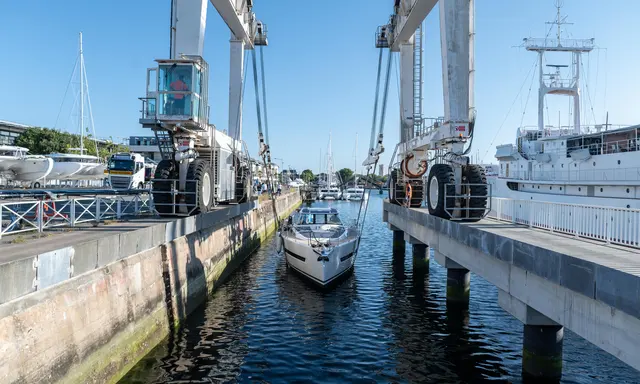
A 14.32-metre overall length and 4.92-metre beam give the Family 47 a notably different footprint from many conventional monohull yachts of comparable length. The benefit is the potential for lateral living space, outdoor entertaining and more separation between functional zones. SilverCat describes its new range as adopting a wider beam-to-length ratio to support comfort and stability. But beam is not a free advantage: it can narrow the choice of marina berths, affect lift-out arrangements and require careful dockside handling. Buyers should view the vessel from both the dock and the water, assess how people reach the side decks and consider whether a family can move comfortably around the boat while lines are being handled. The dimensions create opportunities for design, while the quality of circulation determines whether those opportunities become practical benefits.
Two cabins and a stronger family focus
The manufacturer's Family Series page emphasises two cabins and extended time aboard rather than a purely open, day-cruising layout. That changes the questions a prospective owner should ask. Where are bags stored when the yacht is occupied for a week? Is there practical separation between sleeping spaces and the social areas used by guests? How does ventilation reach each compartment, and what happens when all cabins are closed during high temperatures? SilverCat promotes panoramic glazing, open-plan areas and upgraded interior finishes, but a sensible buyer should inspect the exact arrangement available for the intended build. Cabin count is only one indicator of comfort; berth dimensions, privacy, sanitation, galley arrangements, access to machinery and storage capacity are equally important. A family yacht should make routine daily activities easier rather than requiring constant rearrangement.
The cockpit and the connection to the sea
SilverCat's earlier second-generation design announcement highlighted the unusually generous aft entertainment space, with optional fold-down balconies and an automatic swim ladder developed in-house. Those features are particularly relevant in the Gulf, where much of a cruising day may be spent swimming, entertaining and moving between yacht and water. Owners should examine how the seating is arranged when the side platforms are open and whether practical access remains for dock lines, fenders and boarding. A movable balcony introduces seals, actuators, control systems and safety interlocks that warrant inspection and routine servicing. The swim ladder should be evaluated for wet-footed use, operation from the water and emergency access. The builder's promotional description suggests a close relationship to the sea, but the owner needs to establish the conditions under which each feature can be used safely.
Power and fuel figures need careful interpretation
The published Family 47 technical table states a maximum of 1,200 horsepower in a twin-outboard arrangement of two 600-horsepower engines. It also lists 2,270 litres of fuel and a draft to the propellers of about 0.57 metres. Those are useful reference figures for evaluating the design, but the same official table marks cruising fuel consumption as to be confirmed. It also says final weight, excluding engines, remains to be confirmed. As a result, claims of a particular range or operating cost would be premature without further builder data. A 2,270-litre fuel tank cannot by itself tell an owner how far the boat can travel in conditions that require a prudent reserve. Speed, load, sea state, fouling and propulsion selection all affect consumption. A meaningful sea trial should record these conditions instead of treating a brochure's maximum power as a normal operating point.
Stability and behaviour deserve sea-trial evidence
The builder argues that the second-generation beam increases inherent stability and seaworthiness. Twin-hull craft can have appealing characteristics at rest and underway, but the experience depends on hull shape, weight distribution, sea state and speed. Owners should ask for documented sea-trial conditions that cover short waves, head seas and quartering seas, not simply a calm-water demonstration. The handling of a wide power catamaran in a marina can also differ from the behaviour of a long, narrow monohull. The placement and response of two outboards may help with slow-speed control, yet visibility and windage still need consideration. Crew should evaluate the side decks, working positions and line arrangements with safety in mind. The relevant question is not whether a catamaran is categorically more stable than every monohull, but how this actual yacht performs under defined conditions.
Materials and environmental positioning
SilverCat says the 47 incorporates recycled PET foam-core materials made from recycled plastic, part of its broader effort to lower the manufacturing impact of some composite components. That claim concerns construction materials and should not automatically be converted into a figure for whole-vessel carbon emissions or operational fuel savings. Buyers interested in environmental performance should request technical documentation explaining which structures contain the material, the engineering approval process, repair methods and how the builder evaluates strength and durability. It is also reasonable to ask whether the new material changes the approach to damage detection and repairs during the yacht's life. A premium power catamaran can incorporate improved materials and still require substantial fuel and maintenance. Comparing the full vessel's impact demands a consistent method that includes construction, use and eventual disposal.
Year-round use places demands on climate control
A yacht designed for family comfort in warm regions must manage internal heat, particularly with extensive glazing. SilverCat's announcement refers to a tropical HVAC package, an important feature when the yacht will be used in the Emirates or other high-temperature locations. Prospective owners should investigate installed cooling capacity, distribution between cabins and saloon, generator requirements, condensation management and the availability of replacement parts. They should ask whether the system can maintain comfortable temperatures after the vessel has been sitting closed in the sun. Exterior shading, ventilation and insulation should be examined alongside machinery, not as separate styling details. Comfort is also affected by how much noise the climate-control system produces at night. A genuine overnight trial, where available, may reveal far more than a brief afternoon viewing.
Who is the Family 47 intended to serve?
The Family version's strongest claim is that it provides meaningful accommodation and social life aboard rather than maximising open working deck space. It may suit owners who take children or guests on longer coastal trips, enjoy meals and swimming at anchor and prefer the predictable layout of a twin-hull platform. That does not mean it is automatically preferable to the separate Offshore 47, which is being marketed toward a different activity profile. A serious buyer should write down the typical number of people aboard, days between marina stops, distances travelled, overnight requirements and the nature of the home berth. It may prove that a smaller boat better suits one owner, while another places exceptional value on the Family's width and accommodation. The correct choice depends on intended use, not on a model's nominal size or newest styling.
Delivery and support questions for a new generation
Because the Family 47 is at a launch milestone, particular care is needed when discussing build slots and warranties. Buyers should request a dated technical specification showing the final production hull's construction, propulsion, electrical architecture and approved loading. Identify who will commission the boat, where any applicable sea trial will occur and what forms part of the handover acceptance process. Ask how the optional balconies and automatic swim ladder are inspected and serviced, and whether the required technicians are available in the intended cruising region. Gulf Craft's wider dealer and service networks can be valuable, but responsibility must be documented for the specific hull. New-generation features often make strong first impressions; the quality of spare-parts planning and accessible support determines whether they remain satisfying after several seasons.
What to inspect at Dubai Harbour
The official event setting provides an opportunity to compare the Family 47 with the Offshore interpretation of the same emerging platform. Visitors should prioritise the actual interior, aft deck, access to the water, helm position and service spaces. Measure the usable width of working passages and view the cockpit both with normal seating and any optional platforms deployed. Ask whether the displayed vessel reflects the final production specification and which technical values remain provisional. Obtain the price and delivery conditions for the intended propulsion, accommodation and equipment choices. Do not extrapolate a guaranteed range from capacity figures that the manufacturer has not accompanied with confirmed consumption. The Dubai launch is significant because it moves the project from earlier previews toward an official show presentation, with the evidence needed to assess it properly beginning to accumulate.
A distinct proposition in the 14-metre market
SilverCat's 47 Family brings a wide twin-hull arrangement, two-cabin accommodation and enhanced outdoor living into a length often associated with more compact monohull cruisers. Its arrival in Dubai is not simply a continuation of the original concept announcement: the manufacturer has identified this show as the official launch point after November previews in Qatar. There is a clear buyer proposition, but also outstanding questions on weight, cruise consumption and final specifications. Owners should welcome the chance to inspect the actual craft while treating performance and delivery promises with appropriate care. The most persuasive evidence will be a finished boat, reliable technical data and a transparent support commitment from the builder and its representatives.
Sources and image credits
Reporting based on Gulf Craft Group official Dubai Boat Show 2026 dates, pavilion and new SilverCat launches, Gulf Craft Group Qatar 2026 preview and explicit confirmation of later Dubai launches for SilverCat 47 Family and Offshore, SilverCat first-party 47 Family model specifications and image gallery.
Lead photograph: Official SilverCat 47 Family manufacturer-gallery photograph, illustrating the 47 Family design; builder archive image, not verified to be taken during November Dubai show. © SilverCat / Gulf Craft Group and original photographer. Original first-party Family-series image; underlying rights retained. Original official image source.