The connected boat becomes a continuing service
Sentinel Marine Solutions is arguing that a yacht's useful digital life should extend well beyond the day it leaves the builder's yard. In an interview published during the November 2026 METSTRADE period, chief executive Marko Pihlar described the role that connected boats and their operating data can play in a manufacturer's understanding of real-world use. The Slovenian marine-technology company's official boatbuilder programme places that proposition in a wider service framework: remotely accessible vessel information, branded digital services, owner communication and a more continuous relationship between builder and customer. None of this means a yacht can be repaired from a phone or that remote data should replace a competent survey. But the underlying shift is important for the 12-to-24-metre market. At this size, owners often handle much of the practical planning themselves and can benefit from clearer battery information, maintenance reminders and early warnings between visits to the boat.
Why the relationship usually changes after delivery
A new yacht receives intense attention during construction, commissioning and handover. The builder, dealer and equipment suppliers know the specifications, installation details and intended configuration. Months later, the boat may be cruising in another country with different technicians and a new captain. Information can be scattered among folders, service invoices and disconnected equipment displays. A connected ownership system is meant to preserve more of that continuity. Sentinel's website describes manufacturers using a branded app and connected services to communicate with owners after delivery. From the owner's perspective, the benefit is not a corporate customer database; it is faster access to reliable information and more predictable service. The model will only succeed if data ownership, privacy and the boundaries of remote access are explained clearly. Buyers should understand what a builder can see, what can be changed and which permissions remain under the owner's control.
Data can inform a better second-generation yacht
Pihlar's November interview emphasised designing products that can be improved over time using real-life operational insight. A designer may assume that owners run a particular system for a set number of hours or use a cabin in a predictable way. Actual patterns can be different. Appropriately aggregated operational data may help manufacturers learn which features are used, which alarms recur and what maintenance tasks create disproportionate inconvenience. Such findings could influence future layouts, control systems or service programmes. The key word is appropriately. A builder does not need a detailed record of an individual family's movements to understand a pattern in electrical-system demand. Responsible analytics should minimise personally identifying information and make data-sharing choices understandable. An owner should be able to reject optional analytics without losing access to the fundamental equipment and records needed to operate a boat safely.
Remote monitoring and local reality
Sentinel's product range includes marine monitoring hardware and software intended to report relevant boat conditions remotely. Depending on the equipment and sensor interfaces installed, those conditions may include battery voltage, position, alerts and machinery information. Remote visibility is particularly useful when a yacht spends weekdays in a marina between weekend passages. A low battery, unexpected shore-power interruption or changing water-level alert may deserve attention before the owner arrives. The app cannot resolve the underlying fault by itself, and a delayed or missing warning can occur when communications are unavailable. Owners should distinguish between optional convenience notifications and independently required safety systems. A bilge alarm that depends on a third-party mobile connection must not be the sole safeguard aboard a yacht. Proper installation, local testing and periodic inspection remain essential.
Compatibility begins with existing equipment
A common misunderstanding in connected-boating discussions is that fitting a single monitoring device automatically unlocks every available feature. Sentinel's published configurations show different levels of inputs, network connectivity and remote-control capability. What the system can actually read depends on the boat's sensors, engine interfaces and existing electronics. Many yachts use NMEA 2000 for selected instrument and machinery data, while other functions may remain on proprietary control networks. Compatibility should be established device by device rather than assumed from a shared communication standard. A prospective owner can ask an installer for a written schedule of data fields, alarm conditions and remote-control functions that will work on the particular hull. This is more useful than a demonstration app filled with sample values. Each promised alert should be tested during commissioning, with the owner shown where the sensor is installed and what to do when it reports an abnormal condition.
A digital maintenance log needs discipline
Electronic service histories can reduce the risk that important maintenance tasks are forgotten after a change of owner or crew. They may also help contractors understand what was replaced, when work was completed and what further action was recommended. But the usefulness of a digital log depends entirely on the information entered. A short entry saying that an engine was serviced gives less evidence than a record identifying the model, engine hours, parts, fluids and technician. A connected system can remind the crew of an interval, but it should not claim to have verified that the job was properly performed unless supporting evidence exists. Owners should be able to export their records in a durable format, including attachments and dates, without relying indefinitely on one company's app. A yacht's service history is a long-term asset. It should survive software redesigns, changes in subscriptions and eventual resale.
Where the builder gains an advantage
For a production yacht manufacturer, connected ownership creates opportunities to learn whether particular systems generate repeated support requests or whether an operating manual is confusing. It may also make it easier to identify boats affected by a service bulletin and provide tailored instructions through the original sales network. That could reduce unnecessary travel and improve satisfaction, especially if the owner is cruising away from the shipyard. Yet there is a boundary between useful service and intrusive marketing. Communication should be relevant, optional where appropriate and easy to control. Owners should know if technical data are shared with dealers or subcontractors and whether those third parties have continuing access after maintenance ends. A strong connected-boat programme gives the customer a clearer service relationship, not an open-ended surveillance arrangement.
The effect on charter and multi-boat operations
Fleet operators already have an obvious incentive to monitor usage, location and maintenance across several boats. A charter company may need to know when a vessel is available, when its batteries require attention or how its scheduled service relates to expected bookings. Connected data can support those decisions if the underlying information is reliable and the system is integrated thoughtfully. Private owners who lend a yacht to family members or engage different skippers may face smaller versions of the same problems. A shared app can give authorised people consistent information, while role-based access can prevent a temporary operator from receiving permanent control over the boat. Permissions deserve particular attention in a charter context. Clients should not gain access to sensitive owner information, and former employees should lose access promptly. The technology is useful only where access management is treated as a normal operational responsibility.
Networks at sea are imperfect
A marina berth with strong cellular coverage is an easy place to demonstrate remote monitoring. A yacht cruising between islands or spending time in a remote anchorage presents a less predictable environment. Many connected products use mobile networks, and both transmission quality and roaming arrangements can vary sharply by country. Owners should understand what information remains available locally when a connection drops and whether data are buffered for later transmission. The monitoring unit's power requirements and ability to survive a loss of shore power are equally important. A notification system that becomes unavailable during the very fault it is supposed to report has limited value. Installers should test offline behaviour, not merely a successful connection on delivery day. They should also explain the recurring costs of connectivity and any subscription features so that the owner can budget for continued use.
Cybersecurity must follow the whole ownership cycle
Remote access to boat systems introduces responsibility for account security, software updates and the controlled transfer of credentials. Even read-only monitoring can expose information that an owner would prefer to keep private, such as travel patterns or periods when the vessel is unattended. Remote control functions carry additional operational considerations. Owners should use strong authentication, review account permissions and learn how to disable remote access if a phone is lost. Builders and equipment suppliers should publish update arrangements and explain what happens when a product reaches the end of its supported life. During a sale, the outgoing owner should be able to transfer the vessel configuration without handing over personal history or unrelated connected accounts. A connected boat should not become unusable because the original purchaser no longer maintains a subscription. Good product design anticipates the complete life of the yacht rather than only its first season.
Privacy, consent and the limits of telemetry
The business case for aggregated vessel data is persuasive, but owners are entitled to distinguish between monitoring required for a purchased feature and optional collection for product development. Collecting position history or detailed usage patterns requires careful treatment, particularly where multiple people use the yacht. A clear service should explain which categories of data are collected, how long they are retained, who receives them and how the owner can exercise relevant controls. That information should be provided in plain language at the point of activation. It should also be possible to identify the information actually available to a builder or technician rather than relying on broad privacy promises. Owners can benefit from improved equipment while maintaining meaningful control over their private movements. The quality of those arrangements may become a significant differentiator as connected monitoring spreads through the yacht market.
What the company has and has not established
Sentinel's official website documents its connected-boat offering, its boatbuilder services, mobile applications and hardware platforms. The November interview with Marko Pihlar provides additional context for the company's view that usage data can help future-proof products. The combination supports a report about a developing business and technical model. It does not establish that all manufacturers have adopted the platform, that connected systems eliminate maintenance costs or that a dashboard can predict every equipment failure. Such claims would require separate independent trials and customer data. Nor should a demonstration of remote access be interpreted as permission to operate safety-critical systems without local supervision. The appropriate message is more measured: improved information, well-managed permissions and dependable service processes have the potential to make ownership simpler, provided that the installation and data governance are sound.
Questions to ask before installation
A useful buyer checklist should begin with the exact features supported on the intended yacht. Ask the supplier to identify every monitored input, the hardware required, recurring fees, available communications networks and offline behaviour. Confirm who is permitted to receive alerts and how permissions are removed. Request a demonstration showing both a normal reading and a deliberately triggered alarm. Ask how the service history is exported, how future owners take control and what technical support is offered in the yacht's home cruising region. If a manufacturer plans to use anonymised fleet data for design development, obtain a clear explanation of that arrangement. These are not reasons to reject connected technology. They are the ordinary questions that separate a trustworthy installation from an attractive but poorly defined app.
A quieter but potentially important change
The most significant part of connected boating may not be the latest mobile screen. It is the possibility that builders, dealers and owners share better verified information over many years, allowing problems to be diagnosed earlier and future products to be designed around real operating needs. Sentinel's approach exemplifies that shift while raising familiar concerns about dependence on networks, subscriptions and customer data. For the owner of a 12-to-24-metre luxury yacht, the sensible approach is to begin with a small number of high-value functions, such as battery and bilge-condition awareness, and expand only when compatibility and operational need justify it. Remote convenience should reinforce, not replace, onboard safety and scheduled service. A genuinely future-ready yacht is one whose technology remains understandable, maintainable and transferable long after the excitement of the initial handover has faded.
Primary reporting and image credit
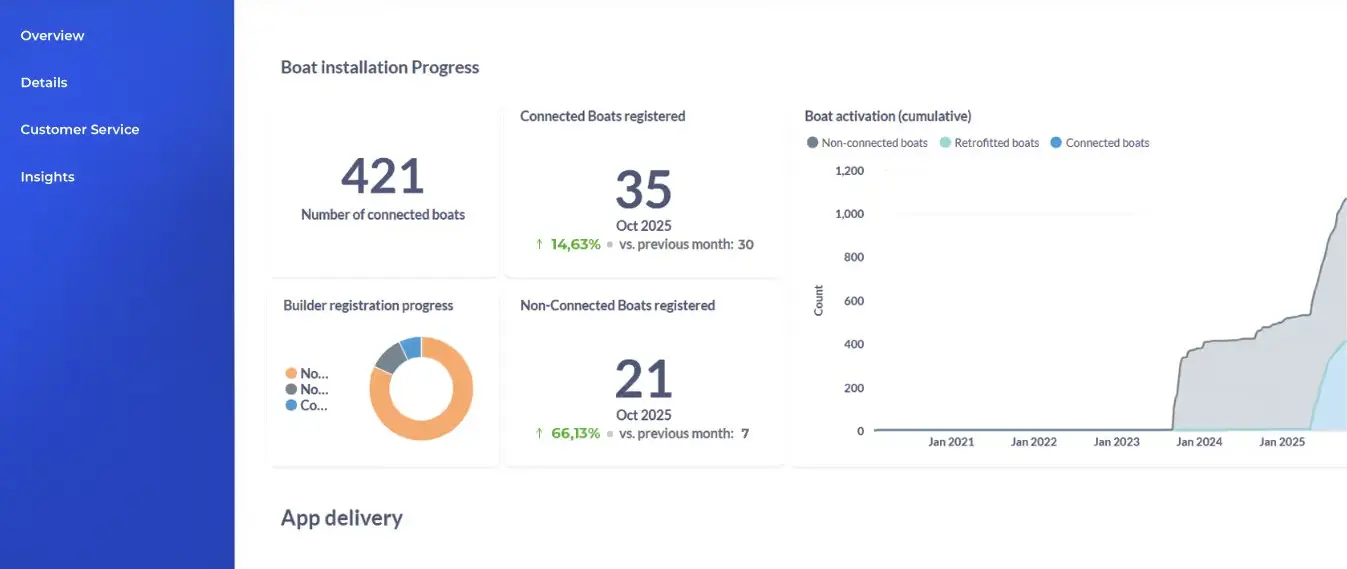
Primary manufacturer and organiser source(s): https://www.sentinelmarine.net/sentinel-2026-bundles/digital-engine-watch; https://www.sentinelmarine.net/boat-builder. © Sentinel Marine Solutions. First-party company marine telematics and mobile application illustration; not a photograph of CEO Marko Pihlar. Image is used only for correctly attributed factual editorial coverage and never represented as open-licence stock photography.