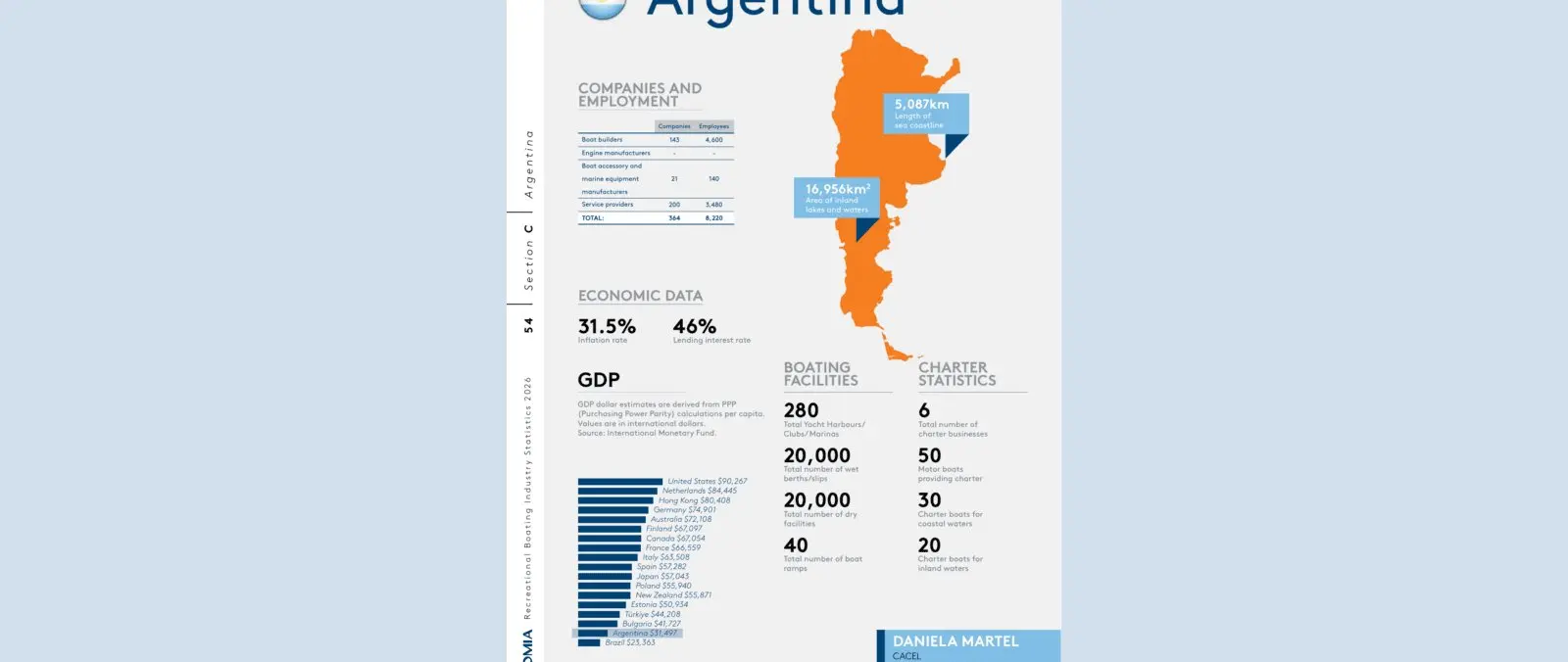
An annual industry reference gains a new measure
The International Council of Marine Industry Associations, known as ICOMIA, released its Recreational Boating Industry Statistics Report 2026 on 13 November, with a notable new addition: data on electric marine engines placed on the European market. The figures are included for the first time in the association's Marine Engine Committee statistics. ICOMIA's announcement describes a reference publication gathering information about national markets, boat production, trade, engines, equipment and other parts of recreational boating. It also identifies Boats Group as a returning strategic partner bringing insight into the important second-hand and brokerage market. These developments matter to builders and suppliers, but they are also relevant to owners of luxury yachts between 12 and 24 metres. A clearer understanding of market structure can influence the availability of equipment, service support, future models and the ease with which a yacht may eventually be resold.
Why electric engine data have become important
Electric propulsion has attracted substantial attention at international boat shows, yet individual product launches are a poor substitute for understanding how many engines are actually being placed on a market. A manufacturer may demonstrate an impressive new motor without achieving substantial sales or distribution coverage. Conversely, numerous smaller units installed in dayboats, tenders and local fleets may shape the market more deeply than one prominent project. ICOMIA says its Marine Engine Committee has expanded the annual statistical coverage to include electric engines on the European market, creating an additional basis for comparisons over time. The announcement does not disclose a headline total for these engines or their share of installations, and it would be misleading to infer either from the fact that the category has been added. Meaningful analysis requires the definitions, geography and time period used in the underlying report, ideally compared with the same categories in future editions.
Understanding what the dataset can show
The distinction between engines shipped, engines registered and engines installed on operating boats is not merely technical. Each measure can lead to a different interpretation of demand. Stock ordered by a distributor may remain in a warehouse, while an installed engine can replace existing propulsion rather than accompany a new boat. Electric motors also vary considerably in power and purpose. A small tender outboard, an auxiliary system for a sailing yacht and a propulsion package for a larger motor cruiser are not directly interchangeable. Readers reviewing the ICOMIA data should establish which technologies and sizes are captured, whether replacement sales are distinguished and how national industry associations collect and reconcile submissions. The announcement states that the new category provides evidence for manufacturers and policy analysts; it does not establish that every subcategory can be compared on an identical basis. Responsible market analysis begins by reading the methodology rather than extracting a single impressive number.
What the results could mean for yacht equipment support
A buyer considering electric or hybrid propulsion may be concerned less with national sales totals than with whether the equipment can be maintained on a long cruising itinerary. Still, market statistics provide indirect evidence about how mature distribution and servicing may become. A growing installed base can encourage more technicians to train on suitable systems, more dealers to keep spares and marinas to consider charging facilities. It is important not to reverse that logic. Even a widely adopted technology may lack strong support in a particular harbour, while a specialist product can be well supported through a dedicated manufacturer network. Owners should use market information as background and then ask precise questions about the installation under consideration. Which workshop can diagnose the motor? How long are replacement power electronics available? What charging arrangements are required? Official sales data can inform those decisions but cannot replace local service checks.
A worldwide view instead of isolated national headlines
ICOMIA represents marine industry associations across multiple markets, allowing its annual reference to consolidate figures that would otherwise be published using different national conventions. The 2026 edition covers production, imports, exports, vessel types, engines and equipment, according to the association's release. This wider view helps separate changes in local demand from shifting international supply patterns. A factory may be building more boats for export even when its domestic market is weak; a dealership can be busy selling used craft while orders for new boats remain subdued. These are different dynamics, and the owners of premium cruisers experience them through price, availability and lead times. A global report is most valuable when the reader understands which national statistics can be compared, how currencies and categories are treated and where data are incomplete. It is a framework for better questions rather than a universal prediction of next year's sales.
Brokerage deserves its own attention
A distinctive feature of the 2026 announcement is the return of Boats Group as a strategic partner, reflecting recognition of the used-boat market as a major contributor to the recreational marine economy. Boatbuilding headlines often focus on new launches, but a substantial number of owners enter or move within the market through brokerage. A pre-owned yacht may offer a different mix of equipment and value from a new model, and its sale generates work for surveyors, repair yards, insurers, marinas and service providers. The brokerage market also influences how easily an existing owner can move to another vessel. Data on used listings and transactions require careful interpretation, however. Asking prices are not achieved sale prices, and an advertised inventory count may include duplicate or stale listings. Buyers should establish exactly which measure a report uses before treating it as a definitive price index. The association's recognition of brokerage is important, but it does not remove these methodological limits.
What a national report can contribute
ICOMIA says that several member associations have contributed expanded national market reports in addition to the main statistical tables. Such material is useful because boating conditions vary dramatically between countries with similar economic output. Geography, marina capacity, local regulation, climate, tourism patterns and boating traditions all influence the types of craft purchased and used. A market with extensive inland waterways may favour different boats from one dominated by offshore cruising. The announcement points to a separate Korea Makes Waves collaboration associated with the Korea International Boat Show, illustrating the interest in explaining national market development rather than simply reporting headline volume. For an owner contemplating a new home port or a manufacturer considering expansion, local insight can help identify where infrastructure and specialist services may be available. It should always be supplemented by up-to-date berth availability and the specific regulatory position of the yacht concerned.
Separating the private-yacht sector from the wider industry
Not all recreational boats are luxury motor yachts. The global data encompass different vessel classes and operating patterns, including smaller powerboats, sailing craft and other leisure categories. This breadth is a strength for researchers, but it can make conclusions about the 12-to-24-metre segment difficult if categories are combined too broadly. An increase in small outboard sales cannot automatically be taken as evidence of growth in premium cruising yachts. Similarly, an increase in electric tender motors does not prove that larger private yachts are ready to abandon combustion propulsion. Readers should look for data segmented by vessel type, engine power or other relevant characteristics where the report provides them. If the publication does not supply a particular breakout, the correct conclusion is that the available public information is insufficient for a precise claim. Presenting that limitation openly helps avoid creating a misleading picture of yacht demand or technology adoption.
Why reliable figures matter to boatbuilders
Manufacturers invest substantial resources before a new yacht model reaches customers. Engineering, tooling, compliance, interior design, dealer training and marketing all involve costs that may be difficult to recover if demand has been misjudged. Reliable historical data do not guarantee the future, but they help builders assess the scale of markets and the balance between segments. A company deciding whether to offer an electric propulsion option, for example, might examine the size and distribution of the relevant engine market alongside technical feasibility and infrastructure. An equipment maker considering a new production line needs a similar view of likely demand and service obligations. ICOMIA's annual reference is designed to support those decisions through a combination of national statistics and industry input. Its usefulness depends on transparent definitions and readers understanding the age of the data rather than assuming every chart represents current market conditions.
The role of the Marine Engine Committee
The ICOMIA Marine Engine Committee contributes specialist engine-market statistics, and its addition of European electric engine data is arguably the most technically significant change announced for the 2026 edition. Engine counts can help the industry understand the pace of change, but they should not be equated directly with emissions reductions or energy efficiency. The environmental outcome of an installation depends on power demand, duty cycle, electricity source, maintenance and replacement decisions. A hybrid yacht that spends most of its time running diesel generators may have a very different impact from an electric harbour launch charged from a low-carbon grid. Conversely, conventional propulsion may remain appropriate where range, infrastructure and reliability requirements cannot yet be met by an alternative. Better data allow the discussion to become more evidence-based, not simpler. Owners should welcome improved measurement without interpreting it as a mandate to choose one particular technology.
Trade policy and the cost of new equipment
In the official release, ICOMIA chief executive Joe Lynch pointed to shifting trade policy, an uneven economic outlook and the continuing energy transition as reasons why reliable industry intelligence is valuable. Those pressures can influence the yacht market even when the boat itself is manufactured nearby. Engines, batteries, electronics, upholstery, fittings and specialist materials may cross borders several times before final installation. Changes in tariffs, currency values or logistics can therefore affect costs and delivery schedules. Owners planning a refit should ask which components have predictable supply and which carry risks of long lead times. Used-yacht buyers should factor in the cost of obtaining genuine replacement equipment, particularly on older designs. A statistics report can help companies understand trade patterns at a high level, but it cannot predict the price or availability of a specific part at a specific marina. Practical ownership decisions still require current supplier quotations.
The report is a professional resource, not a free numerical summary
The ICOMIA announcement confirms that the 2026 statistics report is available through the association, but its full data product is a professional publication rather than a public release of every table. The association has published an overview of coverage and some sample material, while the complete dataset is sold through its website with arrangements for eligible members. This distinction is important for editorial accuracy. Luxury Yacht Guide can report that a new electric-engine category has been included and identify the contributing organisations, but it cannot legitimately invent totals, percentage changes or country rankings from a short promotional summary. Businesses that need exact figures should obtain the report and check its statistical definitions before making investment decisions. Owners can benefit from the broader conclusions drawn by credible industry specialists, but should also distinguish verified data from commentary based on assumptions or anecdote.
How to read a changing market without overreacting
Boating markets can be volatile from year to year. Interest rates, travel patterns, weather, second-hand supply and consumer confidence influence purchasing decisions, often in different ways across countries. A single annual report is therefore a snapshot within a longer sequence. The strongest conclusions come from comparable data over multiple years, with clear explanations for changes in coverage or classification. The new European electric engine category is especially likely to require caution in its first edition, because there may not yet be a directly comparable historical series. Over time, consistent collection could allow more meaningful trend analysis. For yacht owners, the temptation is to treat industry reports as forecasts of resale values or of which propulsion system will become dominant. The more defensible approach is to use them to identify possible changes, then examine the individual yacht's condition, specification and market before making a decision.
The importance of independent and collaborative input
The 2026 release thanks contributors including ICOMIA members, the Marine Engine Committee, Boats Group, The Superyacht Group, the International Federation of Boat Show Organisers, IBI, Liquid Scope and the association's own trade and market intelligence specialists. Such collaboration can widen the scope of available information, but different data providers can have different definitions and commercial interests. A responsible reader should consider where figures originate and whether a data series describes a full national market or a particular contributing platform. ICOMIA's aggregation may make that information substantially more useful, provided the limitations are communicated. A brokerage listing platform, for instance, cannot necessarily describe transactions conducted privately outside its network. An association survey may capture most major manufacturers but miss very small builders. These are normal statistical issues, and careful analysts treat them as questions to document rather than reasons to abandon industry data altogether.
The practical value for luxury yacht owners
A 12-to-24-metre yacht owner is unlikely to purchase an expensive international statistics book solely to decide what oil to carry or where to berth next season. Nonetheless, the developments described in the report can affect those everyday choices. Better data on electric engines may inform investment in shore infrastructure and servicing, while a more complete understanding of brokerage can contribute to realistic expectations in the second-hand market. National reports may help manufacturers support owners in developing boating destinations, and trade data can shape spare-parts availability. The immediate lesson is to ask which market claims are based on measured figures, which represent a supplier's projections and which are merely anecdotal. When considering a new yacht, a propulsion change or a refit, the owner should continue to prioritise suitability, verified performance and service support over broad industry trends.
An improved starting point for informed decisions
The addition of European electric marine engine data to ICOMIA's Recreational Boating Industry Statistics Report 2026 is a meaningful improvement in the information available to the recreational marine sector. Alongside its national coverage and renewed brokerage partnership, it offers a more rounded account of the forces shaping new and existing boat ownership. The association has established the new dataset and described its intended use; the public announcement does not supply all the underlying numerical results. That boundary should remain clear in any discussion of market size or the pace of electrification. For boatbuilders, the publication provides another reference for product planning. For suppliers, it may help guide distribution and investment. For yacht owners, its value is less direct but still important: decisions become better when the industry measures real activity instead of relying solely on high-profile announcements. The report is a reminder that sound yachting choices require both up-to-date technical information and an accurate picture of the market in which the vessel will operate.
Primary reporting and image credit
Primary manufacturer and organiser source(s): https://www.icomia.org/news/icomia-recreational-boating-industry-stats-26/. © ICOMIA. Public 2026 report sample page for Argentina, an original publisher-issued image on an editorial light-blue matte. This is a sample country page, not a chart of European electric engine volumes. Image is used only for correctly attributed factual editorial coverage and never represented as open-licence stock photography.