A shift from one-off superyachts toward repeatable production
Rolls-Royce Power Systems is examining opportunities to extend its integrated yacht technology beyond the largest custom superyachts, according to comments by Christian Paolini, managing director and head of sales at Team Italia Marine, recorded at METSTRADE 2026 and published on 25 November. The emphasis is on packaging navigation, automation, monitoring, engines and propulsion as a coordinated solution that can be specified by production boatbuilders. Paolini described growing attention to yachts in the 30-to-40-metre category, where repeated production can make sophisticated integration more commercially practical. That is still larger than the core 12-to-24-metre readership of Luxury Yacht Guide, and the company has not announced universal availability for smaller craft. The importance of the development lies in the direction of travel: technologies once associated with substantial custom bridges are being designed around scalable architectures and repeatable production, potentially influencing how smaller premium yachts are equipped over time.
The products behind the strategy
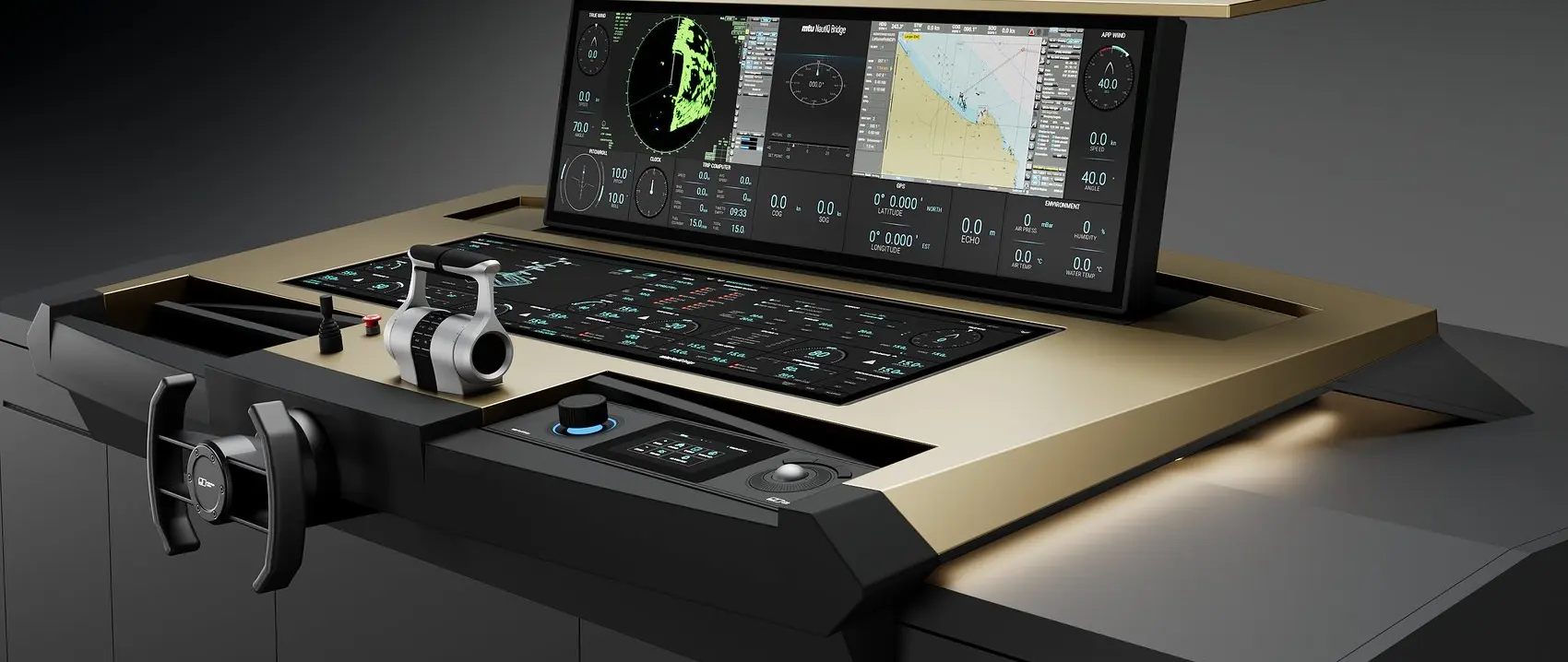
The Rolls-Royce marine technology portfolio includes mtu engines, the mtu NautIQ Bridge architecture and the mtu NautIQ Master Essential monitoring and control system. NautIQ Bridge brings navigation, vessel monitoring and relevant controls into a more unified operating environment; Master Essential addresses alarms and essential onboard functions. The goal is to reduce the number of isolated subsystems that a captain must supervise and to give boatbuilders an organised approach to interfaces. It is important not to confuse a connected user interface with direct control of every item of equipment or to assume that a single display can replace all independent safety systems. Bridge design involves both the presentation of information and a careful allocation of responsibilities. A well-integrated helm should help operators prioritise tasks, interpret alarms and work comfortably, while preserving redundancy and predictable controls when any one network element fails.
Why series-built yachts change the economics
A unique superyacht can carry extensive bespoke engineering, integration work and owner-specific customisation. Those services are labour intensive and are often justified by a substantial overall build budget. A series-built yacht has a different commercial structure. The designer and shipyard typically establish a platform configuration that is then repeated across multiple hulls, allowing installation procedures, documentation and component supply to become more predictable. Paolini explained that a repeatable specification can improve business scale even where the price of an individual installation is lower. That does not make sophisticated electronics inexpensive by default; engineering, certification and long-term support remain significant costs. It does, however, help explain why suppliers are adapting products originally associated with very large yachts for more regular production. Owners may ultimately benefit from clearer specification choices and better-documented interfaces rather than a complete bespoke bridge requiring intensive custom work every time.
Integration begins before the yacht is built
One of the practical difficulties in connecting propulsion and bridge systems is that shipyards often make major decisions at different stages of construction. Engines and shafts may be specified early, while navigation displays, alarms and operator interfaces are refined much later. The teams responsible may be distinct, and each may work with different suppliers. Paolini described that coordination challenge in his METSTRADE interview. A series-built platform allows a shipyard to decide more of the complete package at an early stage, so the interfaces can be planned together rather than joined only when the vessel is close to delivery. This principle matters on a 20-metre yacht as much as on a 60-metre one, even though the actual systems differ. Owners ordering a new boat should ask which interfaces the builder has already validated, which remain optional and whether adding a later component will alter important safety-critical or warranty-covered functions.
A future-ready bridge needs a real upgrade path
Paolini argued that an integrated bridge could make it easier to add new functions after delivery without rebuilding the wheelhouse. That is an attractive proposition for owners who keep a yacht long enough to see several generations of navigation and communications equipment. But future readiness should be understood as a documented upgrade architecture, not a promise that every future technology will fit an existing installation. Hardware processing capacity, software licensing, data formats and cybersecurity requirements can all change. A prospective buyer should ask for written support policies, compatible interface standards and details of the upgrade process. Can a chart display be replaced independently? What happens if the operating system needs a security update? Are archived configurations and wiring diagrams available to future owners? Clear answers will matter more than a broad assurance that a system is advanced. The bridge that ages well is the one built around serviceable interfaces and trustworthy documentation.
The case for fewer isolated displays
Traditional helm stations can accumulate independent screens for engines, navigation, stabilisers, electrical systems and alarms. Each may work well in isolation but demand separate attention from the operator. A coordinated bridge aims to bring useful information into a structured interface so that related conditions are easier to understand. That can reduce unnecessary switching between menus and help present important warnings in context. Yet consolidation also creates design responsibilities. Overloading a central display can make urgent information harder to find, while hiding critical controls behind software menus can make them less intuitive during a fault. The operator should retain a coherent mental picture of what the systems are doing. Buyers considering integrated helms should test typical tasks rather than judging a dashboard from a static screenshot. Start-up, departure, anchoring, docking and an alarm during a passage each reveal different weaknesses in interface design.
Engines, propulsion and automation under one service umbrella
Rolls-Royce is positioning its offering as a bridge-to-propeller package supported by its international service arrangements. The concept appeals to builders and owners who would prefer fewer disputes between equipment suppliers when a fault appears to involve more than one subsystem. If an engine value is not displaying correctly at the helm, for example, the problem may arise from a sensor, a network gateway, software configuration or a display. Clearly assigned responsibility can make diagnosis faster. But a single supplier relationship does not remove the need for qualified local technicians or access to appropriate spare parts. Owners should determine which parts of the system are covered by each service agreement, whether third-party navigation components remain independently supported and how remote diagnosis is authorised. Practical service availability at the yacht's cruising destinations can be more significant than the number of brand names on the specification sheet.
The 30-to-40-metre focus and the smaller-yacht question
The company's current emphasis, as described in the November interview, is on higher-volume production yachts around 30 to 40 metres and on additional geographical markets. That is a meaningful move down from very large custom yachts, but it should not be reported as a confirmed release for 15-metre or 20-metre boats. Smaller owners face a sharper constraint on installation space, electrical loads and cost. Some of the advantages of integrated monitoring may nevertheless migrate into smaller systems, whether through Rolls-Royce products or competitors. The sensible editorial question is which functions actually justify the additional complexity at a given length. An owner of a 17-metre cruiser may value dependable engine data, clear alarms and easy chart integration far more than extensive automation designed for a yacht with multiple dedicated watchkeepers. Scale should influence the system design, not merely its price tag.
International expansion remains a plan in progress
Paolini discussed further opportunities outside the company's existing Italian customer base, citing work and conversations in other European countries as well as interest in Asia and the United States. Such comments describe a business-development direction, not a list of completed contracts. Rolls-Royce has established relationships with major Italian yacht builders, and the company has referenced a number of Turkish projects, but individual negotiations should not be presented as signed orders until formally announced. For owners, the geographical ambition matters because integration is easiest to adopt when a supplier can support the product near the construction yard and throughout the vessel's later use. A system that is relatively straightforward to service in its home market may be harder to maintain across an ocean. A global service claim therefore needs to be tested at the level of actual technician availability, spare-part logistics and local response capability.
Artificial intelligence is an emerging addition, not a replacement skipper
Rolls-Royce has also discussed new artificial-intelligence applications, including tools intended to help captains navigate technical documentation. That is an interesting direction because the paperwork associated with a modern yacht can be extensive: wiring diagrams, operator manuals, maintenance schedules, alarm references and configuration records. A searchable assistant that points users to the right official document could reduce time wasted locating information. It must still be treated as an aid rather than a substitute for verified technical procedures or professional judgement. A software system can misunderstand a question, retrieve an outdated manual or omit an important safety note. Critical tasks should remain governed by current maker instructions and approved operating procedures. Owners should also ask how confidential yacht data are protected and whether the tool relies on an external connection. The value of an AI feature depends on accuracy, traceability and safe failure behaviour, not simply on conversational convenience.
Cybersecurity and controlled access matter more with integration
As onboard systems become interconnected, security design becomes inseparable from convenience. A unified environment may simplify management, but it can also create new pathways between networks that used to be isolated. Owners should understand which systems are connected, where data cross between navigation and non-navigation equipment, and how external maintenance access is approved. The risk is not limited to deliberate intrusion; poorly managed updates and incompatible network changes can disrupt operations as well. A documented commissioning baseline, secure update process and ability to restore known-good configurations are essential. Professional installers should verify that critical functions remain dependable if a network component becomes unavailable. Bridge integration is most credible when the supplier explains boundaries and recovery procedures openly. The larger the range of equipment that a helm interfaces with, the greater the need for disciplined configuration management throughout the yacht's life.
The resale and refit implications
Owners often focus on the convenience of new technology at delivery, but electronic systems can shape a yacht's resale and refit prospects years later. A well-documented, modular installation may allow components to be replaced without extensive reconstruction. Conversely, proprietary equipment that is no longer supported can turn an otherwise attractive yacht into a costly modernisation project. Buyers should retain complete network diagrams, equipment identifiers, software versions and administrator handover procedures. When a yacht changes ownership, credentials and service agreements should transfer through a controlled process rather than remain linked to a former captain or builder. Paolini's argument for repeatable, upgradeable systems is relevant here, but the benefits will only be realised if suppliers preserve long-term support. A premium boatbuilder should treat electronic lifecycle planning as part of the original specification rather than leaving it for the next owner's surveyor to discover.
What was announced and what remains to be proved
The November 2026 report is based on a first-hand discussion with Christian Paolini about the expansion of Rolls-Royce's integrated yacht systems strategy. He discussed series-built yachts, customer demand for coordinated technology, service relationships, additional countries and emerging software tools. The company's official NautIQ product information corroborates the underlying portfolio. The report does not announce a universal new bridge product for all leisure-boat sizes, independent trial results for smaller yachts or confirmed future contracts in every market mentioned. For Luxury Yacht Guide readers, the story is therefore about an industrial direction with possible downstream implications. Owners contemplating a new-build or significant electronic refit should compare open interface standards, service terms, supplier responsibilities and the ability to upgrade systems independently. The promise of a cleaner and more capable helm is persuasive only when the engineering and support behind it remain clear long after the original sale.
What to watch as integration moves downmarket
The next meaningful milestones will be named builder programmes, published equipment specifications and evidence that systems can be supported without exceptional custom engineering. A supplier may make an impressive demonstration at a boat show, but repeatable installations on delivered yachts are the stronger proof. Owners should watch whether the cost of integration becomes clearer, whether important data can be shared across standard interfaces and whether manufacturers commit to long support windows. Rolls-Royce's strategy is a reminder that premium yacht technology is increasingly discussed as a connected system rather than a collection of independent components. For a smaller-yacht buyer, the best outcome would not necessarily be a miniature version of a superyacht bridge. It would be a focused, dependable package that makes the boat simpler to run, safer to understand and easier to maintain, with complexity hidden where it can be justified and avoided where it cannot.
Contemporary interview reference
The November 2026 business-development remarks are reported in Marine Industry News’s METSTRADE interview with Christian Paolini. The official mtu release linked in the credit documents the NautIQ technology portfolio but predates that interview.
Primary reporting and image credit
Primary manufacturer and organiser source(s): https://www.mtu-solutions.com/nea/en/pressreleases/2025/rolls-royce-presents-new-mtu-nautiq-bridge-for-serial-yachts-at-the-cannes-yachting-festival.html. © Rolls-Royce Power Systems / original maker photographer. Official 2025 mtu NautIQ Bridge product press photograph illustrating 2026 company strategy, not a photograph taken at the 2026 interview. Image is used only for correctly attributed factual editorial coverage and never represented as open-licence stock photography.