A race decided by more than outright speed
The 2026 Route du Rhum is producing a punishing contest among its 12.18-metre Class40 monohulls, with leading skippers balancing tactical opportunities against exhaustion and damage risk. The race organisation’s latest reports describe Guillaume Pirouelle aboard Sogestran–Seafrigo and Achille Nebout aboard Amarris in a close contest during a stubborn Atlantic low-pressure system. Pirouelle has described a prolonged period of difficult seas, irregular sleep and repeated shocks to his boat after the passage of a weather front. The official race website’s live ranking has shown tightly grouped leaders, but positions can change with every update and should not be treated as a final result. The more durable story is the intense test of seamanship created when an ambitious solo racer must keep a high-performance boat moving while protecting both the structure and the person aboard.
Why Class40 belongs in this newsroom
Class40 is often discussed alongside significantly larger and faster offshore machines, but the class association defines it as a 40-foot, approximately 12.18-metre offshore monohull. That makes it a yacht-sized racing platform at the lower end of Luxury Yacht Guide’s editorial range. It is not a cruising luxury yacht in interior configuration, yet the engineering and operational lessons are directly relevant to owners of serious sailing yachts. Sail handling, careful preparation, energy management, watchfulness and conservative decision-making all become more demanding when conditions deteriorate. The Route du Rhum’s Class40 stories show the scale of the challenge without requiring a vessel of 30 or 40 metres. Each sailor is effectively managing an expedition while alone, with decisions carrying consequences over days rather than minutes.
Pirouelle’s account from the depression
In a report published by the organisers on 8 November, Pirouelle explains that after the front crossed his track the wind shifted and the sea became harder to negotiate. He described the strain of prolonged movement, the noise of repeated impacts and the difficulty of sleeping when each brief rest was interrupted. He also indicated that stronger winds had been experienced than expected during the preceding phase, before wave direction increased the severity of the boat’s motion. Those are the observations of a participant at sea, not measurements independently verified by our newsroom. Their importance is nevertheless unmistakable: a high-performance yacht can be fast and well prepared yet still reduce its skipper to the basic challenge of managing fatigue, concentration and continued mechanical integrity.
A duel without an assured outcome
The race organisation identifies Pirouelle and Nebout among the prominent competitors in the southern group and notes that the lead has been contested as the weather pattern unfolds. A northerly group led in one phase by Ian Lipinski attempted a different strategic route, but the organisation reported that rough water behind the front limited the expected westward advantage. That sequence illustrates the difficulty of comparing positions on a flat race tracker. Being farther north, south or west is only useful when the next weather system makes the chosen route advantageous. A skipper can hold an apparent lead at one checkpoint and find that the better future wind lies with a competitor. It is this uncertainty, rather than a single ranking screenshot, that explains the tension of the race.
Seven boats and little room for complacency
The organisers’ 8 November account speaks of a group of seven Class40 competitors in the southern route battle. Their prospects depend on the weather ahead as well as the miles already sailed. An offshore racing yacht does not achieve a faster average simply by sailing faster in every individual hour. A damaged sail, a broken fitting or an exhausted skipper can lose days of progress after a brief burst of unnecessary speed. The leaders must decide how hard to press and how much strength to reserve for later phases of the Atlantic crossing. This is a distinction familiar to cruising owners: a passage is judged by its overall safety and arrival, not by the most impressive number briefly shown on the speed display.
What the Class40 design makes possible
The class was established to provide a structured form of offshore competition in 40-foot boats rather than permitting a limitless escalation in size and cost. Its association describes the concept as one of making ocean crossing more attainable within a defined technical framework. These boats are therefore highly specialised but recognisably yacht-sized. Their crews are expected to work with practical limitations in space, payload and physical endurance. In a solo race, a skipper moves between navigation, steering management, sail adjustments, maintenance and rest without a relief watch. Even a relatively small failure can create a complex problem when no second person is aboard to keep the boat sailing while repairs are made. Good preparation becomes the foundation of speed.
The conditions that complicate sleep
At sea, fatigue is not simply a matter of staying awake through a long day. It affects judgement, physical coordination, the interpretation of weather information and willingness to address a problem before it grows. Pirouelle’s account of repeated jolts disturbing sleep makes the challenge unusually concrete. A racer may need to change the sail plan in uncertain conditions and then struggle to regain rest as the wind shifts. The risks are not identical for a crewed yacht carrying guests, but a watchkeeper can still become tired during a rough overnight passage. The fundamental mitigation is preparation: sensible watch arrangements where crew are available, robust deck routines, accessible safety equipment and sufficient margin for the conditions actually encountered.
The weather routing trade-off
The official reports show that the Class40 fleet has separated according to different readings of the Atlantic weather systems. A strategy that appears mathematically shortest is not always quickest or safest. Wind direction, sea state and the boat’s performance at a given angle all influence the choice. Moreover, the skipper must account for personal endurance and the condition of the yacht. The northern group’s reported difficulty after the front provides a reminder that weather does not award points for theoretical elegance. A well-drawn line can be undermined by waves that make the target speed unattainable. Owners of larger cruising yachts may use sophisticated routing tools, but they too should treat model output as a forecast scenario requiring judgement, not a command.
Experienced favourites, international challengers
Before the start, the organisers highlighted Pirouelle and Corentin Douguet as leading contenders on the strength of recent Class40 results. They also described a broad field of experienced sailors and newcomers drawn from several countries. This depth helps explain why the lead can remain tightly contested even after a week of racing. Teams bring different experience, equipment configurations and strategies to boats of broadly similar dimensional class. The official entry preview stated that 49 solo skippers were set to line up in Class40, the largest fleet in the 2026 event. That figure describes the starting field rather than any guaranteed number of finishers. With the race still unfolding, prudent reporting distinguishes entries, current participants and confirmed results.
Competitors further back have their own races
The 8 November organiser report also highlights the challenges facing sailors outside the leading pack. Irish skipper Pamela Lee had reached the Azores for a technical stop connected with charging and sail-attachment problems, while Spain’s Aina Bauza spoke about managing strong conditions on a first major solo Class40 race. These stories matter because the event is not exclusively about the eventual winner. For a competitor trying to finish a first transatlantic race, sound decisions and a functional boat may matter more than gaining a few places immediately. The same principle applies on private voyages: abandoning an unrealistic timetable, diverting for repairs or waiting for weather can be a mark of good judgement rather than failure.
Why rankings must be time-stamped
Online offshore race tables are designed to change. Position, reported speed, distance to finish and estimated time gaps reflect a particular tracker update and can be affected by reporting intervals and the calculation used to project advantage. We therefore do not present a provisional gap as a permanent fact. The official Route du Rhum site offers a live Class40 classification for readers who wish to follow the latest positions. More useful for an article with a longer life is to explain the strategic and human conditions behind those numbers. As the weather changes, a few miles of separation may become decisive—or disappear completely. Until the boats reach Guadeloupe, the final order should remain open.
The coming phase of the Atlantic crossing
Organisers indicated that sailors in the southern group expected an improvement in conditions after the difficult low-pressure phase, but forecasts remain subject to change. That possibility creates another test: a skipper who has spent days managing heavy weather must be ready to take advantage of better winds without overlooking damage or fatigue accumulated earlier. Routine inspections, hydration, food, rest and sound sail choices can decide whether a boat remains competitive. The 2026 Class40 contest is consequently a valuable reminder of the relationship between performance and resilience. Luxury Yacht Guide will follow the 12.18-metre class as a distinct racing fleet, without confusing its boats or results with the larger IMOCA and multihull divisions.
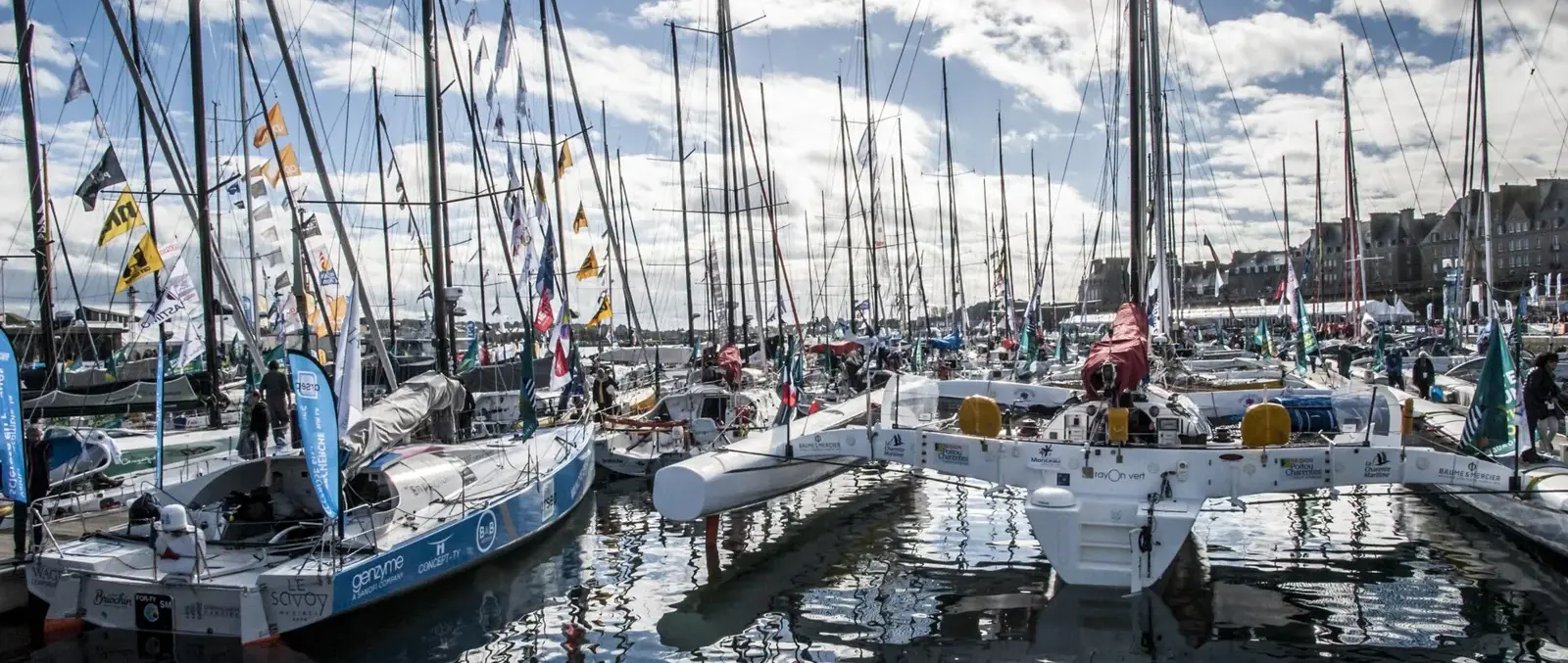
Archive image: Class40 and Multi50 yachts at the 2014 Route du Rhum, photographed by bobostudio. Wikimedia Commons, CC BY 2.0. Resized and converted to WebP. This is not an image of the 2026 competitors.