A New Zealand squad looking beyond its next race
New Zealand's Black Foils SailGP team has begun a training programme in Pensacola, Florida, aimed at strengthening its squad for the 2027 championship. In an update dated 6 November 2026, the team confirmed that emerging sailors Jake Pye and Kate Stewart are working at SailGP's recently opened training facility, while established sailors receive more time in the F50. The timing is noteworthy: the 2026 season still has two events to run, in Dubai and Abu Dhabi, so the work is both a near-term performance exercise and a longer-term investment in crew depth. SailGP's F50 is a 15-metre hydrofoiling catamaran, placing its physical length within the 12-to-24-metre range followed by Luxury Yacht Guide, although it is a dedicated professional racing craft rather than a cruising yacht. The distinction matters, as do the lessons in crew development and high-performance technology.
Who is joining the training group
The official SailGP report identifies Jake Pye, 21, as a new talent being developed in wing-trimming and flight-control roles. It says he took silver at the 2024 Moth World Championship and won a youth world title in 2025. Kate Stewart, recruited earlier in 2026 as a reserve strategist, is also training at the Florida base while working towards the Los Angeles 2028 Olympic Games. These details make the recruitment more concrete than an undifferentiated claim that the team is adding young sailors. The two are being prepared for different responsibilities on a fast multihull, and neither is described by the team as replacing a named frontline athlete at this moment. A developing sailor's participation in training should not be reported as a confirmed race-day selection. SailGP's account is about developing options before they are urgently needed.
Blair Tuke emphasises a wider squad
Black Foils wing trimmer and co-chief executive Blair Tuke says building crew depth has become an important priority. The team's explanation refers to contingencies as well as the longer-term benefit of giving talented younger sailors time in the boat. That approach is familiar to professional sport but particularly demanding in foiling: the connection between hands, systems and hull response must become instinctive. In the official interview, Tuke discusses the value of developing both newcomers while retaining time for the existing first-choice crew. That suggests an effort to avoid treating a reserve as an emergency name on a list. For an owner following advanced sailing design, it is a useful reminder that technological capability only becomes effective through carefully rehearsed roles. A sophisticated yacht does not sail itself; trained judgement is still the deciding element.
Why the F50 is a distinct type of 15-metre yacht
SailGP describes its F50 as a one-design, 15-metre catamaran based on the earlier America's Cup AC50 concept. The class races on hydrofoils, reducing hull contact with the water as speed rises. The league says modern versions can exceed 100 kilometres per hour in suitable conditions, a performance category that has almost no resemblance to a conventional luxury cruising catamaran of similar length. Its wing sail and foil systems are configured for controlled high-speed racing, not weekend comfort or easy coastal ownership. Even so, the dimensions make the class a compelling example of how far technology can diverge within the same broad vessel-length bracket. Readers should not compare its speed directly with a 15-metre production cruiser or expect its operating demands to translate neatly to private yachting.
Flight control is a specialist skill
Jake Pye's work on wing-trimming and flight control is particularly interesting. On a foiling yacht, the crew must control lift and balance while the apparent wind and boat response change rapidly. The league's technical guide explains that F50 teams can use different wing sizes and foil configurations for varying conditions, rather than relying on a single fixed rig arrangement. The best setup also requires execution: crew members must anticipate the boat's reaction and act with very small margins for error. This is why a reserve cannot simply be shown where a control sits and expected to perform at full race pace. The difference between understanding a system and operating it well is substantial. The Black Foils training programme aims to give promising sailors practical time in those specialist positions before a championship start demands their best.
A Pensacola base changes the training equation
The Florida sessions are taking place at a new SailGP training facility in Pensacola. A dedicated base offers a practical route to organising training time away from the pressure of an event weekend, when boats, shore teams and racing schedules are tightly committed. The Black Foils statement links the facility to the team's preparation for next season and to the opportunity to develop its younger sailors. It does not provide a numerical forecast for the performance improvement or guarantee that the new recruits will race in Hong Kong. Those claims would be premature. The meaningful change is a structured opportunity to practise. Owners of smaller performance yachts may recognise the principle: even modest improvements in crew familiarity and manoeuvre routines can make a boat easier and safer to handle, though SailGP's technical environment is at a very different level.
The 2026 season is not finished
Although attention is turning to 2027, the team's 2026 programme remains open. The league's calendar lists the Dubai Sail Grand Prix for 21–22 November and the Abu Dhabi Grand Final for 28–29 November. Black Foils management says it wants to finish the season strongly before beginning again, following a difficult year affected by injury, damage and missed racing. Those forthcoming results should be reported only after the events, not guessed from form or training reports. This time separation matters because high-performance team news often mixes a near-term race target with a multi-year development plan. Pensacola is not evidence of a result in Dubai. It is preparation for whatever roles and conditions the team may face. The next two events should offer further context for judging the squad's competitive readiness.
Hong Kong is the published 2027 opening
SailGP's report identifies 23–24 January 2027 as the championship's planned opening weekend, with a debut visit to Hong Kong. For the Black Foils, that brings the development programme into a recognisable time frame. The team has weeks rather than years to turn training progress into choices about crew balance and reserve cover. The official dates should still be treated as the league's published schedule, subject to the organiser's updates. A yacht owner reading such a programme may find the logistics revealing. Moving a foiling fleet between countries, training teams and event venues involves much more than transporting hulls. The human team needs continuity while adapting to changing conditions and operational settings. In this respect, the Black Foils story is as much about the organisation behind the boat as the speed of the boat itself.
New talent without a promised starting place
The strongest account of Pye and Stewart's opportunity keeps two ideas separate. Their selection for development is a positive signal that the team values their ability, but it is not a public guarantee of any particular race-day role. The league says Stewart has been working in the strategist position, while Pye has been trying two technical roles that help control the F50. Such experimentation can reveal where an athlete contributes most and which combinations of people work well together. A mature sporting organisation also needs reserves who can step in without completely changing its operating style. The prospect is exciting for the young sailors, but the selection decisions will ultimately depend on performance and the team's needs. Readers should follow future official crew sheets for confirmation, not infer it from training photographs.
What leisure sailors can actually learn
A private cruising yacht will not imitate an F50's wing-sail engineering or its extraordinary speed. The transferable ideas are more human. Allocate duties clearly before a manoeuvre, build familiarity with critical controls, train a capable backup for essential tasks and make sure junior or occasional crew members have meaningful time aboard. These habits matter particularly on 12-to-24-metre yachts that may be sailed shorthanded. A sudden illness or an unexpected equipment problem is easier to manage when more than one person understands the fundamentals. No sports programme can replace formal training or vessel-specific operating procedures, but watching how professionals prepare can sharpen owners' questions about their own boats. The Black Foils are investing in depth rather than merely assembling a list of famous names; that is a principle with broad practical value.
The significance of a November training story
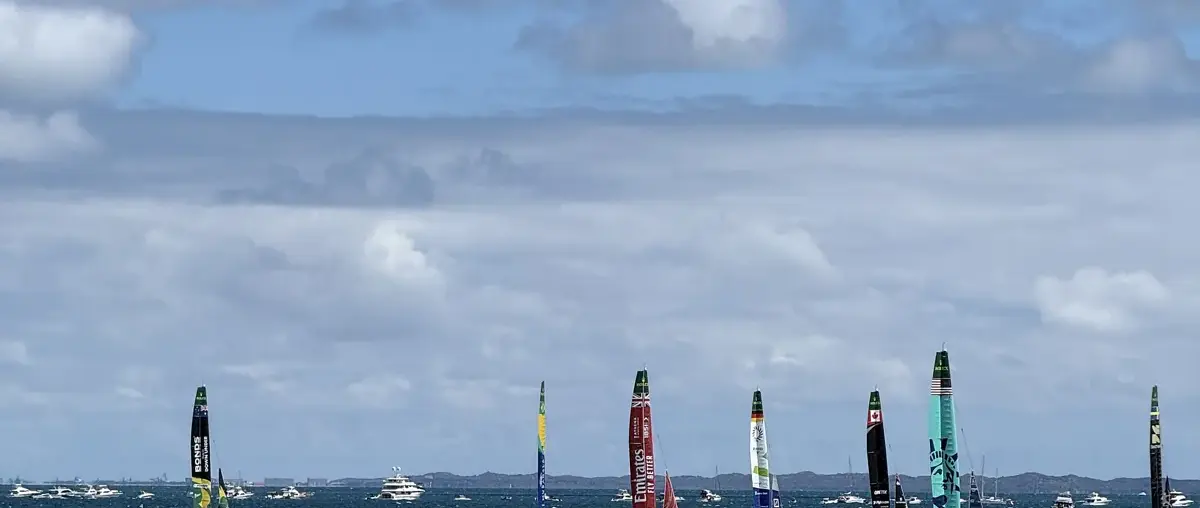
SailGP's 6 November announcement is not a boat launch, a race result or a change to the F50 class rules. It is a personnel and training development, with named athletes, assigned roles and a clear connection to the next season. Its value lies in showing how an elite team tries to sustain performance as the championship becomes more demanding. The photograph accompanying this report shows SailGP in Perth earlier in 2026 and is marked as archive imagery, not as a picture of Pensacola or of the newly described training sessions. For Luxury Yacht Guide, this is an example of 15-metre yacht racing at the technology end of the sport. The most compelling question now is whether the additional preparation creates genuine resilience once racing resumes. That answer belongs to the events ahead.
Photograph: F50 catamarans at the Perth SailGP event in January 2026, by 5225C, Wikimedia Commons, CC BY-SA 4.0; resized and converted to WebP. Archival Perth race view, not the November Pensacola training camp.