A specialist technology conversation inside the leisure-marine show
METSTRADE has confirmed that its 2026 Foiling Technology Zone will occupy Hall 10 at RAI Amsterdam during the 17–19 November exhibition, with the area developed in partnership with the Foiling Organization. The organisers describe a showcase of products and discussions about the adoption of hydrofoil technology in the recreational market, rather than a pure racing-boat display. That distinction matters to owners and designers of luxury yachts between 12 and 23.99 metres, where the strongest technical proposition is not necessarily maximum speed. It may instead involve controlling resistance, ride behaviour, structural loading and energy demand while retaining practical cruising comfort. The organisers say the accompanying stage will feature nine sessions covering design, broader market adoption, sustainability and the future of foiling. The sessions are forthcoming as of 8 November; they have not yet taken place. A serious reading of the programme therefore starts with the questions the industry intends to examine, not with claims that exhibition demonstrations have already proved particular performance benefits.
Why the 12–24-metre market should watch
At the small end of the cruising-yacht market, builders balance speed, seaworthiness, interior volume, safe docking and cost. Foiling introduces another layer of trade-offs. Lifting part of a hull's weight from the water can reduce wetted area under some conditions, but retracting or protecting underwater appendages adds mechanical complexity. The effect on resistance and passenger comfort depends heavily on vessel configuration, sea state, operating speed and control systems. A yacht that spends much of its life cruising slowly or manoeuvring in marinas has a different business case from a racing craft that repeatedly operates near its design speed. For buyers of 12–23.99-metre yachts, the useful question is whether foiling or foil assistance would make their normal passages more comfortable and efficient, not whether an experimental boat can set an impressive peak-speed figure. The METSTRADE zone is relevant precisely because the sector is exploring what can be transferred from competition to everyday ownership without overlooking these practical constraints.
The exhibitor mix goes well beyond the foil itself
The organiser's public 2026 exhibitor list identifies naval technology consultancies, composite specialists, foil-design services, controls-related suppliers and propulsion businesses. Caponnetto Hueber is described as a naval technology consultancy and laboratory, while CDK Technologies highlights high-performance composite structures. Eligio Re Fraschini is listed for keels, daggerboards, rudders and carbon applications. Foilchemy presents foiling-boat design services, and Foil Drive describes modular electric foil propulsion. The names are important for what they suggest about the system: a foil is not an isolated piece of hardware. Designers need sufficient structural information, manufacturers need consistent material quality, and control components must work with the hull, propulsion and operating profile. These exhibitor summaries are descriptions provided through METSTRADE, not independent test results or endorsements. Visitors looking for technology applicable to a medium-size yacht should ask suppliers for verified marine operating envelopes, service support and references rather than assuming a racing pedigree translates into effortless cruising.
Controls and structural reliability belong at the centre
A foil changes loads on the vessel as speed, heel, waves and trim change. In practical design terms, the hull and appendage system need to act as an integrated structure. The organiser's list includes Rota, described as a producer of linear and rotary position sensors, and companies associated with design, component manufacturing and foiling systems. The presence of such specialists points towards a deeper discussion than exterior styling. The reliability of position measurement, actuation, redundancy and fault response can determine how a system behaves when conditions are imperfect. For a cruising yacht, a failure case is often more revealing than an ideal demonstration. Can the vessel continue safely if the foil control system is unavailable? What happens to manoeuvrability near a berth? How are exposed parts inspected and repaired, and what is the interval between service operations? These are editorial questions for boatbuilders and suppliers; METSTRADE's listings alone do not establish any supplier's answers. Owners should ask for documented engineering evidence and sea-trial data.
Efficiency and sustainability: a claim that needs context
The METSTRADE description raises the possibility that foiling can improve efficiency and sustainability. There is a sound engineering reason to investigate reduced drag, yet no single percentage saving can be inferred from the event announcement. Every design has a speed range, payload and sea condition in which its intended benefits may appear. Added hardware has material, maintenance and repair implications, and the full environmental assessment also depends on build methods and the vessel's lifetime use. A boat that achieves an excellent result at a precise test speed may perform differently when loaded with cruising stores or operating at a different trim. The correct comparison for yacht buyers is measured energy or fuel consumption across relevant passages, with sea state, displacement and speed clearly stated. For battery-assisted vessels, an increase in range should be evaluated together with available charging arrangements and practical reserve margins. Any forthcoming product announcement needs to be assessed on those terms, not on an unqualified phrase such as 'zero impact'.
What nine sessions could establish—and what they cannot
Organisers have announced nine discussions on the Foiling Technology Stage, touching on future design, the market for foiling boats, broader adoption and sustainability. That is a worthwhile programme for naval architects, builders and owners interested in the technology's next steps. However, a stage conversation is not certification, and a supplier's concept drawing is not the same thing as an in-service boat with a published maintenance history. The most useful reporting from Amsterdam will identify which systems are in production, which remain prototypes and what test evidence is available in each case. Questions should include the range of craft sizes served, class or regulatory considerations where relevant, appendage protection in shallow water, repair access, noise and ride quality. On a 12–24-metre yacht, these details can affect both purchase decisions and the practical ownership experience. Readers should reserve judgement on individual products until the exhibitors disclose measurable specifications and independently reproducible operating conditions.
A useful distinction between full flight and foil assistance
Not all designs using underwater lifting surfaces aim to fly wholly clear of the water. Some use assistance to reduce immersion or influence ride attitude while much of the hull remains engaged with the sea. That variation is important for leisure craft because comfort, motion control, docking and storage can outweigh the pursuit of maximum lift. A naval architect may choose a modest assistive element for one craft and an actively controlled system for another. The best solution depends on mass distribution, layout, intended cruising speed, propulsion and the owner's routes. Hydrofoils can be especially visible in fast passenger-craft or compact recreational prototypes; applying them to a yacht with substantial cabins, tanks and equipment poses a different set of constraints. The 2026 exhibition offers an opportunity to put these design choices in front of specialists from several disciplines. A credible industry assessment will examine complete vessel systems rather than make a simplistic comparison between 'foiling' and 'conventional' boats.
What Luxury Yacht Guide will look for in Amsterdam
For owners and charter operators in the 12-to-23.99-metre segment, the questions are straightforward. Which proposed systems can actually support an occupied, fully loaded cruising yacht? At what speed and in what conditions do savings or ride improvements occur? How much hull space and weight do mechanisms require? Can a competent local yard inspect and service them, and is the technology usable in familiar Mediterranean harbours? Who carries responsibility for controls and integration when components come from multiple suppliers? The event runs from Tuesday 17 to Thursday 19 November at RAI Amsterdam. It is premature to declare winners before the show opens. For now, METSTRADE's official listings establish the location, nine-session stage and named exhibitors, while independent answers about performance, pricing and suitability remain to be demonstrated. The foiling market is worth watching because its developments may affect the yachts ordinary owners can actually buy and maintain, not merely machines designed to attract attention on a racecourse.
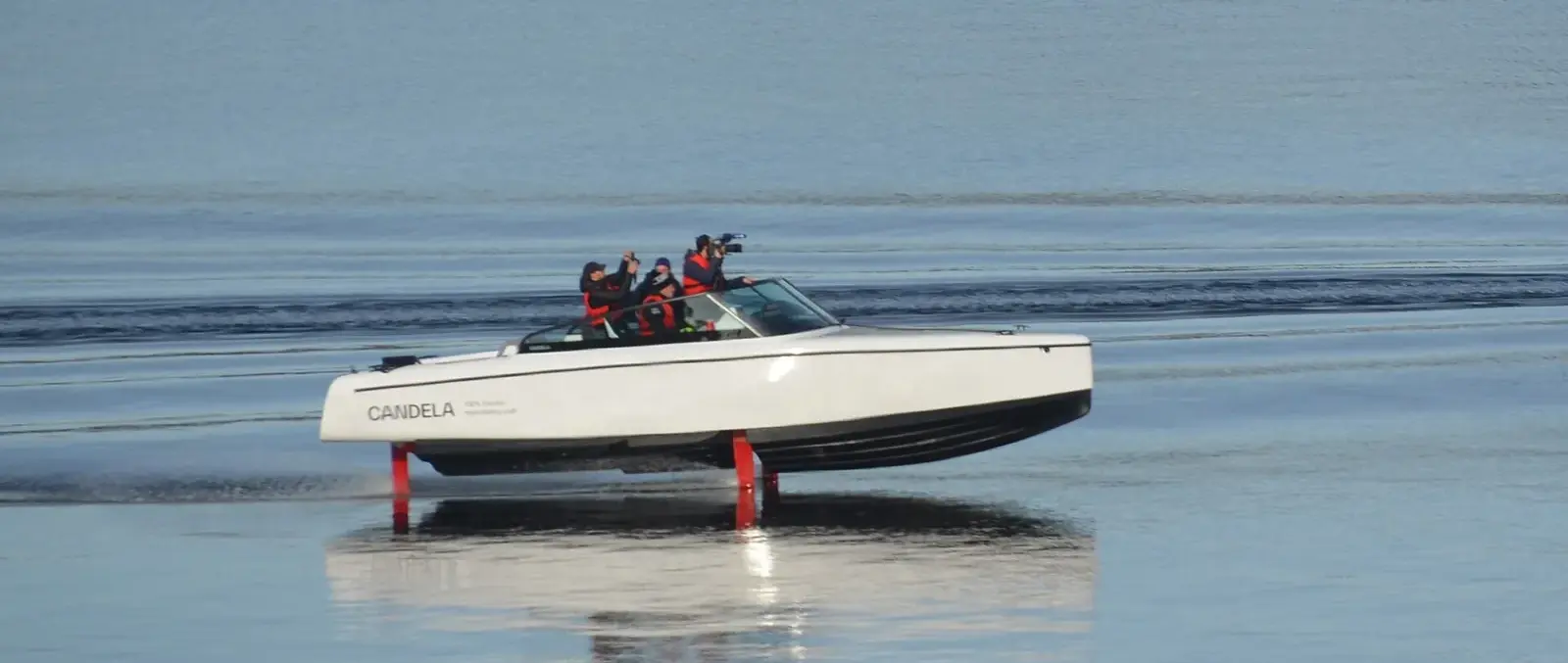
Illustrative header photograph: Candela C-8 hydrofoil, photographed 27 October 2024 by Boberger, CC BY-SA 4.0, Wikimedia Commons. Resized and converted to WebP. This smaller vessel illustrates a hydrofoil configuration; it is not depicted as a METSTRADE 2026 exhibit or a 12–24m yacht.