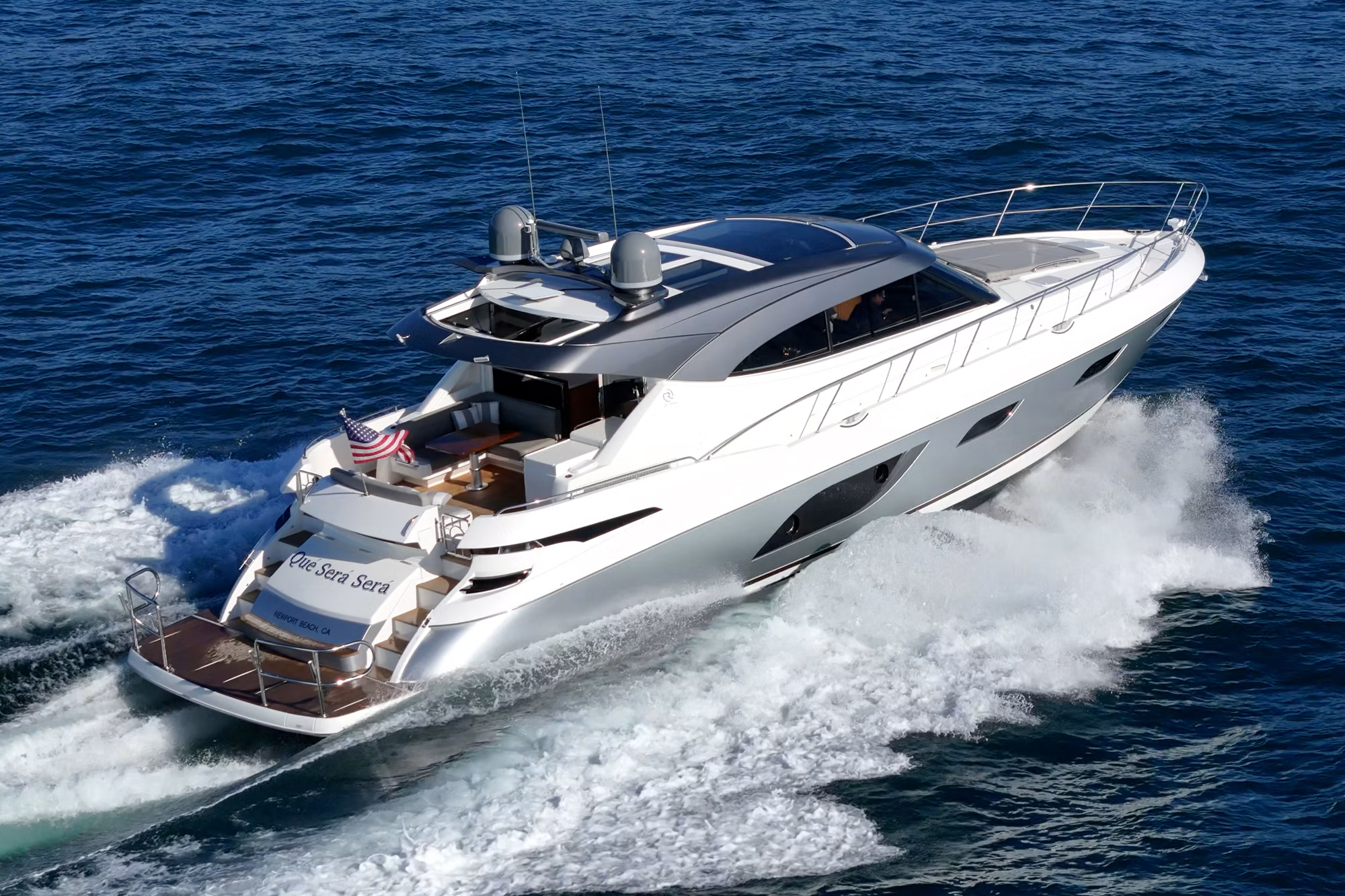
Northrop & Johnson has announced the addition of QUE SERA SERA to its brokerage fleet, offering the Riviera 6000 Sport Yacht Platinum Edition at $1.849 million. The 16 November 2026 release identifies Robert Petrina as the listing broker and draws particular attention to recently fitted propulsion pods and engine maintenance. The yacht is approximately 18 metres long and is marketed in Newport Beach, California, placing it squarely within the sector of luxury motor yachts that many owners operate with limited permanent crew.
There is a useful distinction to make at the outset. The broker's news announcement calls the vessel a 2019 build, whereas its dedicated listing labels it 2020 and gives a length of 18.29 metres. The precise build and model-year designation should therefore be checked against the hull identification number and registration documents. That discrepancy does not undermine the announcement of the brokerage appointment, but it is relevant to comparisons with other Riviera yachts and should not be silently resolved in favour of either date.
A sports yacht arranged on one principal level
The 6000 Sport Yacht concept concentrates much of the social experience around the saloon, galley and aft cockpit. Rather than requiring guests to move upstairs to reach the principal entertaining area, the design connects these spaces in a broadly continuous arrangement. This reflects a different approach from a traditional flybridge yacht, where the elevated deck may serve as the main daytime gathering place.
The advantage of the sport yacht configuration is especially apparent during short coastal trips and afternoons at anchor. Guests can move between the interior and outdoor areas without negotiating multiple flights of steps. The driving position also remains close to the principal social space. Buyers should nevertheless assess how effectively the saloon can be separated from the operating station when weather conditions demand concentration and communication between those handling the boat.
A recent propulsion investment
The important mechanical detail in the new release is the replacement of the propulsion pods. The announcement also reports servicing of the engines and gives approximately 500 operating hours for the two Volvo Penta IPS 950 installations. The diesel engines are each described as having a rating of 725 horsepower. It is a significant package for an 18-metre boat, and the replacement pods warrant attention in any comparison with otherwise similar yachts.
A buyer should ask exactly when and why the replacements were undertaken. The invoices and installation records can establish whether the work involved both complete drives or particular assemblies, what additional components were serviced and whether any warranties apply. A new drive does not make the associated engine, controls or electrical infrastructure new. Understanding the scope of the work is central to forming an accurate estimate of future maintenance obligations.
Performance and the cost of covering distance
According to the broker, QUE SERA SERA has a cruising speed of 23 knots and a maximum speed of 28 knots. That gives the yacht a very different operating profile from a displacement passagemaker. An owner may be able to consider a more distant destination within a weekend, while the vessel remains designed to carry an attractive social and overnight accommodation package.
The advertised speeds must be distinguished from verified performance under a particular load. Fuel and water levels, tender weight, marine growth, sea state and engine condition can all affect the results. Prospective buyers should request recorded consumption at several speeds and arrange a sea trial. A journey that is possible at cruising speed may not be desirable in every sea state. Actual running costs, comfort and the availability of suitable fuel stops should shape realistic cruising plans.
Integrated manoeuvring systems
The installation includes Volvo Penta joystick controls and the company's Dynamic Positioning System, according to Northrop & Johnson. These are useful features for owners considering how often they will be able to operate the boat themselves. Pod-based control systems can simplify certain low-speed manoeuvres by coordinating propulsion directions rather than relying on conventional shaft-driven responses alone.
However, the availability of sophisticated assistance does not remove the need for competent boat handling. A prospective operator should establish the particular system functions fitted, review the manuals and receive instruction appropriate to the vessel. The operation of alarms and the procedures for dealing with a component failure should also be considered. The effectiveness of the equipment in challenging conditions is a matter for demonstration, not simply an assumption based on its brand or presence in an inventory.
Gyroscopic stabilisation
The yacht is listed with a Seakeeper 9 gyro stabiliser. This is a noteworthy addition for guests who expect to spend substantial periods socialising or dining while the vessel is not travelling quickly. A gyro addresses rolling motion through a mechanism contained within the yacht rather than external stabilising fins. For a relatively compact sports yacht, that may provide an attractive approach to comfort.
The actual performance and suitability of the installation depend on vessel displacement, loading and operating conditions. The broker has not published an independent measurement of roll reduction for this particular yacht. A buyer should verify service history, noise levels, electrical requirements and the condition of the gyro's associated machinery. If comfort at anchor is a major reason for selecting the vessel, testing the system in representative conditions is worth including in the viewing programme.
The outdoor entertaining arrangement
The aft cockpit incorporates a teak-finished social area with facilities for outdoor cooking and refreshments. Its proximity to the indoor galley gives guests an alternative to formal dining inside. The forward deck also provides a place to recline outdoors, allowing the boat to offer different social settings despite having a relatively compact length compared with large crewed motor yachts.
Practical questions include the degree of protection from sun and wind, the effectiveness of drainage and the storage available when furniture or equipment needs to be secured for a passage. Owners who expect to entertain frequently should also assess the working space around the cooking equipment and the ease with which guests can move around the cockpit. An attractive layout in a photograph may feel quite different when six people are aboard with provisions and personal belongings.
The tender and the relationship with the water
The hydraulic bathing platform provides access to the water and to the tender storage area. This is a significant aspect of the yacht's usability. Instead of treating the tender as a permanently visible piece of deck equipment, the garage arrangement can keep the boat's exterior relatively uncluttered. The platform also gives guests a more convenient point from which to swim or transfer to smaller craft.
Its practical benefits depend on the tender's size, the lifting mechanism, and the condition and serviceability of the equipment. A survey should establish the platform rating and how the system is operated and maintained. If a buyer intends to carry a different tender, the dimensions and load limits of the garage and platform should be verified before committing to an additional purchase.
A saloon designed for natural light
The broker describes broad glazing and an electrically operated opening roof in the saloon, with a galley adjoining the interior seating. The arrangement gives the yacht a character that can change according to the weather and the preferences of those aboard. A sheltered cabin may become a more open social environment during a favourable afternoon.
The closing and sealing systems are important components on a used boat. A purchaser should inspect the roof mechanism, seals and drainage, as well as the condition of the glazing and ventilation. Because the yacht is intended to provide comfortable accommodation in both warm and cooler climates, the actual performance of the air-conditioning and the ability to manage sunlight deserve attention. These practical matters will influence daily life aboard more than minor differences in decorative finish.
Three cabins for six guests
The three guest cabins each have their own bathroom, with the owner's cabin arranged across the hull, a double guest cabin forward and a further room with twin sleeping places. This arrangement is useful for families or groups whose accommodation requirements do not fit a two-cabin boat. It also allows the principal deck to remain dedicated to operating and social activities rather than requiring sleeping accommodation in the main saloon.
Space below deck should be considered in relation to how long the boat will actually be occupied. Storage, ventilation, noise when machinery is operating and access during a passage are important alongside berth dimensions. Buyers who frequently travel with children or older relatives should assess how easily the cabins and bathrooms can be reached. The suitability of a yacht depends on the way a specific group uses it, not only on the maximum number of berths.
Navigation equipment and domestic independence
The listed equipment includes two Garmin 17-inch navigation screens, radar, autopilot, an Onan generator rated at 29 kilowatts and a watermaker. These systems indicate that the boat is intended to support a degree of independence from marina services, although they do not establish how long it can remain away from shore without replenishment. Fuel capacity, water storage, battery condition and actual loads will determine that.
The value of this equipment will depend on the quality of its installation and maintenance. It is worth requesting the dates of service and checking whether manuals and records are available. The yacht's navigation displays also rely on supporting sensors and electrical supplies. A buyer should investigate those connections and backup arrangements, especially if the vessel will be operated in unfamiliar waters.
A specific offering, not a completed transaction
At $1.849 million, QUE SERA SERA is a current brokerage offering rather than evidence of a completed sale at that price. Its proposition rests on an established sport yacht layout, a substantial propulsion package and reported recent machinery investment. Buyers considering comparable Riviera models should pay particular attention to the documentation of those works and the unresolved build-year labelling in the broker's own presentation.
Northrop & Johnson's dated announcement confirms the listing and its reported specification. It does not certify the yacht's technical condition. The next stages for an interested purchaser are to establish the official identification details, examine the service documentation and commission an appropriate independent survey. Those steps will show how the recently installed equipment and the boat's design translate into ownership value.
Related Luxury Yacht Guide reporting
- Riviera 735 SUV Expands Australian Luxury Cruising Range With New Flagship
- Riviera 645 SUV Makes GCC Debut at Dubai Boat Show 2026
- Princess Confirms S74 and Y72 for boot Düsseldorf 2027
- Princess C48 Deck Saloon Brings a Sheltered Option to Sports Cruising
Primary reporting and image credit
Primary broker announcement(s): https://www.northropandjohnson.com/news/brokerage-new-build/que-sera-sera-60-18-2m-riviera-6000-sport-yacht-for-sale. © Respective photographer / Northrop & Johnson. Subject-specific first-party brokerage photograph, credited to its source; photographer not individually identified. Image is used only for correctly attributed factual editorial coverage and never represented as open-licence stock photography. Original broker image.