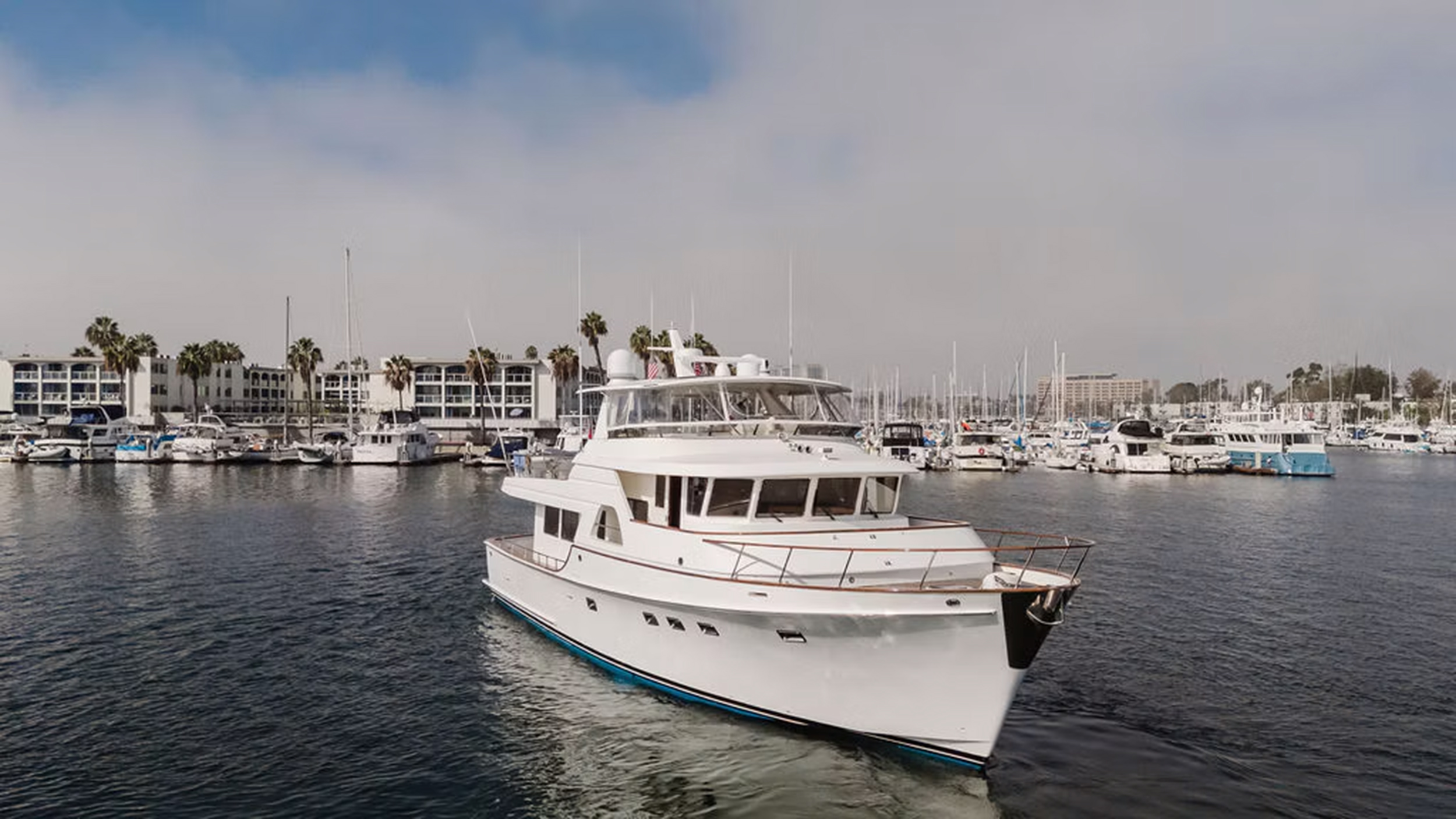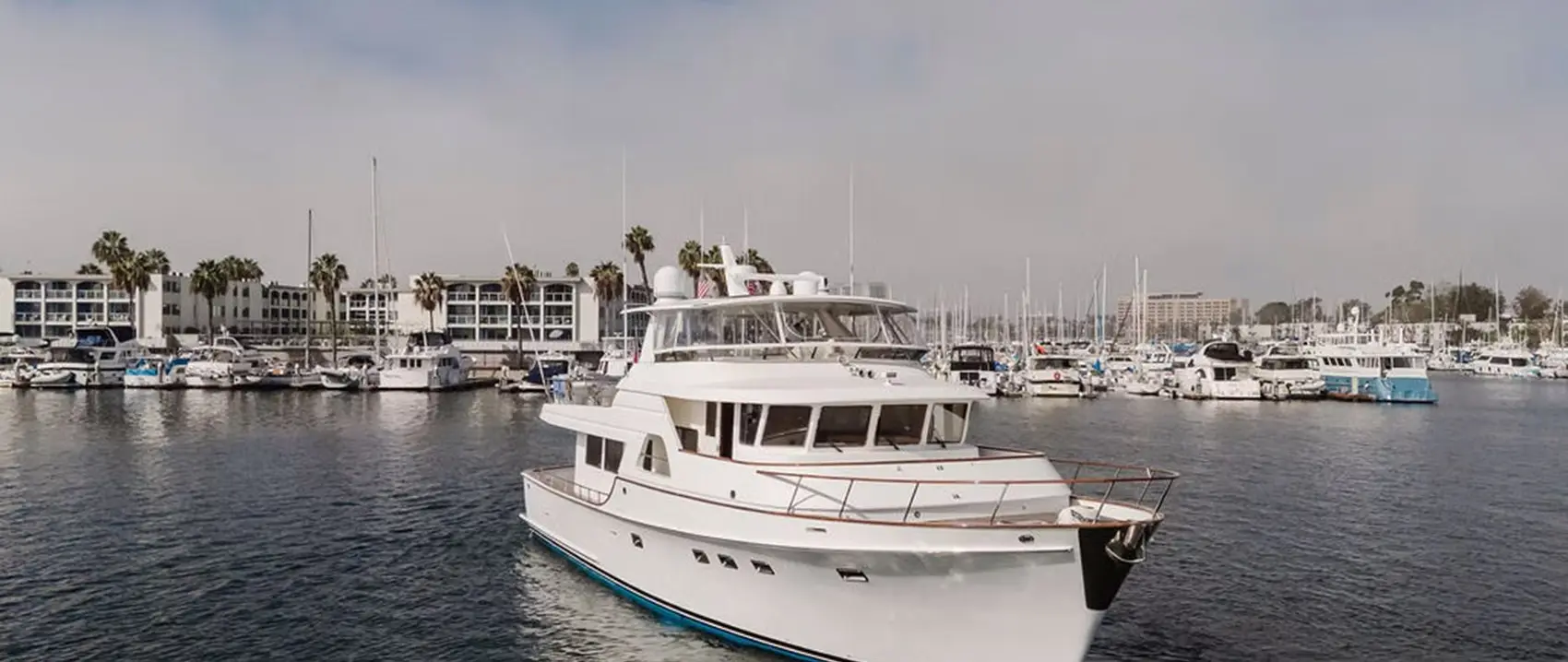
A 1999 Ocean Alexander Classico has entered the brokerage market in Southern California with an asking price of $1.5 million and an unusually substantial recent maintenance and modernisation history. Northrop & Johnson announced the listing of LONG RUN on 23 November 2026, identifying Chad Pordes as the broker. At approximately 19.5 metres in length, the yacht is a raised-pilothouse trawler designed around passage-making rather than the high speeds commonly associated with contemporary sports motor yachts.
The most significant detail in the announcement is the reported $1.3 million expenditure between 2020 and 2022. That work addressed much more than cosmetic improvements and included attention to the machinery, navigation, electrical equipment and the interior. For prospective owners, the listing presents an interesting question: what value does a well-documented modernisation programme bring to a yacht built more than a quarter of a century ago? The amount spent is not proof of current condition or market value, but it provides an important starting point for further investigation.
A cruising yacht with a different set of priorities
The broker gives a cruising speed of ten knots and a maximum of twelve. Those figures make clear that LONG RUN is not competing with a similar-sized planing yacht on journey times. The appeal of this design instead lies in providing a substantial accommodation platform and allowing a crew to approach cruising at a more measured pace. A ten-knot passage can cover significant distances when the weather, fuel reserves and navigational conditions allow, without requiring the owner to organise every day around a high-speed transit.
A prospective buyer should consider the intended use rather than automatically equating greater speed with a better yacht. A boat used for extended periods away from its home marina may be valued more for protected watchkeeping, machinery access and useful storage. The actual economical range of LONG RUN cannot be calculated from the advertised speed alone; documented fuel capacity, consumption measurements, reserve policies and prevailing conditions must be examined before making passage plans.
The reported investment in the refit
The 2020–2022 works encompass multiple parts of the yacht that are expensive to renew and can be disruptive to address after purchase. The broker describes changes to electronic equipment, replacement of onboard pumps and air-conditioning machinery, renewed interior fabrics and servicing of several critical mechanical systems. Taken together, those interventions suggest a programme intended to make the vessel more practical for continued ownership rather than simply prepare it for photography.
Buyers should request invoices, work specifications, service reports and the dates of individual jobs. A large total may include items of very different useful lives. Replacing a cooling component, servicing a shaft installation and renewing an interior covering do not have the same implications for maintenance five years later. The specific work completed is more useful than the aggregate figure when trying to anticipate future costs. Any remaining warranties, where transferable, should also be identified separately.
Caterpillar machinery and displacement cruising
LONG RUN retains Caterpillar propulsion machinery, according to Northrop & Johnson. Its announcement identifies servicing of the engine and transmission cooling arrangements, steering equipment, shafting and rudders. Those are particularly relevant details for a cruising yacht whose purpose involves spending time underway. The description does not establish that every component was replaced, nor does it provide current oil analysis or a complete engine diagnostic report.
A mechanical survey should be designed to assess the machinery as an interconnected installation rather than a pair of engines in isolation. Cooling-water flow, exhaust condition, gearbox behaviour, alignment and access for routine maintenance all matter. A controlled sea trial can establish how the vessel performs at different operating conditions. The purchaser should compare those observations with the manufacturer's limits and the surveyor's advice, rather than infer the quality of the propulsion system from an advertised top speed.
Stabilisation and life at displacement speed
The brokerage release specifically includes the Naiad stabilisers among the systems serviced during the earlier refit. Fin stabilisation can make a meaningful difference to comfort while underway, particularly on a vessel intended to spend substantial time at relatively low speed. The effectiveness of an installation depends on its configuration, the sea conditions, the speed of the boat and the condition of the associated machinery.
It would be inappropriate to infer zero-speed capability or a quantified reduction in rolling solely from the brand name. An interested purchaser should confirm the particular model and control arrangement fitted to LONG RUN, request maintenance documentation and discuss operational expectations with a qualified technician. Comfort while at anchor should be assessed independently of the performance of the stabilisers during a passage. The distinction matters to an owner considering cruising grounds with exposed anchorages.
A navigation package built around two stations
The modernisation included seven Garmin GPSMAP 8617 displays distributed between the raised pilothouse and enclosed upper helm. The significance is not simply the number of screens. The arrangement allows navigation, monitoring and manoeuvring tasks to be organised across two separate operating positions, while providing the potential for different information to be displayed simultaneously. It also creates a need to understand the network architecture behind the equipment.
Multiple screens connected to common sensors do not necessarily constitute independent navigation systems. A survey should establish the power feeds, data connections, chart arrangements and backup equipment available if a shared component fails. The quality of an installation includes the readability of alarms and the ease with which a watchkeeper can locate the necessary information. A prospective operator should spend time at both helm stations, checking sightlines and the controls used most frequently.
Why the raised pilothouse matters
A separate, sheltered navigation area remains an attractive feature for owners who intend to operate their own yachts. It provides a place to concentrate on navigation without making the principal guest living space serve simultaneously as the main command station. The physical separation may also help organise watch routines on longer journeys, especially when one person needs to rest while another remains on duty.
The enclosed flybridge provides an additional operating and social area. The broker describes a seating group, dining facilities and a built-in grill, making it a space that can serve several purposes depending on the circumstances. Before purchase, owners should assess how readily the helm can be reached from the lower decks and how crew members move between the two positions. Practical access matters considerably more in poor weather than in a static viewing.
Accommodation for extended family use
LONG RUN's three sleeping cabins are arranged to accommodate seven people. The owner's cabin spans the width of the interior, while the other rooms accommodate a forward double berth and a combination of lower and upper sleeping arrangements on the port side. This configuration can appeal to a family that needs more flexibility than a layout designed exclusively around three couples.
The galley and saloon are linked by a breakfast counter, creating a domestic arrangement suited to informal living aboard. The broker's description of timber cabinetry and extensive glazing indicates a design language quite different from the minimalist interiors of many current builds. A buyer should evaluate the actual storage, ventilation and acoustic separation as carefully as the visible finishes, particularly if the boat is intended to function as a seasonal second home.
Carrying a tender without surrendering the cockpit
A 14-foot AB tender dating from 2021 is identified among the yacht's equipment, carried on the upper boat deck. Its location leaves the lower aft area available for other uses, rather than occupying the principal space where guests would normally enter the yacht or relax near the water. A dedicated tender also expands the range of anchorages that can be used without requiring the main vessel to berth every night.
The condition and serviceability of the lifting equipment deserve independent examination. Weight limits, structural attachments and the practical handling procedure should be confirmed using the equipment documentation and competent instruction. Prospective owners who expect to spend much time at anchor should also test the practical ease of getting into and out of the tender. Boarding comfort is often an underappreciated element of a yacht's suitability for a particular family.
Assessing the price against the condition
The advertised $1.5 million is an asking price, not a disclosed transaction value. Although the reported refit expenditure is close to that amount, the figures cannot be added together or treated as an indication of the seller's return. Refit costs frequently include maintenance necessary to preserve a yacht's existing value. Market comparisons should account for the age of the vessel, its condition, the machinery specification and the equipment actually included.
A sensible due-diligence process would establish title, taxes and ownership status as well as technical condition. The buyer should request a current inventory and identify any further investment required for the intended operating area. The geographical location of available service providers can affect the economics of ownership, particularly when dealing with a large vessel whose equipment spans multiple generations of marine technology.
What the new listing tells the market
LONG RUN's November listing is an illustration of the continuing relevance of well-maintained displacement motor yachts in the 12–24 metre sector. Its reported history offers a contrast to the more common discussion of new model launches and higher-performance propulsion. For the appropriate buyer, an existing hull with a comprehensive documented equipment programme may deserve serious consideration alongside newer alternatives.
Northrop & Johnson's announcement establishes that the yacht was marketed at the stated figure and describes the refit as completed between 2020 and 2022. The remaining question is how accurately that record reflects the yacht's condition in late 2026. Independent inspection, maintenance history and a representative sea trial will determine whether the vessel is a compelling purchase. The listing provides useful evidence about its intended cruising role, without replacing those essential checks.
Related Luxury Yacht Guide reporting
- Riviera 735 SUV Expands Australian Luxury Cruising Range With New Flagship
- Riviera 645 SUV Makes GCC Debut at Dubai Boat Show 2026
- Steeler Enigma 59 Launches as 18m Steel Motor Yacht in the Netherlands
- Beneteau ABIDE AWHILE Reduced to $1.599m Before FLIBS
Primary reporting and image credit
Primary broker announcement(s): https://www.northropandjohnson.com/news/brokerage-new-build/long-run-64-19-5m-ocean-alexander-classico-for-sale. © Respective photographer / Northrop & Johnson. Subject-specific first-party brokerage photograph, credited to its source; photographer not individually identified. Image is used only for correctly attributed factual editorial coverage and never represented as open-licence stock photography. Original broker image.