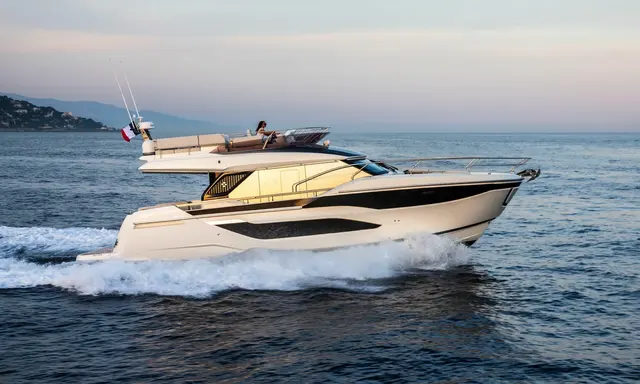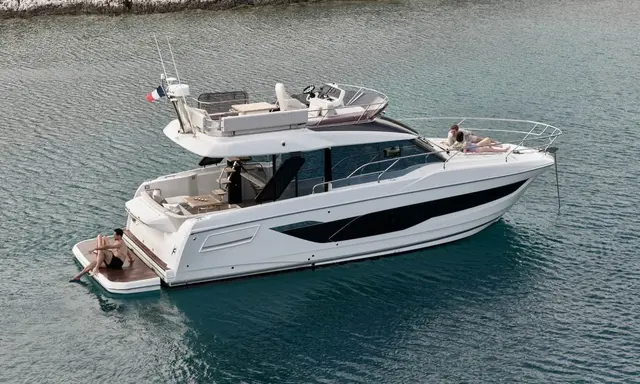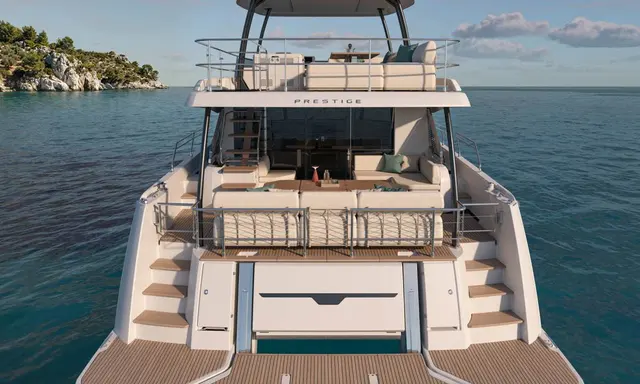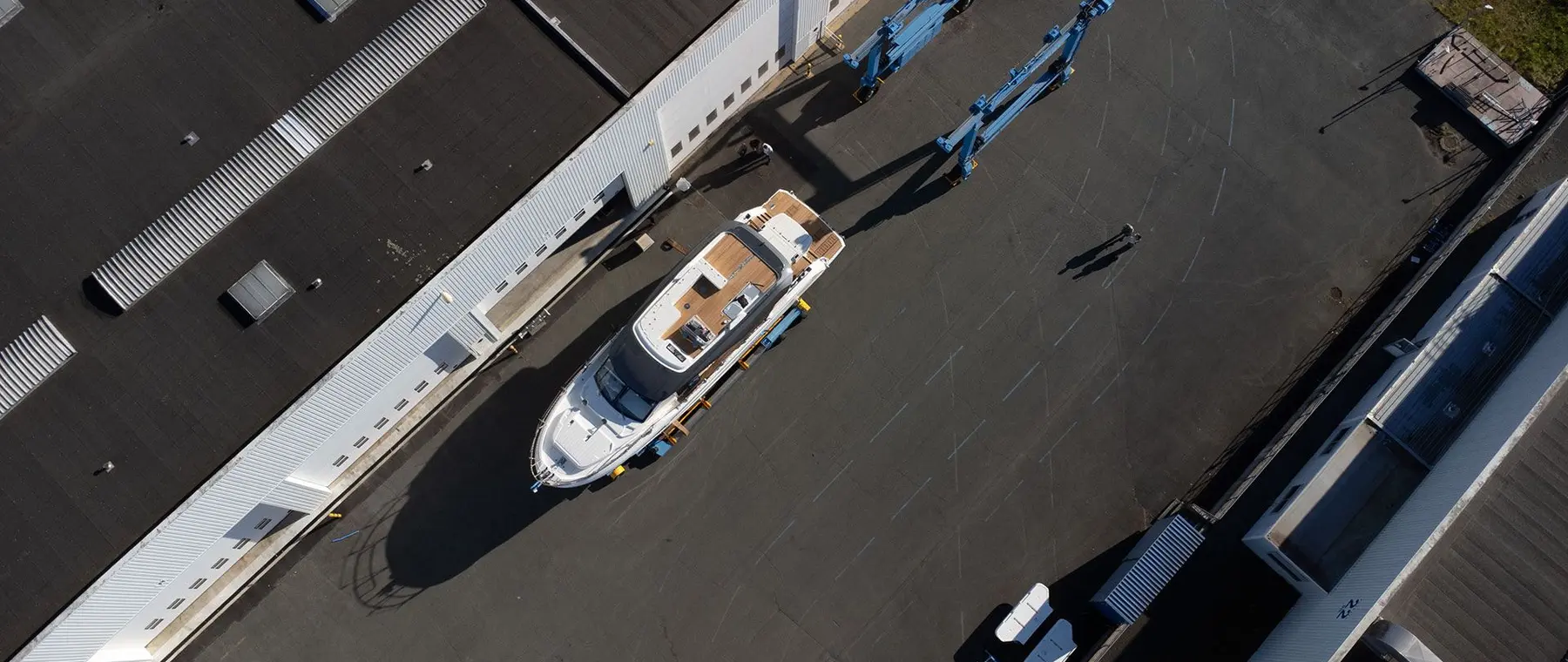
PRESTIGE has opened a window onto the production programme behind its new F6.7, showing how the largest model in the latest F-Line generation is being developed at the builder's Les Herbiers facility in France. The model follows the F4.9, F5.7 and F4.3 and completes the third generation of the company's flybridge family with a flagship aimed at experienced owners.
The builder describes the F6.7 as the product of industrial methods combined with specialised manual work rather than a simple exercise in scaling up a smaller yacht. More than 15 disciplines are involved in the project, and PRESTIGE says a dedicated team of 25 specialists has been assigned specifically to the model to control quality, fit and finish through the construction process.
A flagship built around the new F-Line philosophy
The F6.7 extends the design language established by the smaller F-Line models, with an emphasis on light, circulation and usable living space. Italian designer Camillo Garroni is responsible for the concept, while PRESTIGE's internal teams have developed the yacht for series production and the practical requirements of owners moving into a larger platform.
That transition is important because a flagship has to do more than look related to the rest of a range. It must introduce greater space, systems complexity and owner expectations without losing the ease of use that makes a production flybridge yacht attractive compared with a fully custom project.
More than 15 disciplines contribute to each yacht
PRESTIGE lists naval architecture, engineering, woodworking, upholstery and engine expertise among the fields involved in the F6.7. The diversity of that work illustrates how modern production yacht building has become a systems-integration business in which structure, machinery, electrical systems, interiors and finishes must come together on a controlled schedule.
The 25-person dedicated team is intended to bring continuity to those stages. Specialist work still includes significant hand finishing, but it sits within a repeatable industrial process that begins with mould development and continues through assembly, installation and final detailing.
Industrialisation does not remove manual craft
PRESTIGE's description is useful because production yachts are sometimes presented as the opposite of hand-built boats. In reality, efficient moulding and standardised engineering can coexist with a large amount of skilled manual work, particularly in cabinetry, upholstery, final fit and the adjustment of systems once the yacht is assembled.
The challenge is consistency. A one-off custom builder can solve individual issues around a single yacht, while a series producer must make sure the same solution can be repeated across multiple hulls without the quality drifting from one build to the next. Dedicated teams and tightly controlled sequences are one way of protecting that repeatability on a larger, more complex model.
Les Herbiers becomes part of the product story
PRESTIGE has chosen to emphasise that the F6.7 is conceptualised with Italian design input, developed by its own teams and built in France. The combination reflects the brand's established French-Italian design identity while drawing attention to the industrial knowledge accumulated at Les Herbiers over decades of production.
For owners, the factory story matters because larger production yachts increasingly compete with semi-custom alternatives. Buyers want design flexibility and premium finishes, but they also value predictable delivery, established service processes and the engineering reassurance that comes from a repeated platform.
Cannes will be the first major public test
The F6.7 is scheduled for an advance presentation at PRESTIGE Exclusive Days in Beaulieu-sur-Mer before its world premiere at the 2026 Cannes show. Those appearances will shift attention from the production process to the finished yacht, allowing buyers to judge whether the scale, circulation and material quality deliver the flagship experience promised by the factory programme.
The manufacturing detail already makes the F6.7 interesting beyond its dimensions. PRESTIGE is showing that the competitive advantage of a mature production builder lies not only in design but in the ability to organise people, processes and suppliers around a repeatable high-quality result. As yachts in this size bracket become more sophisticated, that industrial capability is increasingly part of what owners are actually buying.
The F6.7 programme also illustrates the hidden scheduling challenge behind a flagship production yacht. Larger interiors and more complex systems increase the number of trades working in the same structure, so sequencing becomes critical if the yard is to preserve both efficiency and access for quality checks. A dedicated team can help coordinate those handovers and reduce the risk that late-stage corrections disturb work already completed elsewhere in the yacht.