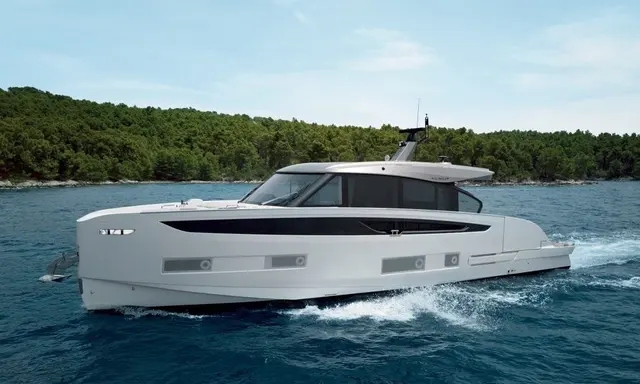
New German builder Pioneer Yachts is approaching the public debut of its first PY60, a 60-foot power catamaran conceived from the beginning around solar-electric propulsion rather than converting an existing diesel design. The first yacht, Pioneer One, is due to appear at the 2026 Cannes Yachting Festival after launch and sea trials in Germany.
The project brings together Cossutti & Ganz for exterior design and naval architecture with Micheletti + Partners for the interior. Founder Mike Frank says the company was created around the idea that a solar-electric yacht should remain useful in real cruising conditions, which is why the system includes batteries, integrated solar generation and backup diesel generators rather than relying on one energy source.
Designed around the energy system
Pioneer says the PY60 was not developed by taking a conventional power catamaran and replacing its engines late in the process. Hull geometry, roof area, weight distribution and onboard systems were considered around the requirements of electric propulsion and solar collection from the beginning.
That integrated approach is important because battery weight and panel area influence the entire yacht. A successful electric platform has to reduce energy demand as well as increase storage, otherwise additional batteries simply add displacement and create a cycle of greater power requirement.
Solar, batteries and generators work together
The yacht’s roof carries a large photovoltaic array feeding battery banks used for propulsion and hotel loads. Diesel generators remain available as range extenders and backup energy sources, giving the crew a way to continue operating when weather, distance or onboard demand exceed what the solar system can provide directly.
Pioneer is therefore positioning the PY60 around reduced dependence on fossil fuel rather than claiming that every passage will be completed only on sunshine. That distinction makes the concept more realistic for owners who want to cruise independently rather than operate within a carefully controlled demonstration route.
The builder quotes an 11-knot maximum
Pioneer’s Cannes release gives the PY60 a maximum speed of about 11 knots and a cruising speed around 7.5 knots. Those figures are modest compared with high-output diesel power catamarans, but they reflect a design brief centred on efficient displacement-speed cruising and energy autonomy.
Speed is one of the clearest trade-offs in current electric yacht design. Every additional knot at the upper end can demand disproportionately more power, so the PY60 deliberately targets owners prepared to exchange rapid passages for quieter operation and lower routine energy consumption.
German engineering meets Italian design
The catamaran is being built in Stralsund, with Pioneer promoting German engineering and manufacturing discipline alongside the Italian design input. Cossutti & Ganz are responsible for the hull and exterior, while Micheletti + Partners are developing the living spaces and material language.
That separation of disciplines is conventional in yacht building, but the energy brief forces closer collaboration than usual. Window area, interior systems, insulation, deck structure and roof geometry all affect electrical demand or solar performance, so aesthetic decisions cannot be isolated from the technical package.
Cannes will provide the first public test
The first PY60 is scheduled to reach the water before Cannes and complete commissioning work ahead of its public presentation. Until those sea trials are complete, claims about real-world autonomy will remain partly theoretical and dependent on the operating profile selected for testing.
That makes the Cannes debut especially interesting. The boat will move from renderings and engineering projections into an owner-facing product, and the quality of the finished yacht—noise, systems integration, charging behaviour and everyday usability—will matter as much as the novelty of its propulsion system.
Real-world energy accounting will decide the PY60 story
The PY60's most important numbers will eventually be the ones recorded over complete cruising days: solar generation, battery state, hotel demand, generator hours and energy used per mile. Those measurements will show whether the integrated approach meaningfully reduces dependence on combustion machinery when the yacht is carrying normal owner loads rather than operating in ideal demonstration conditions.
Pioneer is deliberately accepting modest speeds to improve that equation, and that makes the yacht a clear proposition rather than a conventional power catamaran with electric branding. Buyers attracted to the project must be comfortable with efficient passage making instead of high-speed running. Cannes will reveal whether enough owners see quieter autonomy and lower routine energy demand as a worthwhile exchange for slower travel.