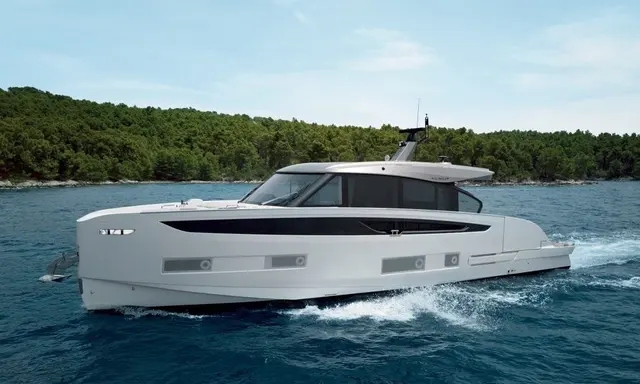
Pogo Structures has brought a very different performance argument to the motor-yacht market with the LOXO 40. Instead of using increasing horsepower to chase 20- or 25-knot cruising speeds, the French builder has designed the 12.80-metre boat around a narrower 12–15-knot efficiency window and the low displacement associated with its offshore sailing yachts.
The yard says the LOXO 40 displaces about four tonnes and uses a vacuum-infused sandwich structure. That combination allows comparatively modest installed power, while the hull form and construction are intended to reduce the amount of fuel required for owners who value distance and simplicity more than maximum speed.
A hull designed for 12–15 knots
Pogo says the LOXO 40 has been hydrodynamically optimised around the speeds at which the boat is expected to spend most of its cruising life. This is a different starting point from planing motor yachts whose hulls and engine packages are sized primarily around much higher maximum speeds.
The yard reports measured consumption of about nine litres per hour at 12 knots, equivalent to roughly 0.75 litres per nautical mile in its test conditions. Those are manufacturer figures, but they illustrate how aggressively the design team has prioritised resistance reduction over headline power.
More than 500 nautical miles from 480 litres
The published fuel capacity is 480 litres, and Pogo says the boat can exceed 500 nautical miles of range at its intended cruising speed. That range is notable for a 12.8-metre motor boat because it can support genuine coastal passagemaking without requiring the large tanks and heavy engines common in faster cruisers.
Range also changes the way owners can plan a trip. A boat that consumes fuel slowly can choose smaller harbours and remote anchorages without making every itinerary depend on the next fuel dock, while the lower daily burn can reduce the cost penalty of longer cruising seasons.
Offshore sailing knowledge moves into power
Pogo Structures is best known for lightweight sailing yachts developed from offshore racing experience. The LOXO project transfers that culture of controlling weight and drag into a motorboat, using a pronounced V section for seakeeping while keeping the structure light enough to work with moderate propulsion.
The builder says the first units have already cruised in demanding European waters, including routes around France, Ireland and Scotland. That operating use is important because the concept is intended as a real cruising boat rather than only an efficiency demonstrator for flat-water tests.
Shallow draft and beaching broaden access
The LOXO 40 draws roughly 0.5 to 0.7 metres depending on load and can rest on two stabilising fins when deliberately dried out. That gives owners access to shallow anchorages and tidal areas that can be difficult for deeper-draft motor yachts.
A shallow hull does not remove the need for careful pilotage, but it fits the same philosophy as the low fuel burn: the boat is designed to widen where and how an owner can cruise without adding large or complicated systems. The shallow-draft capability therefore supports the same emphasis on access and simplicity as the efficient cruising speed.
Comfort remains part of the brief
Despite the weight focus, the interior includes two separate cabins, a large bathroom, significant storage and accommodation for as many as six people. Pogo is also using recycled-PET foams and offers bio-based timber alternatives in parts of the construction.
The LOXO 40 therefore makes its case through restraint rather than excess. It is not the fastest yacht at Cannes, but it demonstrates how much range and accommodation can be extracted from a compact platform when hull efficiency and weight are treated as the primary design problems.
Efficiency changes the ownership calculation
A boat that burns fuel slowly can alter more than the cost of a passage. Smaller engines, modest tankage and reduced daily consumption can simplify maintenance, weight and trip planning, while the ability to cover long distances between fuel stops gives owners more freedom to use remote harbours and anchorages without treating every itinerary as a search for the next marina pump.
The LOXO 40 is therefore a useful counterpoint to the horsepower race visible elsewhere in Cannes. Pogo is not arguing that speed has no value; it is asking whether owners who normally cruise at moderate speeds need to carry the engines, fuel and displacement required for much higher numbers. The first series boats will show how many buyers are prepared to make that choice deliberately.