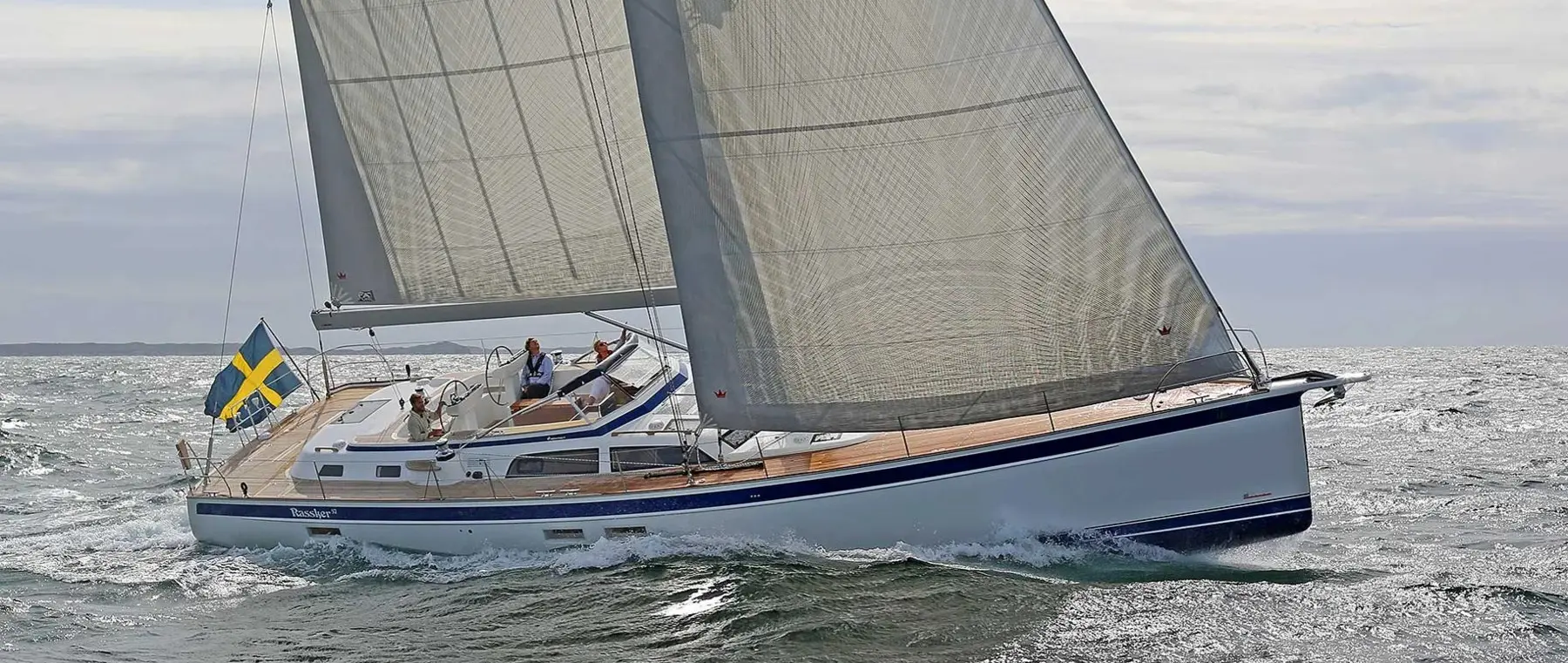
A 57 designed for demanding miles
The Hallberg-Rassy 57 is presented by its Swedish builder as an ocean-capable cruising yacht that brings modern Germán Frers design into a long-established family of bluewater boats. Its 17.44-metre hull length provides substantial accommodation and technical volume. More importantly, the yacht is arranged for owners who expect to sail serious distances.
The manufacturer quotes a beam of approximately 5.11 metres and a light displacement around twenty-eight tonnes in its technical sheet. Those figures help explain the generous cockpit and interior. They do not, by themselves, describe how a yacht will behave in every sea state or with a different loading condition.
A protected centre cockpit is one of the design's defining features, providing a place from which to navigate while retaining access to the principal deck areas. Twin wheels allow passage through the cockpit and give helmspeople alternative positions. The layout deserves inspection from a seated and standing viewpoint to understand sightlines and handholds.
Compared with boats designed primarily for marina weekends, a long-range cruiser must make routine work practical at sea. Reefing, securing equipment and moving safely between decks matter every day. Hallberg-Rassy's specification places considerable attention on those details rather than relying on size alone.
Twin rudders and simplified sail control
The 57 uses twin rudder blades, an arrangement intended to maintain steering authority when the yacht heels. The builder also highlights the use of twin wheels in this size of centre-cockpit boat. Owners should discuss handling characteristics with an experienced instructor and evaluate the systems during a proper sea trial.
A key part of the marketing is powered sail handling, including hydraulic in-mast furling and other electrically or hydraulically assisted functions. This can reduce the physical demands of working a large rig. Assistance systems still need maintenance and do not remove the requirement for sailing judgement or safe procedures.
The yacht has a modern sail plan and an integrated bowsprit that serves several practical functions. Such details affect how headsails are handled and how the foredeck remains organised during a passage. The exact sail wardrobe, rig setup and options should be reviewed on an individual boat.
Owners attracted to the idea of sailing with a small crew should rehearse common tasks before committing to an offshore voyage. Practising departures, sail changes and contingency manoeuvres reveals the importance of well-placed controls. A manageable yacht is the result of planning and skill as much as machinery.
A remarkable amount of useful stowage
Hallberg-Rassy describes roughly ten cubic metres of exterior locker capacity spread among forward, aft and cockpit spaces. This is a practical advantage on a boat expected to carry tools, fenders, spare parts and cruising equipment. Storage is particularly valuable when the owner does not want to occupy guest cabins with gear.
The vessel includes a dedicated walk-in engine room, an unusual convenience compared with yachts where servicing requires reaching through narrow access panels. The manufacturer describes accessible equipment and sound insulation around the main engine and other systems. Ease of inspection can improve maintenance habits during a long passage.
The technical specification lists a Volvo Penta D4 engine rated at 175 horsepower and tanks for approximately 1,050 litres of diesel and 1,030 litres of freshwater. Those capacities support self-sufficiency but must be interpreted with actual consumption figures. Passage planning needs reserve allowances and a working knowledge of all onboard systems.
Deck lockers are only helpful when equipment can be secured safely against movement and water ingress. Owners should inspect drainage, access and how heavy items can be lifted without strain. Small storage decisions become important on a voyage lasting weeks rather than days.
A comfortable home beyond the harbour
Below deck, the builder highlights generous sleeping spaces, natural light and a largely level floor arrangement. The forward and aft accommodation can provide room for a cruising couple and occasional guests. The yacht's spaciousness needs to be weighed against how occupants move through it while underway.
The 57 is a large sailing yacht with substantial installed systems, so operating it responsibly includes maintaining rigging, machinery and electrical equipment. Training, spare-parts planning and inspection routines are essential. None of those demands is removed by automated winches or a comfortable interior.
Owners should also consider their intended cruising grounds when choosing keel depth, sails and auxiliary equipment. The manufacturer notes variants in draft, and such choices affect where the vessel can comfortably navigate. A well-designed boat still needs a specification fitted to its owner's routes.
The Hallberg-Rassy 57 demonstrates how traditional offshore priorities can coexist with contemporary handling support and residential comfort. Its twin rudders, sheltered cockpit and service access all contribute to the ownership case. The real test is how naturally those features support the next long journey.