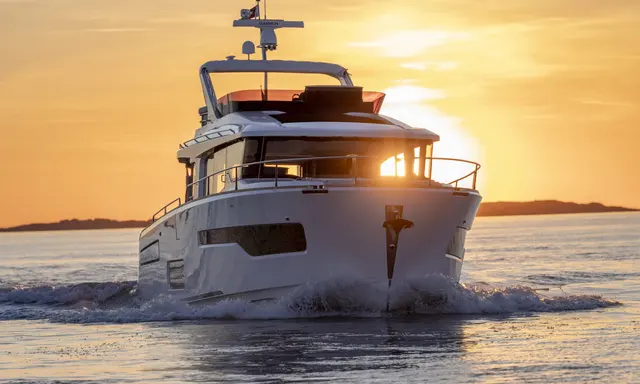
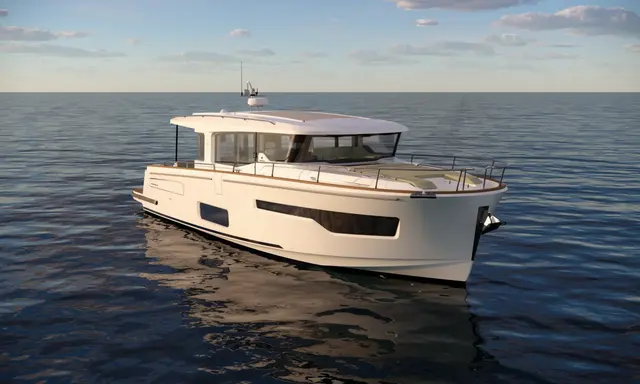
Nimbus has brought the Sport Tender 35 to Cannes for its world premiere, using the new boat to reset the direction of its Sport Cruiser range. The model is the first of three planned versions sharing one new hull, with Sport Weekender and Sport Coupé derivatives intended to follow.
The Swedish builder is describing the project through its ‘Crafted for Living’ philosophy, placing the emphasis on how people use a boat through an entire day rather than on a single performance statistic. The result is a layout in which both forward and aft living areas can change form quickly as the crew moves between passage, anchoring, swimming and dining.
One hull will support three models
The Sport Tender 35 introduces an air-lubricated twin-stepped hull that will also underpin the Sport Weekender and Sport Coupé. Sharing the running surface gives Nimbus a consistent handling base while allowing the superstructure and weather-protection strategy to change significantly between versions.
This platform approach mirrors the way many modern builders control development cost without creating near-identical boats. The key for Nimbus will be ensuring that the Tender feels purpose-built as an open social model rather than simply a Coupé with parts of the cabin removed.
The foredeck changes during the day
Nimbus describes the forward deck as both a secure working area and a leisure zone. During boarding or line handling it provides clear footing, while at anchor furniture can be arranged into broad sun lounges so that the same physical space serves a completely different purpose.
The concept is intentionally simple: equipment should move out of the way when it is not needed rather than permanently consuming valuable deck area. That kind of transformation is especially useful on a mid-size boat where adding separate zones for every activity would quickly make circulation difficult.
Aft seating opens toward the water
The aft deck uses a large U-shaped sofa with a three-part backrest that can form seating, a sunbed or face outward over fold-down side balconies. Lowering the platforms extends the living area closer to the sea and gives swimmers a larger transition zone between water and cockpit.
A nearby galley supports the space so that food and drinks can be handled without repeated movement below. Nimbus is clearly designing the stern around long periods at anchor, where the quality of seating and water access may matter more to owners than the arrangement used for a short high-speed run.
Overnight capability remains important
Although the Sport Tender is the most open member of the planned family, Nimbus has still provided sleeping accommodation and a proper head below deck. The official launch material describes a full-length double berth forward, two full-length berths amidships and an additional convertible sleeping position.
That gives the boat a genuine weekender role rather than limiting it to daylight operation. It also helps explain why Nimbus is calling the series Sport Cruisers: the deck may look like a social tender, but the design is expected to support an owner who decides to stay aboard after the anchorage empties.
Cannes starts a broader Sport Cruiser reset
The world premiere is important beyond the 35 itself because Nimbus says the model sets the future direction of the Sport Cruiser family. Design themes proven here can therefore be expected to influence larger or differently enclosed models as the series develops.
For existing Nimbus owners, the new generation promises a more transformable and social interpretation of the brand’s Scandinavian functionalism. Cannes gives the company its first chance to show whether that philosophy remains recognisably Nimbus when applied to a more open and performance-oriented boat.
Nimbus is resetting the Sport Cruiser family from the inside out
The Sport Tender 35 is important because Nimbus says the new hull will support an entire family rather than one isolated launch. That means the ergonomics, running behaviour and structural decisions developed for this first version need to remain convincing when the same platform later receives more enclosed Weekender and Coupe arrangements.
Starting with the most open model exposes the deck philosophy clearly. Buyers can see how the forward and aft areas change during a day without cabin structures disguising the basic circulation. If the Tender proves easy to use rather than merely clever, the shared hull gives Nimbus a strong foundation for a coherent range in which buyers choose weather protection without abandoning the same handling and spatial logic.