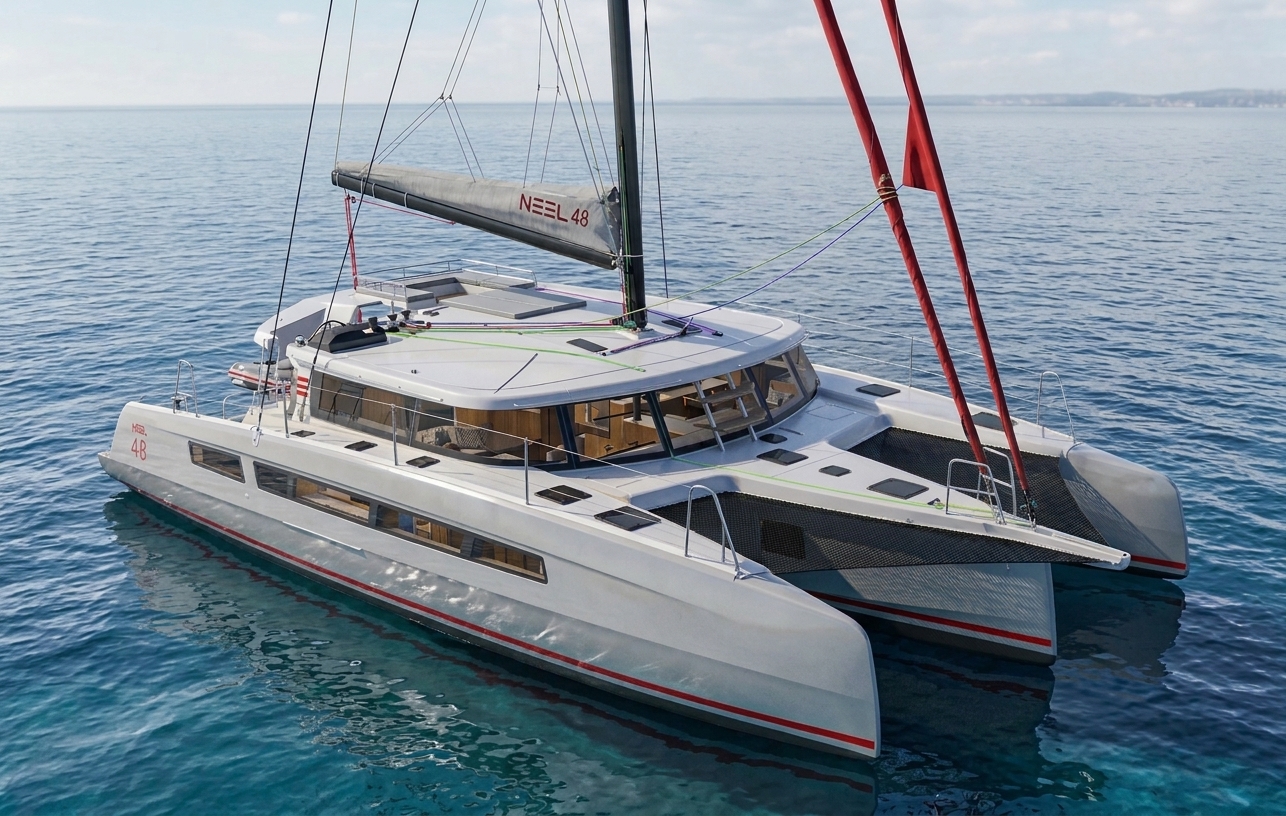
The Paris Nautic Show opens at Le Bourget on 25 November with a particularly useful opportunity for prospective offshore multihull owners: NEEL Trimarans is presenting the planned NEEL 48 alongside conversations about its existing 43 and 52 range. The La Rochelle builder says the first hull of the 48 project is scheduled to launch in September 2027. That distinction matters. This is a presentation of a future design and an opportunity to question the builder, not a report of a completed launch or a claim that a finished 48 is afloat. At Stand E31, visitors can meet Maxime Vedrenne and Charles d'Aviau de Ternay throughout the five-day show, which runs through 29 November. For readers examining the 12–24-metre ownership market, the news is less about an exhibition opening than about how one of the few builders committed to cruising trimarans is describing its next generation before the first vessel is delivered.
A 2027 launch horizon, not a 2026 delivery
NEEL's announcement is unusually explicit about the programme. The company identifies the NEEL 48 as a new project and says the first hull is expected to be launched in September 2027. An announced target is not the same thing as a confirmed delivery slot, an owner handover or a completed sea trial. Anyone using the Paris meeting to plan a 2027 or 2028 cruising season should ask for a written build programme, key decision dates, deposit arrangements and a current specification, rather than assuming that the exhibition date marks production readiness. Models can evolve between an initial presentation and the first boat, particularly where the design introduces new structures or underwater appendages. The most useful outcome of a show conversation may therefore be a clear list of what is already engineered, what has been validated and what remains subject to design change. That evidence is more valuable than a confident but undocumented launch promise.
What NEEL is promising for the 48
The yard's official event announcement describes exceptional living space, a dedicated owner's suite, high-performance equipment and innovative appendages as intended features. It does not, in that announcement, publish a complete inventory of installed machinery, independently measured performance, final certified displacement or a detailed price schedule. Those omissions do not undermine the project; they set the limits of what can responsibly be reported today. The words 'high performance' need to be translated into intended displacement, sail-plan calculations, achievable operating speeds and eventually recorded sea-trial results before buyers can compare the new design with established boats. Likewise, an apparently generous owner's suite should be examined through dimensions, access routes, ventilation and motion at sea. A configuration drawing may express an appealing design intention, but only a completed build establishes the practical compromises that come with bulkheads, tankage, systems and sail-handling equipment.
Why a trimaran changes the ownership question
A cruising trimaran is not merely a catamaran with a third hull. Its central hull accommodates important structural and living functions while the floats provide stability across a broad platform. That arrangement raises distinctive questions about marina berth width, loading, bridge-deck use, weight distribution and access to machinery. Owners accustomed to a monohull may find the breadth and layout attractive but should budget for marina restrictions and the realities of moving a wide craft through crowded harbours. Compared with cruising catamarans, the relationships among central hull volume, outer hull buoyancy, and the position of living spaces are different. None of those characteristics, considered in isolation, establishes whether the 48 will suit an individual owner. A family seeking quiet coastal weekends will place different value on the design than a crew planning repeated Atlantic passages, and both should begin with their actual sailing pattern rather than a brochure photograph.
The 43 and 52 provide essential context
NEEL is not presenting the new project in isolation. Its Paris announcement specifically says representatives will discuss the NEEL 43, 48 and 52 range. This is valuable because an interested buyer can distinguish features inherited from working boats from ideas that are specific to the proposed 48. On the 43 and 52, established arrangements for helm protection, sail controls, interior separation and access to forward areas give the owner useful reference points. A brochure comparison is only a start. More useful questions include what has been changed after owner feedback, which components are common across the range, and whether experience from existing offshore passages has informed the new project. Where a claim depends on a numerical measurement, the yard should be asked to supply the current technical sheet. Model names identify the range, but should never be treated as a verified metre-by-metre statement of final overall length.
Space should be evaluated in motion
The announcement puts particular emphasis on living space and the owner's accommodation. Buyers should resist evaluating that promise solely in square metres or in wide-angle interior renderings. It is also important to consider how crew members reach the galley, a bathroom or the cockpit in a seaway, where handholds can be placed, and whether sleeping positions remain practical when the yacht is moving. A beautiful central social space can transform time at anchor but can create long unsupported walking routes if the joinery has not been designed for passage-making. Cross ventilation, daylight, the direction of cabin doors and stowage capacity matter just as much as a dramatic panoramic view. The ideal inspection involves walking a comparable completed NEEL in port and, where possible, seeing how its sailing characteristics affect normal use. Paris offers the design conversation; later sea trials should supply the evidence.
Appendages and performance deserve precise questions
NEEL describes the 48's appendages as innovative, but the public exhibition notice stops short of a detailed technical explanation. This is an area where serious owners should request drawings and ask about maintenance procedures, impact tolerance, grounding considerations and access for inspection. Underwater geometry influences how a sailing yacht behaves, but real performance also depends on hull loading, rig configuration, propeller drag and sailing technique. The yard may have sound engineering reasons for the arrangement, yet a comparison with other multihulls should be made under similar conditions and with a realistic cruising payload, not by quoting an unverified peak speed. Owners intending to sail short-handed should also examine how any performance-oriented choices affect handling loads, reefing, visibility and autopilot operation. The right question is not simply whether the yacht can sail quickly; it is whether that performance can be accessed safely and consistently by the crew who will actually operate it.
A practical list for a meeting at Stand E31
The show invitation identifies two people available to discuss the new design and encourages appointments in advance. Prospective clients should take advantage of that access. Ask for the latest general arrangement and the revisions already made since the first concept. Request a breakdown of what the quoted build specification includes: rigging, sails, batteries, energy production, electronics, tender handling and essential safety equipment. Discuss how technical options change weight, balance and electrical endurance. A realistic ownership worksheet should include import and registration arrangements, insurance, home-berth feasibility, commissioning, warranty support and routine yard access. Buyers considering a managed vessel should determine where service and repair decisions will be handled once the yacht is away from France. These are ordinary due-diligence questions, but they are especially important before a new design has accumulated a record of completed deliveries.
La Rochelle's construction experience matters
NEEL emphasizes that its trimarans are designed and built in La Rochelle. A buyer can use that information to examine production oversight, supplier relationships, material traceability and the yard's arrangements for customer visits. A construction location is not proof of quality on its own, yet it gives a clear starting point for independent inspections and communication with the team responsible for the work. For a new 48, milestones such as final engineering sign-off, tooling completion, hull assembly, systems installation and launch preparation are worth separating. An owner who understands those stages will be better placed to make decisions on optional equipment without disrupting essential build work. The same approach helps a surveyor or technical representative develop a sensible inspection schedule. In this context the announcement of a September 2027 first-hull launch is a useful planning marker, not an assurance that every later milestone is fixed.
Paris is a decision point, not a substitute for sea trials
The Paris Nautic Show is held at the Paris-Le Bourget Exhibition Centre from Wednesday 25 to Sunday 29 November. NEEL lists Stand E31 and says it welcomes advance appointments. The strongest reason to attend is therefore direct access to project information at a moment when the future 48 is taking shape. A visitor can compare a new design's intended capabilities with the practical experience represented by the existing range and identify questions that should be answered before financial commitments are made. The sailing community has no shortage of ambitious renderings; what distinguishes a responsible new-build decision is the paper trail from declared design objectives to technical evidence and completed construction. For now, the clearly verified development is the presentation of the NEEL 48 project and its stated 2027 first-hull target. Further announcements should be assessed against that original timeline, and the first actual sea trials will provide the most meaningful test of the builder's aspirations.
Sources and image credits
Reporting based on NEEL Trimarans: first-party Paris Nautic Show 2026 attendance and project update, NEEL Trimarans: builder's NEEL 48 design, 14.75m length and autumn 2027 programme.
Lead rendering: Official NEEL trimaran under-sail illustration accompanying its November 2026 NEEL 48 Paris project announcement; conceptual image, not a launched NEEL 48. © NEEL Trimarans and its original designers. Official illustrative image supplied with the builder's project announcement; underlying rights remain with the creator. Original official image source.