Luxury Yacht Guide News | 21 November 2026
A November report revisits a summer sea trial
Dufour Yachts has published a detailed account of two days of press sea trials of its Dufour 54 off La Rochelle, describing how the substantial cruising sailboat performed in light summer winds and how visitors responded to its accommodation. The official report, dated 10 November 2026, covers sailing on 7 and 8 July after earlier tests near Marseille. Dufour says German journalist Michael Good measured a speed of up to 6.8 knots in 8–10 knots of wind, while a French sailing journalist observed progress above five knots upwind under light conditions. The company's account also focuses on the hardtop's usefulness when temperatures approached 40°C and on a range of interior configurations. Those are specific, practical observations for owners evaluating a cruising yacht in the seventeen-metre category, where comfort, sailing efficiency and the ability to manage the boat with limited crew are all important.
What the reported speeds do and do not show
A cruising yacht's ability to make progress in light wind can influence how often the engine is needed on a coastal passage. The builder's November article cites Michael Good of YACHT magazine for a maximum of 6.8 knots in 8–10 knots of wind. That is a useful reported observation, but it is not the same as an independently published polar-performance chart for all wind angles and sea conditions. Speed depends on sail selection, sea state, trim, boat loading and the accuracy of the instruments used. A few minutes of favourable conditions can produce a higher peak than the average maintained through an extended passage. The most meaningful result is the evidence that journalists considered the boat responsive in conditions in which some heavy cruisers might struggle to sustain comfortable progress. Prospective owners should request a full performance assessment suited to their intended sailing programme.
The La Rochelle sailing environment
The two days took place under bright sunshine, with light wind occasionally strengthened by a thermal breeze. That is a very different test environment from a demanding offshore passage in strong wind and steep seas. A boat may be balanced and lively in light airs yet place more demanding loads on its crew when conditions deteriorate. Dufour's report notes that an earlier trial in Marseille had exposed the model to stronger winds and produced favourable comments about its handling. Comparing reports from different locations is useful, although the condition of the sails, load aboard and exact configuration may not have been identical. A serious buyer should resist reducing the entire sailing experience to one figure. The important question is whether the yacht can sustain manageable, efficient progress across the range of conditions likely to be encountered in normal use.
The hardtop became important in extreme heat
With temperatures reaching around 40°C during the La Rochelle trials, the cockpit's fixed protection from the sun received particular attention. The company says the hardtop provided welcome shade while permitting air movement and maintaining good access around the cockpit. On a luxury cruiser, that contribution may matter more to guests than a small difference in maximum speed. A well-protected outdoor seating area can be used through the hottest part of a Mediterranean afternoon, whereas an exposed cockpit may become uncomfortable even when the yacht is stationary. However, shade is only part of thermal comfort. The orientation of the vessel, material temperatures, available ventilation and whether the yacht is moving all affect the experience. Prospective buyers should inspect the hardtop's visibility, drainage and the way it integrates with sail handling rather than regard it as a decorative feature.
Cockpit ergonomics for actual passages
The manufacturer's summary of the journalists' observations describes a cockpit that functions as an outdoor room. Tables, usable recesses and an arrangement that provides space for movement are important because objects must remain secure when the vessel heels or rolls. The ideal cockpit should allow an owner to socialise at anchor while preserving a clear route to winches, lines and the helm under way. The relationship between those functions is difficult to understand from a static side-profile image. A detailed inspection should include reaching for controls while seated and moving between the companionway and the deck under simulated passage conditions. For an owner travelling with guests who are less familiar with sailing, secure handholds and uncomplicated circulation can be as valuable as the amount of seating.
Sixteen reported interior combinations
Dufour's November account refers to sixteen potential interior arrangements, a significant number for a yacht in this size category. The example inspected by the journalists included two aft cabins, a forward owner's suite, an office area and a dressing-table arrangement. The ability to configure the lower deck offers options for owners with different priorities. A family may value additional sleeping accommodation, while a couple undertaking long passages might prefer a dedicated working area and more storage. Yet every change in partitioning can influence service access, tankage location and the usability of shared spaces. The existence of multiple layouts should not encourage choices based on cabin count alone. Buyers need accurate drawings and a clear understanding of what is included in the price, as well as any implications for ventilation and storage.
An office that doubles as a navigation space
The report notes that journalists paid attention to an office capable of serving some traditional chart-table functions. In a modern yacht, electronic navigation can be distributed among helm displays, tablets and mobile devices, but there remains value in a place to consult documents, plan routes and work without occupying the main dining table. The arrangement can also be helpful for owners who divide time between cruising and professional commitments. A secure desk, reliable charging points and space for communications equipment may be more valuable than a nominal study that cannot be used comfortably underway. It is sensible to verify whether a proposed layout includes the necessary wiring, lighting and seating, since a photograph of an attractive desk cannot establish how effectively the area supports real tasks.
Handling and comfort in one design brief
The Dufour 54 is positioned as a yacht for owners who want considerable living space while retaining capable sailing behaviour. Those goals are not inherently contradictory, but they do require careful engineering. Additional interior volume affects displacement, while broad deck structures can influence weight and windage. A full cockpit shelter improves comfort but must be integrated into the rig and deck plan. The reported light-air performance suggests that Dufour's design team sought to maintain a useful sailing response despite those constraints. Yet the published press summary should be treated as a report of selected tests, not proof that the yacht is faster than all alternatives. Buyers comparing boats should consider sail-area ratios, actual displacement, cruising payload and the effort required to change sail configurations in different conditions.
What to request before committing to a Dufour 54
Prospective customers should review the exact hull and sail specifications, all sixteen advertised layout options, the relationship between equipment packages and the boat's displacement, and the service access around machinery and plumbing. A sea trial is most informative when conducted with the load and sail inventory representative of actual intended use. Owners should also ask how easy it is to reef sails, whether the cockpit remains protected during rain and how the boat is ventilated below decks in hot climates. The company has drawn on press experiences from different locations, providing useful qualitative feedback. A buyer should compare those accounts with their own inspection rather than accept a selected endorsement as a complete technical report.
A more useful narrative after the premieres
The November release is valuable precisely because it moves beyond the excitement of a new product presentation and addresses how the Dufour 54 was experienced on the water. Observations about light-air speed, shade and interior flexibility speak to everyday ownership rather than purely visual appeal. They also illustrate the importance of context: a fast result under particular conditions is not a universal performance guarantee, and a comfortable cockpit at anchor may have different strengths in heavy weather. For Luxury Yacht Guide readers considering a seventeen-metre sailing cruiser, the report provides questions worth taking into a proper sea trial and a reminder that the most successful boats balance their sailing and domestic personalities without forcing an owner to choose one entirely at the expense of the other.
Sources and image credits
Reporting based on Dufour Yachts official 10 November 2026 sea trial account and journalist observations.
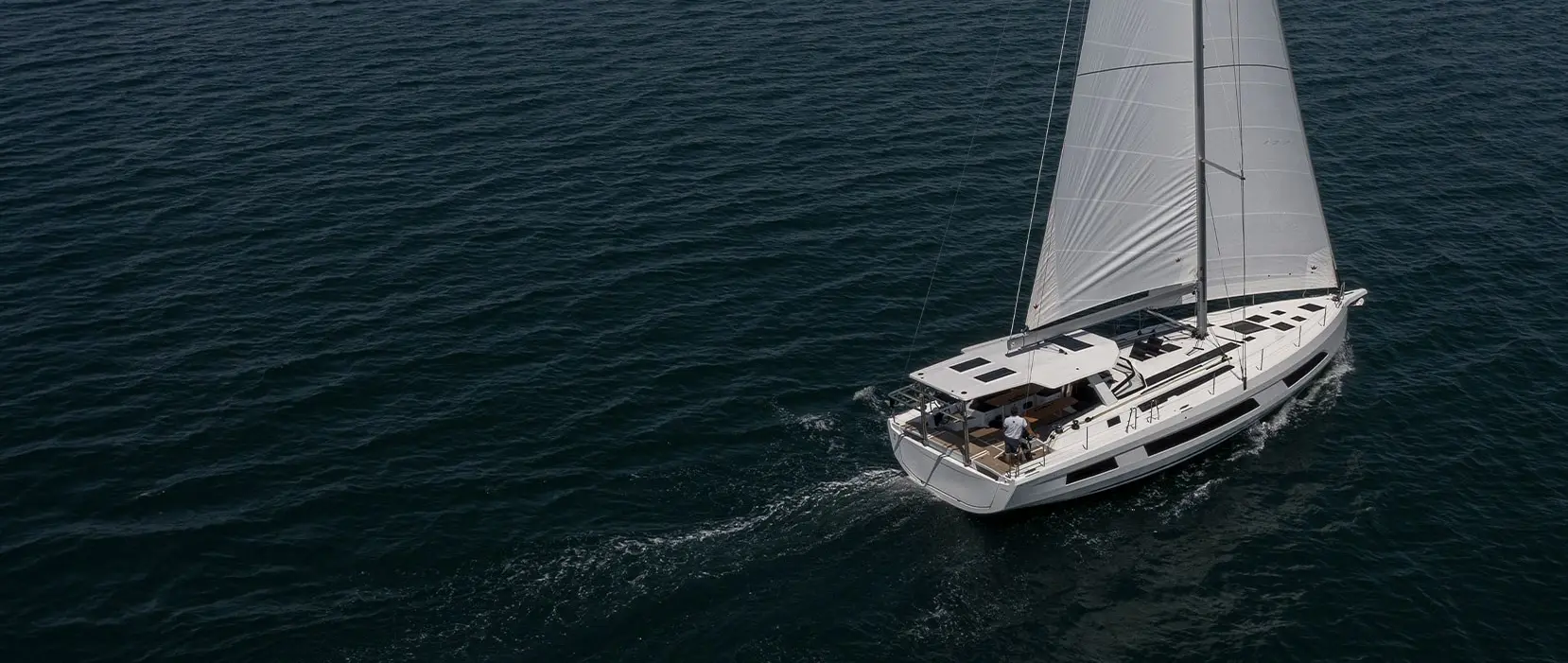
Lead photograph: Dufour 54 underway during official La Rochelle sailing trials. Dufour Yachts, first-party photograph issued with the builder’s November 2026 La Rochelle test report. Original official image source.