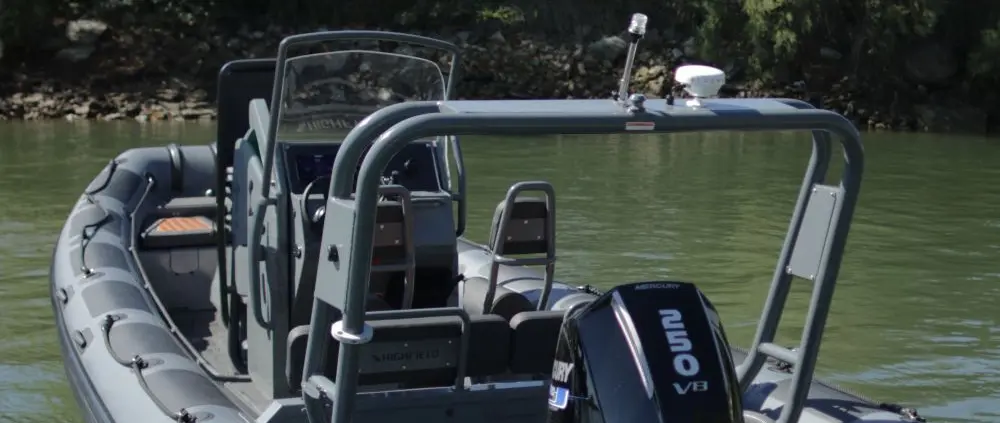
Mercury Marine and BlueNav have used the 2026 Cannes Yachting Festival to demonstrate a retrofit-style hybrid propulsion concept that keeps a conventional Mercury outboard while adding retractable BlueNav electric propulsion for low-speed operation. The approach is significant because it does not ask an owner to replace a serviceable combustion engine simply to gain electric manoeuvring and position-control capability.
The demonstration boat is a Highfield Patrol 700 fitted with a Mercury SeaPro 250 hp outboard and two 8 kW BlueNav electric motors. Although that particular RIB sits below Luxury Yacht Guide's principal yacht-size range, the propulsion architecture and BlueNav technology are applicable to larger leisure boats and therefore relevant to the wider ownership and equipment market.
Combustion power remains the primary propulsion
In the demonstration, the Mercury outboard remains responsible for higher-speed running, range and the normal passage-making role. The BlueNav motors are intended to take over when silence, fine thrust control and low-speed efficiency are more useful, such as harbour manoeuvres, position holding and slow operation.
This is different from a single hybrid drivetrain that blends two power sources through one transmission. It is better understood as two propulsion systems sharing the same boat, with each used for the operating phase where it has the strongest practical advantage.
A retrofit route lowers the barrier to hybridisation
BlueNav says its technology can be installed on boats that already have Mercury propulsion, making hybrid capability possible without removing the main engine. For an owner considering an upgrade, that can materially change the economics because the existing outboard remains part of the package rather than becoming redundant equipment.
The concept also allows electric propulsion to be added for specific functions instead of forcing the entire boat to depend on battery power for range. That pragmatic approach may suit owners who want quieter harbour operation and smarter manoeuvring but are not ready to accept the charging, weight or range trade-offs of full electrification.
Mercury alternator output supports onboard charging
Mercury and BlueNav point to the charging capability of Mercury outboards as part of the integration strategy, with some V8 models offering alternator output up to 115 amps. That electrical generation can support the BlueNav system and helps explain why the companies see the pairing as more than a temporary show installation.
Actual charging performance will depend on the engine model, battery architecture, duty cycle and other onboard electrical loads. Owners evaluating a retrofit would therefore need a proper energy audit rather than assuming the headline alternator figure translates directly into unlimited electric running time.
Smart Navigation adds another layer to the hybrid proposition
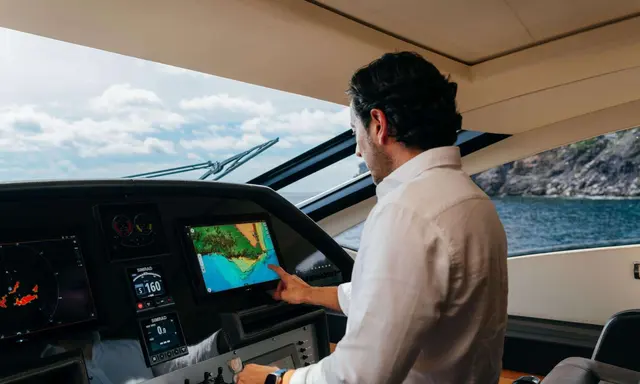
BlueNav combines the electric motors with functions including Virtual Anchor, Smart Mooring, Docking 360° and control through the BlueNav App. Those features use electric thrust not just as propulsion but as a precise actuator for low-speed vessel positioning.
That is where the collaboration becomes particularly relevant to yacht owners. Hybridisation is often discussed mainly in terms of fuel and emissions, but the strongest near-term benefit may be a quieter and more controllable boat during the parts of ownership that are most stressful: docking, holding station and moving slowly through confined water.