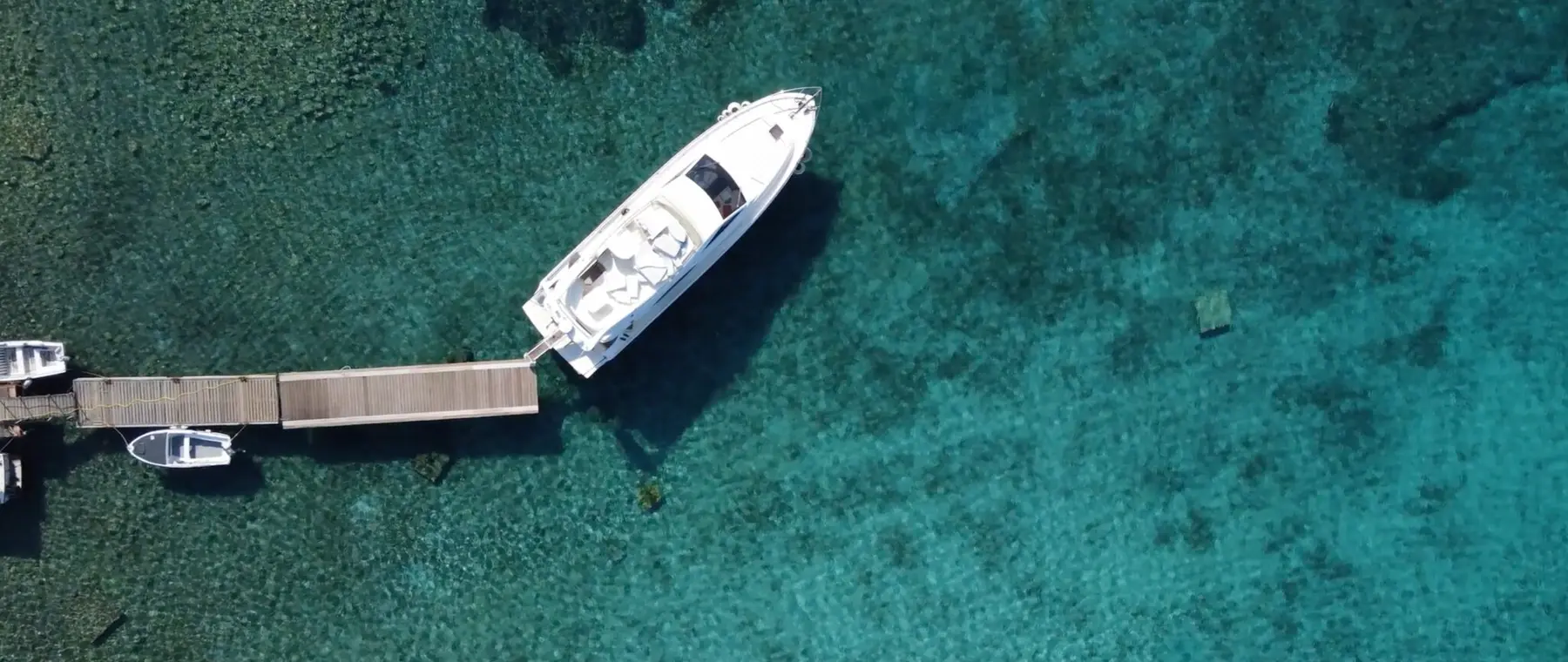
BlueNav Smart Mooring has won Best Equipment Improving Navigation at the 2026 Cannes Yachting Festival Innovation Route Awards, recognising a system designed to make close-quarters boat handling more precise and less stressful. The award puts an owner-facing navigation function ahead of more conventional electronics upgrades, which is significant because manoeuvring remains one of the moments when technology can most directly reduce workload.
Smart Mooring combines BlueNav electric motors, the company's Precision+ GPS and its app-based control environment. Rather than treating propulsion and navigation as separate systems, BlueNav is using electric thrust as part of a coordinated position-control package.
Smart Mooring extends control around the boat
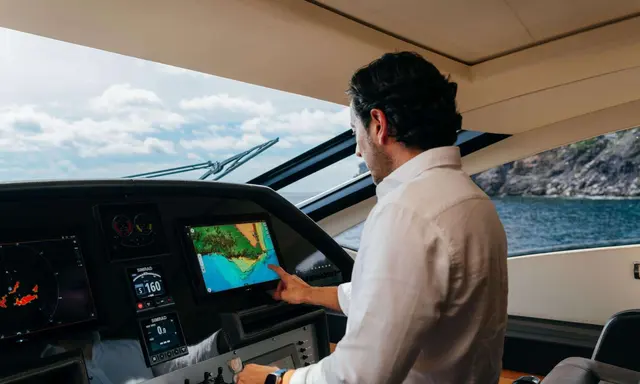
The BlueNav App can be used to supervise and adjust Smart Navigation functions from a smartphone, allowing the operator to move around the deck while keeping access to key controls. BlueNav positions that mobility as especially useful during docking, when sightlines and communication can matter as much as the helm display itself.
The system is intended to work with BlueNav's propulsion and positioning hardware rather than functioning as a standalone phone application. That integration is important because dependable low-speed control requires the software, position sensor and propulsive response to behave as one system.
Precision+ GPS targets 20-centimetre accuracy
BlueNav says its Precision+ GPS can deliver positioning accuracy down to 20 centimetres and updates at 10 Hz, with NMEA 2000 connectivity for onboard integration. The company uses that position data for functions including Dynamic Positioning, Virtual Anchor and Smart Mooring.
For owners, the useful question is not the headline accuracy number by itself but whether the system can maintain predictable behaviour in wind, current and confined water. Those real-world conditions are where electronic position keeping either reduces stress or becomes another layer the crew has to manage.
Electric propulsion becomes a manoeuvring tool
The award also illustrates a broader change in hybrid and electric boating: electric motors are being used for more than low-emission cruising. Their precise response at low speed makes them suitable for position control, docking assistance and other tasks where fine thrust changes are more valuable than maximum power.
BlueNav is developing this approach alongside conventional propulsion rather than insisting every boat become fully electric. Its recent collaborations show a strategy in which combustion propulsion handles higher-speed passages while electric propulsion and Smart Navigation take on low-speed and precision work.
What the Cannes award does — and does not — prove
The Innovation Route Award gives Smart Mooring useful industry recognition, but owners should still judge any manoeuvring system by installation quality, redundancy, service support and performance in the conditions they actually encounter. A demonstration in calm water cannot answer every operational question.
Even with that qualification, the direction is important. Manoeuvring assistance is moving from isolated thrusters and joysticks toward software-coordinated propulsion, and BlueNav's Cannes result shows that this is becoming a mainstream area of yacht technology development.