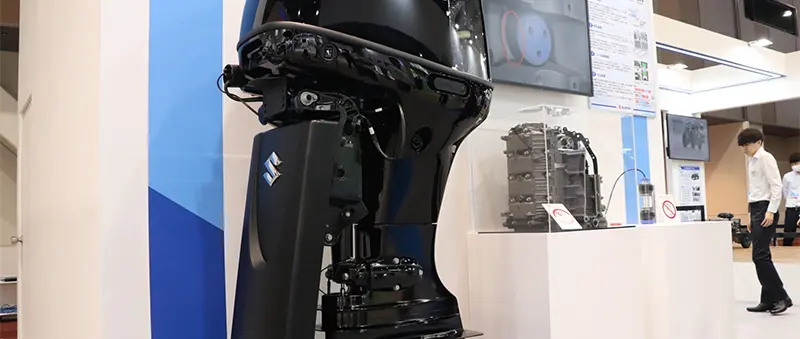
Suzuki Edge eCoat has won Best Eco-Friendly Product at the 2026 Cannes Yachting Festival Innovation Route Awards, recognising an engine-component treatment designed to improve corrosion resistance while reducing manufacturing emissions. The result is notable because the innovation is already being used in production outboards rather than remaining a future concept.
Suzuki developed the anodising process for components including the cylinder block, cylinder head and crankcase, where cooling water exposure and high operating temperatures create demanding conditions. The company says the treatment forms a uniform protective layer in water passages and other areas that are difficult to protect consistently with conventional coatings.
Corrosion protection is the owner-facing benefit
Saltwater use places a long-term burden on internal cooling passages and exposed engine materials, so corrosion resistance directly affects durability and maintenance risk. Edge eCoat is intended to improve protection in those areas while also withstanding the high temperatures found around the engine.
That makes the technology more relevant to owners than a sustainability claim that changes only the factory process. If the coating performs as intended over years of service, environmental gains in manufacturing are paired with the practical benefit of protecting expensive engine components.
Suzuki says manufacturing CO2 falls by about half
According to Suzuki Marine, Edge eCoat reduces carbon-dioxide emissions associated with the relevant treatment stage by around 50 per cent compared with conventional chemical treatment and painting. The reduction comes from eliminating drying and baking processes used with paint-based protection.
The claim concerns the manufacturing treatment rather than the total lifetime carbon footprint of an outboard, so it should not be confused with a 50 per cent reduction in engine operating emissions. That distinction matters when comparing environmental claims across propulsion products.
The process is already moving through production
Suzuki first used the process on the DF140B in August 2024 and had extended it by September 2025 to the DF140BG, DF140B, DF115BG and DF115B. The company says adoption will progressively expand across its marine model range.
That rollout gives the Cannes award more weight because buyers can encounter the technology in actual engines rather than waiting for a future generation. It also gives Suzuki a growing installed base from which long-term corrosion performance can eventually be judged.
Sustainability increasingly includes how equipment is built
Marine sustainability discussions often focus on fuel consumption, hybridisation and alternative propulsion, but manufacturing processes can also be improved without changing how an owner operates the boat. Edge eCoat is an example of that less visible route to reducing environmental impact.
For Luxury Yacht Guide readers, the useful measure will be whether the process delivers both sides of the proposition: lower manufacturing emissions and durable protection in saltwater service. The Cannes award identifies the technology as worth watching, while service history will provide the more important long-term evidence.