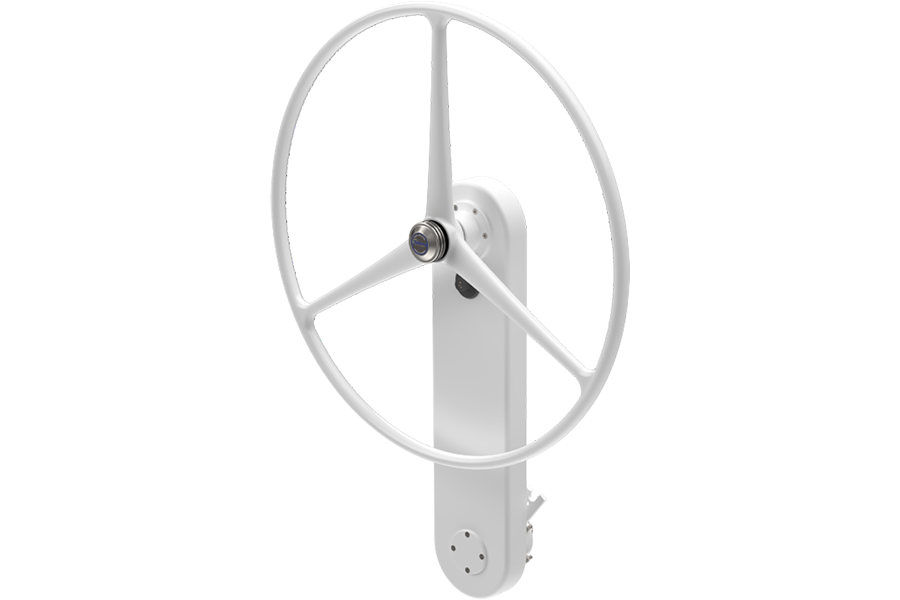
A new direction for cockpit steering equipment
Jefa Steering has introduced the WP950, a bulkhead-mounted steering pedestal developed particularly with multihull yachts in mind. The supplier announced the product through its BSI Marine Equipment Group presence at METSTRADE 2026, where it described an arrangement that attaches directly to a bulkhead rather than requiring the usual cockpit-floor mounting. It can be positioned differently from one yacht to another and configured for wire or mechanical steering transmission. That combination makes the WP950 more than a revised pedestal shape: it gives designers another way to arrange circulation and helm ergonomics on catamarans.
The company is positioning the WP950 as a more compact and flexible alternative for owners familiar with its WP900 and WP910 pedestals. It does not say that all existing boats can install the new model without structural alterations, or that any arrangement can be certified merely because a pedestal is offered for refit. For readers commissioning a luxury catamaran, the relevant news is the change in layout possibilities and the engineering questions that follow.
Why the bulkhead mounting matters
A conventional pedestal frequently competes with seating, passageways and working space on a yacht's cockpit sole. Mounting a steering assembly on a suitably engineered bulkhead could leave more of that floor area available, particularly on boats where the cockpit serves several jobs at once. Owners may want protected seating, access to a side deck, a dining area and a helm station in the same aft or forward cockpit. Removing a floor-based pedestal foundation can provide a designer with new options, although the actual amount of usable area depends on the geometry of the individual boat.
The structural load does not disappear when the mounting point moves. Steering wheels are handled under dynamic conditions, and people naturally use nearby fixtures for support. An installation must consider loads at the bulkhead, local reinforcement, water ingress around fixings and how those loads pass into the supporting laminate or other structure. The WP950 should therefore be evaluated as a complete steering arrangement, not just a space-saving fitting.
Wire and mechanical transmission compatibility
Jefa says that the WP950 can be adapted to wire or mechanical transmission steering systems by changing the sprocket on its outgoing shaft. That detail is potentially valuable because not every multihull relies on the same steering layout. Boatbuilders can select a transmission approach suited to their hull geometry and intended installation, while refit yards can investigate whether the new pedestal may be compatible with a vessel's established system.
Compatibility still demands more than exchanging one part. Wheel diameter, expected torque, routing distances, cable bends, linkages, rudder stops and emergency-steering arrangements must be considered together. A pedestal that works in a supplier workshop might behave differently once connected to a long, complex system with two rudders. Builders should request current drawings and specify the exact sprocket and downstream transmission components before promising an owner any particular conversion.
Moving the steering position
The official announcement notes that the WP950 can be moved from port to starboard and fixed in different positions. This invites designers to reconsider where the skipper stands for docking, manoeuvring and sailing. On a multihull, sightlines may be different when approaching a pontoon on the port side or when watching the leeward hull. The ability to adjust the location of a wheel could be valuable if the mechanism remains practical and secure within the chosen cockpit layout.
Actual benefit depends on the boat rather than on the product's name. A fixed central helm may remain the safest configuration for a particular yacht, while a more flexible arrangement might suit another. A prototype or mock-up should show whether the operator can reach engine controls, sail-handling switches and the relevant instruments from every approved steering position. Moving the wheel should not leave critical equipment awkwardly out of reach.
The engagement mechanism described by Jefa
Jefa has also described a straightforward handle-operated engagement system. Its official release says the handle can be opened to change pedestal position and then clicks into the next position as the selected location is reached. The engagement plate can be placed at a desired angle and made to order when a custom configuration is required. For owners and yards, this is an indication that the supplier has considered the routine act of adjusting the equipment, not merely its appearance in static drawings.
The operational requirements are more demanding than the appearance suggests. A designer needs to understand how positive engagement is confirmed, what prevents unintended movement, and what checks should be made before sailing or manoeuvring. The announcement does not provide a universal safety procedure or a complete set of load specifications. Those details belong in installation and operation instructions supplied for the actual system chosen.
Materials and protection outdoors
The WP950 uses high-strength aluminium in an effort to keep weight relatively low while retaining the strength expected of steering equipment. Jefa says it applies an alochrom treatment for protection and a durable finish. Both details are pertinent to luxury yachts, where cockpit hardware may spend extended periods in salt spray, tropical sunlight and changing humidity. A component that can be carried and positioned conveniently is of little benefit if its exterior deteriorates rapidly or its moving elements become difficult to operate.
The exact service environment still matters. Direct contact between different metals, fastener selection, drainage and maintenance access affect long-term durability. A yard should confirm the recommended isolation and fastening method and whether the surface treatment is appropriate to the proposed finish and cleaning routine. Owners should avoid assuming that a treated aluminium component is completely maintenance-free.
What this means for luxury catamaran design
Luxury catamarans often offer generous beam but that does not mean cockpit space is unlimited. Helm visibility, deck traffic and the separation between active sail handling and guest relaxation can make or break an otherwise attractive design. Designers may now consider a bulkhead steering pedestal when trying to create a more adaptable cockpit without surrendering a major portion of the usable sole. It is a worthwhile new option for concept studies and early engineering discussions.
The decision should be taken alongside rig-control locations, guardrails, companionway openings and the need for crew to move safely when the yacht heels or pitches. Although multihulls tend to sail with comparatively modest heel angles, motion at sea and sudden acceleration can still be significant. The WP950 is a hardware development, not a substitute for good traffic planning, adequate handholds or proper human-factors work.
New builds and retrofits need different assessments
On a new build, the bulkhead can be prepared for the loads and the steering runs planned around the WP950 from an early design stage. The yard has more control over panel thickness, reinforcement, cable routes and the placement of accessible inspection points. Coordinating those tasks before mouldings and cabinetry are finalised may help avoid awkward compromises later. The pedestal's configurable output also offers a clear subject for discussion between the steering supplier and a yacht's naval architect.
A refit has far less freedom. Existing furniture, structural panels and steering linkages may limit where the pedestal can go. Removing a floor-mounted unit may leave penetrations that require careful repair and finishing. The owner must budget for work beyond the price of the new pedestal, including surveys, drawings, possible reinforcement and a full steering-system test. That is why a statement of product compatibility should not be mistaken for a fixed installation cost.
Keeping maintenance and emergency steering in mind
A yacht steering system should be inspectable and understandable to the people who maintain it. A compact bulkhead-mounted arrangement might improve accessibility in one installation and complicate it in another. Engineers should ask how to inspect the outgoing shaft, change an associated sprocket, check locking engagement and monitor wear over time. Maintenance instructions should also specify any adjustment limits and the correct approach after a suspected overload or collision with an obstruction.
Emergency arrangements must remain central to the design. A mechanical steering problem should not make it impossible to reach the approved emergency steering connection or obtain independent rudder control where required. The official launch information does not establish the WP950 as a standalone emergency-steering solution, so builders must evaluate it within their yacht's complete equipment and certification plan.
The WP900 and WP910 comparison
Jefa says the new product retains many of the features appreciated by users of its WP900 and WP910 families while making the installation more compact and flexible. This gives prospective buyers useful context, but it should not be read as proof that internal components, maintenance intervals or external dimensions are interchangeable across the range. A careful comparison will require drawings, mounting details, transmission ratios and the precise options available for the intended vessel.
Experienced owners may judge steering equipment primarily by feel rather than by appearance. The free movement of the wheel, response to small corrections, resistance under changing loads and ease of operation can all shape the helmsman's confidence. A boat-show display can demonstrate the mechanism; a properly commissioned yacht provides the fuller test of whether the chosen arrangement meets the owner's expectations.
A practical checklist for the specification meeting
Before ordering, an owner or yard should ask Jefa for dimensional drawings, approved mounting and reinforcement requirements, the available sprocket choices, details of the movable-position locking mechanism and the treatment of exposed fixings. The installation review should include steering loads, cable runs, helm visibility and how the operator accesses other controls. It should also confirm which settings may be changed by the crew and which are intended for installation specialists.
The WP950 was presented through the BSI Marine Equipment Group at METSTRADE in Amsterdam in November 2026. Its significance is that steering-equipment design can support different cockpit layouts instead of forcing every project toward one floor-mounted pedestal arrangement. For smaller luxury multihulls and custom catamarans, that is a useful development provided the freedom of movement is backed by sound engineering.
The next step after a trade-show introduction
The strongest case for any newly announced piece of steering equipment comes from installations that are appropriately documented, tested and supported. Jefa's published explanation gives buyers a clear initial description: bulkhead mounting, selectable steering-transmission compatibility, repositioning capability and a handle-operated engagement mechanism. It does not establish vessel-specific performance or universal suitability, and a responsible specification should preserve that distinction.
A thoughtful yacht project will translate the new options into tangible outcomes: safer movement through the cockpit, sensible helm ergonomics, a maintainable steering train and a finish suited to long-term outdoor use. The WP950 deserves attention because it broadens that design conversation, not because it eliminates the need for it.
Sources and image credits
Reporting based on Jefa Steering, official supplier-submitted WP950 launch news for METSTRADE 2026 via BSI Marine Equipment Group.
Lead photograph: Jefa Steering WP950 alternate first-party product photograph. Jefa Steering WP950 official manufacturer product photograph from its own WP950 model page; a different image from its METSTRADE 2026 announcement. Original official image source.