A three-part idea reaches Amsterdam
Swedish marine-technology company Humphree says it will bring its integrated three-component stabilisation system to METSTRADE in Amsterdam on 17–19 November 2026. The presentation follows the product’s earlier appearance at the Cannes Yachting Festival and puts the combination of electric fins, a gyroscopic stabiliser and interceptors in front of designers, builders and suppliers preparing their next yacht specifications. Humphree identifies stand 01.681 as its meeting point. It is an upcoming exhibition presentation, not a claim that a new boat fitted with the system has just been launched or delivered.
The announcement matters to Luxury Yacht Guide because Humphree describes the arrangement as engineered for leisure yachts from 35 feet upward. That range overlaps much of the 12-to-24-metre luxury-yacht segment, especially owner-operated motor yachts and compact crewed cruisers. It does not follow that every 12-metre yacht can accept every component without major structural or electrical work. Suitability depends on hull design, displacement, available space, power architecture and the way a vessel is used. Those practical distinctions are more useful to an owner than a broad promise of comfort on every sea.
What the manufacturer has actually announced
On its official METSTRADE page, Humphree calls the integrated package “Total Stabilization Elevated” and identifies three elements: electric fins, a gyro and interceptors. The company plans to show the system to boatbuilders during the Amsterdam exhibition and will also promote its Lightning interceptor technology. Its company news record dates the METSTRADE preview to 29 September 2026, while the event itself lies ahead. The distinction in dates is important: this is a preview of equipment at an approaching trade show, not a new product unveiling that occurred on 10 November.
Humphree’s wider news archive explains that the three-component approach builds on the manufacturer’s existing interceptor and fin work by adding an integrated gyroscopic unit. Each technology tackles a different aspect of movement and operation. The marketing proposition is that combining their strengths may improve the consistency of the boat’s behaviour over a wider range of conditions than relying on one device. Humphree has not supplied, in the exhibition announcement, a vessel-by-vessel independent comparative trial demonstrating a particular percentage improvement for every yacht class.
A simple distinction: fins, gyro and interceptors
Fins are underwater control surfaces that can generate a corrective force as water passes them; depending on the design and control system, active fins may also be used to reduce rolling when the boat is nearly stationary. A gyro takes a different route, using the dynamics of a rapidly spinning mass to resist roll. Interceptors act at the transom, altering pressure and lift around the aft part of the hull and helping regulate running attitude. They are often associated with trim, pitch and roll control while moving. The exact functions of an individual installation depend on the equipment supplied and its operating modes.
Those are complementary tools rather than three labels for the same mechanism. A fast motor yacht making a lively crossing may benefit from active running-attitude control, while a family spending an afternoon at anchor will often judge comfort by how much the boat rolls as people move around. The engineering challenge is not simply to bolt on another actuator. It is to coordinate sensors, software and control outputs without creating contradictory corrections or unexpected changes in feel. Humphree is presenting its integration as the answer to that challenge.
Why the 12–24-metre owner should pay attention
In a yacht of 12 to 24 metres, space and mass are finite resources. A system that could be accommodated comfortably on a larger semi-custom vessel may compete with storage, fuel, batteries, machinery access or tender arrangements on a smaller boat. Owners therefore need to separate a compelling technical concept from a feasible installation. The manufacturer’s statement that the equipment is intended for leisure yachts from 35 feet creates a relevant starting point; it is not a substitute for a detailed sizing proposal that addresses the exact hull.
There is also a guest-experience reason to look carefully. On a compact luxury yacht, the salon, aft cockpit and cabins are closer to the water and to the motion of the hull. Reducing uncomfortable rolling can influence whether guests choose to stay aboard for a long lunch or return to the marina earlier than planned. At speed, smoother attitude may reduce fatigue for someone standing at the helm. These are logical use cases, but the value of Humphree’s particular combination still needs evidence from a properly matched yacht and operating profile.
Not all stabilisation happens at the same speed
It is easy to discuss “stability” as a single performance statistic, but the requirements change across a day afloat. Leaving a berth involves manoeuvring at low speed. Coastal passages may involve a range of speeds and sea angles. At anchor, the yacht has little forward motion, and the dominant discomfort may be side-to-side rolling. A system that works superbly in one condition may be less effective in another unless it has a suitable operating mode. The reason for combining fin, gyro and interceptor technologies is therefore understandable, even before independent performance results are examined.
For a prospective buyer, the useful question is how the system transfers between those modes. Does the helm display communicate which elements are active? What happens when speed drops abruptly? How are alarms handled? Is there a transparent manual override? The exhibition should be an opportunity to ask about integration rather than merely admiring a polished control panel. No published short description, however sophisticated, can replace a sea trial with the actual hull and a representative load on board.
The new gyro and the retrofit question
Humphree says the newly integrated gyro expands its stabilisation offering, and its technical-document centre lists installation guidance for a HIG5 gyroscopic unit. The existence of documentation is useful evidence that the package has entered a stage where installers need to consider real mounting and service requirements. It does not prove that the gyro can be safely installed anywhere a space happens to be free. Gyroscopic equipment has loads, heat, vibration, access and electrical demands that must be evaluated by the manufacturer and qualified marine professionals.
Retrofit owners face additional constraints. They may have to preserve access to existing machinery and firefighting systems while finding suitable foundations, cable routes and ventilation. The designer must consider total mass and its location, not just the box dimensions. Shore power and generator capacity may also constrain the decision. These are general engineering considerations, not claims that Humphree’s current design requires a particular electrical upgrade. Any promise of a straightforward fit should come only after a survey and the supplier’s written specification.
Fins and through-hull decisions
Fin stabilisers are established on cruising yachts, but installation requires serious attention to the hull. A fin system generally introduces penetrations, bearings or drive mechanisms and structural loads that cannot be treated as incidental accessories. On a new build, the naval architect can plan the reinforcement and equipment location early. On a completed yacht, available structure and space may narrow the range of choices. The owner also has to understand what maintenance and inspection will entail over several seasons, not only what the system does during the first demonstration.
Humphree’s materials promote electric fins and its recent company updates describe a next-generation fin servo intended to make operation quieter and maintenance more accessible. Such advantages, if demonstrated in a particular installation, can matter on smaller yachts where cabins may sit close to machinery spaces. Yet noise level and service interval should not be assumed from marketing language alone. Ask for the conditions of any quoted test and the exact product version, then have a competent yard assess the practical implications for the vessel.
Interceptors and the running hull
The Lightning interceptor line will also be displayed at Humphree’s METSTRADE stand. The manufacturer promotes the ability of responsive transom-mounted surfaces to alter lift, speed and efficiency, but a buyer should distinguish a technically plausible mechanism from a guaranteed fuel saving. Changes to trim can affect resistance; the net outcome depends on the specific hull, loading, speed and control tuning. A percentage claim achieved on a demonstrator does not automatically transfer to a deep-V sports cruiser or a heavier flybridge yacht carrying full tanks.
On board, the visible result of good interceptor control may be less dramatic than a marketing animation suggests. A yacht that rises onto plane with a more manageable bow attitude, keeps an appropriate running angle or reduces repeated pitching can feel easier to drive. However, incorrect setup can produce unwanted behaviour. Experienced commissioning, a documented baseline and a supervised trial are important before treating a fitted system as an automatic improvement. Data from a real vessel is much stronger than a general product claim.
Integration is the real test
The distinctive feature of Humphree’s announcement is not that marine fins, gyros and interceptors exist; all are familiar technologies. The story is the intention to make them operate together as one controlled package. That raises questions about shared sensors, prioritisation of corrective actions, fault handling and the information shown to the operator. In an owner-operated yacht, simplicity matters: the skipper should not need to become a systems engineer to understand whether the vessel is in an appropriate mode.
A thorough product assessment should ask whether one component can be isolated for maintenance while the others remain functional, how faults are logged, and what happens if communications between components fail. Owners should also ask which data are available on their existing displays and which require a dedicated control head. Humphree provides manuals and integration documents through its technical-document centre, but the exact configuration must be confirmed against the manufacturer’s current drawings and approved installation guidance.
What METSTRADE visitors can verify
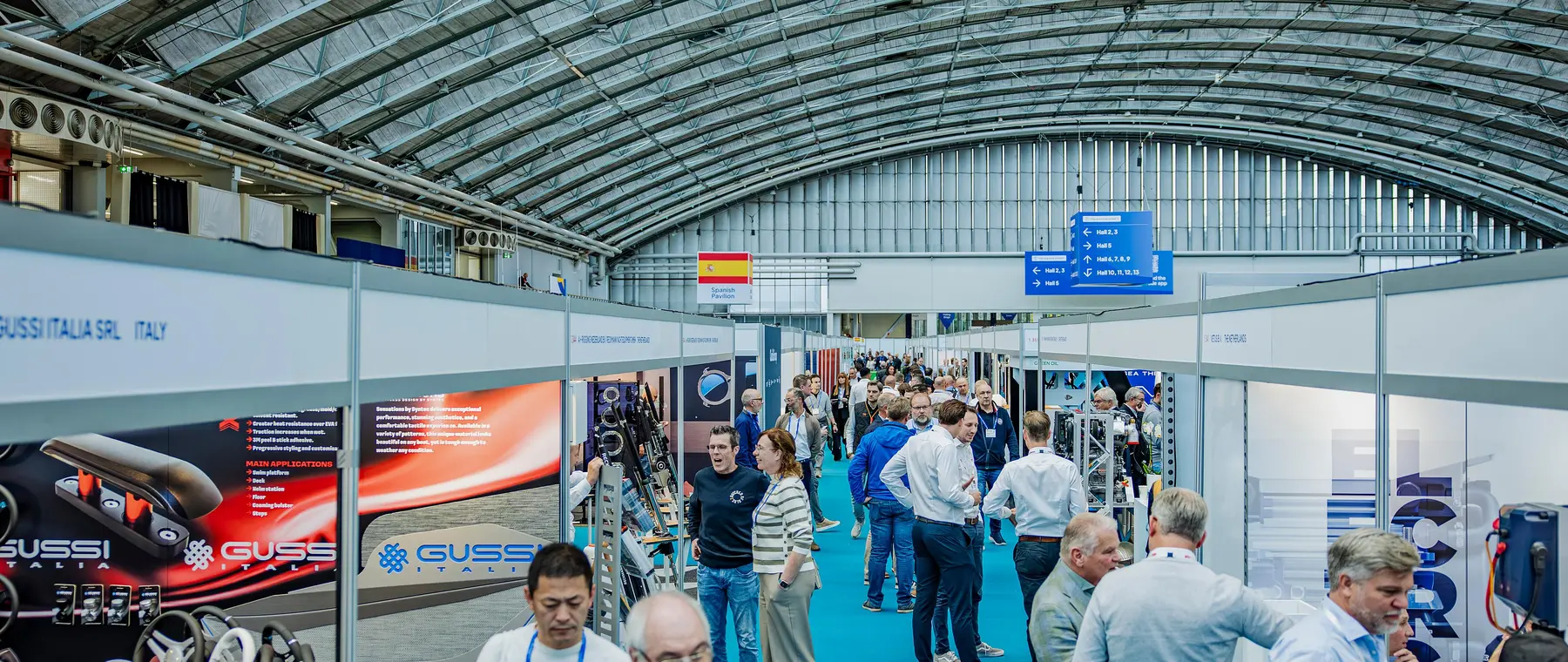
METSTRADE 2026 is scheduled for 17–19 November at RAI Amsterdam. Humphree lists stand 01.681; as with any exhibition appointment, the number and availability should be checked in the organiser’s directory before a visit. The event offers a chance for prospective buyers, installers and builders to discuss sizing and commissioning with the supplier in person. A static stand demonstration can clarify interfaces and engineering philosophy, even if it cannot reproduce the motion of a yacht in open water.
Owners arriving with a specific project should bring useful facts rather than a vague request for “better comfort”: hull model, length overall, beam, draft, displacement, typical speed range, existing equipment, planned operating area and any recurring motion complaints. A builder or naval architect may additionally need drawings and machinery specifications. Ask which components Humphree would recommend, why it would omit any others and what comparable installations can be inspected or trialled. A good answer may be a smaller configuration, not necessarily the entire three-part package.
Operating costs and lifecycle questions
A stabilisation upgrade has consequences beyond purchase price. Running power, inspection, service access, software updates, corrosion protection and the availability of trained local technicians all shape the ownership experience. On a 12–24-metre yacht used seasonally, downtime in the middle of a short cruising window may matter more than a modest difference in theoretical performance. The decision should therefore account for spare-parts logistics and the likely service plan across several years.
An owner should request a written, vessel-specific proposal with equipment, installation, structural work, electrical changes, commissioning and sea trials shown separately. That makes competing options easier to compare. Do not assume a lower fuel bill, a particular resale premium or a specific reduction in roll without evidence tied to the hull and sea state. The manufacturer’s presentation provides a starting point for a technical conversation; it is not a complete ownership-cost calculation.
Reading the claim carefully
Humphree describes its system in ambitious language about comfort, control and performance. Those are the manufacturer’s product claims, not conclusions reached through independent testing by Luxury Yacht Guide. At the time of this report, the published METSTRADE preview does not include a standardised trial matrix for 12-, 18- and 24-metre yachts or comparative measurements for each of the three components operating together. That absence does not establish that the technology is ineffective; it defines what has yet to be independently substantiated for readers.
The distinction is particularly important when discussing motion. “Less roll” can mean different things at anchor, on a beam sea at displacement speed or when turning sharply at planing speed. A proper demonstration should specify speed, loading, wave conditions, instrumentation and whether the crew applied any manual corrections. Buyers can then judge whether the results resemble their own use. Such discipline gives a sophisticated owner a better basis for investment than a spectacular short video.
What happens next
The scheduled Amsterdam appearance gives Humphree a timely opportunity to explain why it has combined technologies that are often specified separately. The supplier’s statement places the product squarely within the conversation about comfort on compact luxury yachts, while the detailed engineering assessment will remain vessel specific. Owners considering a new build can raise the subject early with their naval architect. Refit owners should begin with a practical survey before committing to equipment quantities or expected results.
For the sector, the wider question is whether more integrated control packages can make a yacht’s behaviour consistently pleasant across the many states that define a normal cruising day. Humphree will have the chance to present that proposition at METSTRADE, alongside its Lightning interceptors. Until then, the firm facts are the announced three-part configuration, the company’s leisure-yacht positioning, and the confirmed exhibition plan. Performance on any given 12–24-metre hull remains a question for documented testing and competent installation, not an assumed result.