Two equipment ideas, one cabin-comfort question
Blue-Airco has put two different approaches to onboard climate control into focus ahead of METSTRADE 2026: a 12-volt variable-speed air-conditioning unit and a kit designed to create two independently regulated comfort zones from one existing system. For owners of luxury yachts between 12 and 24 metres, the distinction matters more than the exhibition headline. One product concerns the refrigeration machinery itself; the other concerns the way conditioned air is distributed and controlled. They address overlapping owner frustrations—limited machinery space, uneven cabin temperatures and electrical demand—but they do not offer identical solutions.
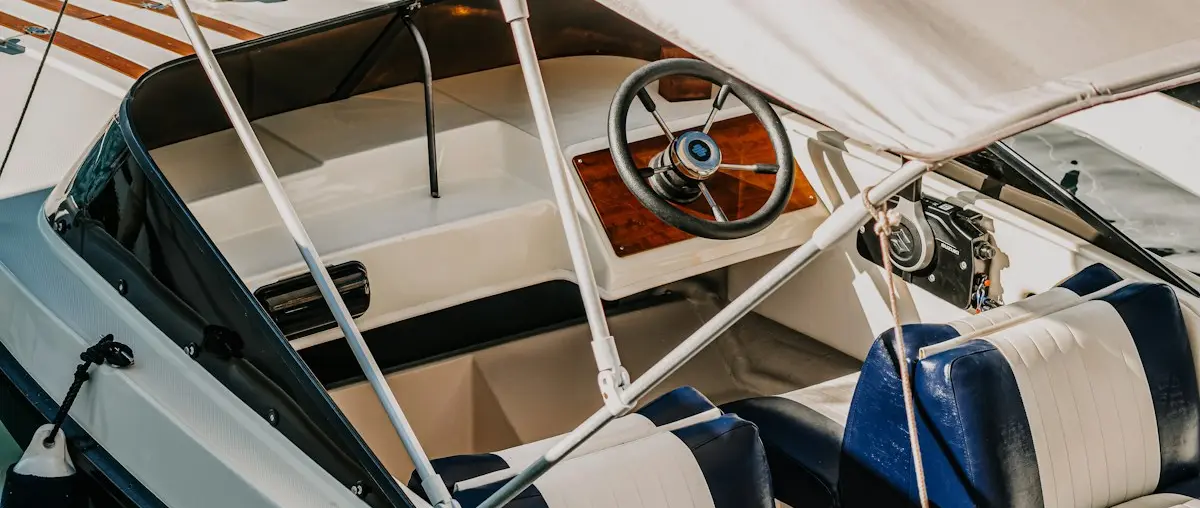
The Italian supplier identifies the SDC15V12E as part of its 12V DC range and separately presents a Multizone Control Kit. The trade show's exhibitor pages describe both in technical terms. The company is not claiming that a standard split system can be replaced without design work, nor that a second climate zone creates additional cooling capacity. These are engineering products whose suitability depends on a particular yacht's compartment layout, ventilation, electrical arrangement and operating profile. The accompanying boat-interior photograph is an illustration of onboard space, not a product or installation photograph.
What is new about the SDC15V12E
The SDC15V12E is a 12V DC, variable-speed self-contained marine air conditioner. Blue-Airco lists a maximum cooling output of 15,100 BTU per hour, equivalent to roughly 4.4 kilowatts, with reported power consumption of 790 watts under its stated tropical test conditions. The manufacturer says its Evolution model uses revised compressor and heat-exchange components together with faster electronic-expansion-valve control. Those are meaningful design changes in a category where space, weight and performance at low demand are operational concerns rather than brochure details.
The METSTRADE product description compares the new model with the preceding SDC12V12 and states an increase in cooling output of 21.8 percent without changing the unit's quoted 470 by 300 by 330-millimetre dimensions or 28-kilogram weight. That does not mean every existing installation is a drop-in swap. Connections, airflow, electrical protection, service access, refrigerant specifications and installation instructions still have to match. The figures should be read as the manufacturer's published specification, not as independent measurements obtained aboard a yacht.
Low-output operation and battery thinking
The company also reports an ECO operating point of 5,400 BTU per hour at 170 watts. This illustrates a potential advantage of variable-speed refrigeration: the machine may reduce output and input when the thermal load is lower. For an owner who spends quiet nights at anchor, the relevant question is not simply how much a unit can cool at maximum demand. It is how it behaves during the long periods when a cabin needs only enough conditioning to maintain comfort. The exact outcome will depend on insulation, humidity, outside temperature and the way other loads share the DC system.
The 12-volt architecture should not be treated as an invitation to connect the unit to any available battery cable. The company's own table indicates current approaching 66 amps at the cited maximum operating point, before allowing for the details of installation. Cable length, voltage drop, battery chemistry, inverter or charger interactions, fusing and charging capacity require a proper electrical design. In a 12–24-metre yacht, there may be generous domestic battery capacity, but 'low voltage' is not synonymous with 'light duty'. A practical refit assessment begins with a load schedule and a competent marine electrician.
A change in refrigerant with implications
The new unit uses R-454C refrigerant rather than the R410A specified for Blue-Airco's older 12V models. METSTRADE lists a 390-gram charge and a global-warming-potential figure of 148 for the new system. Those numbers are product claims worth quoting accurately, but a refrigerant change is not merely a marketing comparison. It can affect handling procedures, safety requirements, service equipment and future maintenance. An owner should insist that the installation and any subsequent service follow the dedicated model manual and relevant local regulations.
Blue-Airco provides a specific installation manual for the SDC15V12E and distinguishes it from instructions covering its other self-contained products. That separation is particularly important where an apparently familiar casing may conceal different refrigerant and control requirements. A qualified installer should evaluate compartment ventilation, access, seawater intake and discharge, condensate removal and safety arrangements. A company brochure cannot establish the compatibility of a particular yacht. The sensible message is that a newer product creates options, and responsible selection still requires detailed survey work.
The Multizone kit is not another air conditioner
Blue-Airco's second announcement takes a different path. Its Multizone Control Kit is intended to serve two independently controlled climate zones from an existing single air-conditioning unit, managing the distribution of conditioned air rather than adding a new refrigeration circuit. The trade-show description identifies a motorised shutter, a variable-speed brushless DC fan and a dedicated touchscreen. The stated standard kit weight is around 1.8 kilograms, while quoted airflow capacity reaches 200 cubic metres per hour with an electrical load of about 22–24 watts.
Those figures help explain the idea, but also the limitation. If two cabins together require more cooling than the underlying air-conditioning unit can supply, a smart shutter cannot manufacture the missing capacity. The value would be in better control of delivery to spaces with different occupancy and heat gains. A guest cabin that is empty much of the day may not need the same airflow as the saloon. Conversely, a small cabin with direct sun exposure can demand careful balancing. The system needs suitably designed ducts, return-air paths and commissioning; a touchscreen alone does not solve poor duct geometry.
Integration for a contemporary yacht
The manufacturer says the kit operates across 12-, 24- and 48-volt DC systems, an attractive prospect for yachts with different service-voltage arrangements. The SDC15V12E specification also mentions connectivity through MQTT with Wi-Fi, Modbus RTU and CAN Bus. For a modern yacht, these interfaces are potentially useful because climate control may sit alongside lighting, energy management and monitoring dashboards. Yet the existence of an interface is not proof of plug-and-play compatibility with a particular vessel's automation platform.
Any integration ought to be defined by the actual installer and the supplier: supported messages, control authority, fault reporting, cybersecurity, behaviour during network loss and warranty responsibilities. An owner may prefer simple standalone controls if the yacht does not have an established automation system. Another might need status integration without giving a central screen unrestricted control over cooling plant. These choices are most easily made during a refit survey. The objective is a predictable onboard environment that crew can maintain, not maximum complexity for its own sake.
Why it matters between 12 and 24 metres
In this size band, yacht designers must often fit comfortable accommodation, tender storage and useful machinery into a hull that still has to perform efficiently. Adding a second compressor, seawater system or substantial duct network can have disproportionate consequences when technical spaces are already crowded. A small controls-led change may therefore be appealing where the existing refrigeration plant has capacity but distribution is the problem. Conversely, a more efficient replacement unit may be appropriate when the machinery is ageing, the owner's energy goals have changed or a refit is already planned.
The right specification begins with a heat-load calculation, not a sales headline. Count the people normally aboard, identify the hottest spaces, measure the existing electrical demand and assess the condition of seawater plumbing and ducts. Ask what can be serviced without dismantling joinery. Also consider night-time noise and guest comfort, because cooling numbers alone cannot describe whether a cabin feels restful. The product information gives useful questions to take to a designer or installer rather than an automatic shopping list.
What to verify at METSTRADE and afterwards
METSTRADE is scheduled for 17–19 November 2026 in Amsterdam, and Blue-Airco is presenting these products through the show's supplier listings. A serious buyer should ask for current full datasheets, installation constraints, independent operating evidence where available, local service arrangements, pricing and lead times. The most valuable exhibit discussion may concern a real refit case: an existing yacht, its cooling load, machinery space and electrical budget. A supplier who can explain what will not work is often more useful than one who promises a universal solution.
At this stage, the confirmed news is the supplier's published technical offering, not an independently tested installation aboard a particular 18-metre yacht. The climate-control case for smaller luxury yachts is nevertheless clear. Owners increasingly ask whether comfort can be improved without multiplying equipment, wiring and maintenance. The SDC15V12E and Multizone Control Kit propose two distinct ways to address that question. Whether either delivers on a given vessel will be determined in the machinery space, under load, after careful installation and commissioning.
Image credit: Boat interior illustrating marine onboard comfort — Frames For Your Heart / Unsplash. Original photograph, used under the Unsplash License. The lead photograph is illustrative and does not depict an unverified product or berth.