A technical programme before the equipment show
The 29th International HISWA Symposium on Yacht Design and Yacht Construction will take place at RAI Amsterdam on 16 and 17 November 2026. This year's theme, From Experiments to Experiences: Exp², is particularly relevant to owners considering a yacht whose design relies on unfamiliar hull forms, active stabilisation or new propulsion technology. The organisers have published a detailed two-day programme, including a course on the basic principles of seakeeping, a concentration of research on hydrofoils and a session on the hydrodynamic performance of catamarans. The symposium begins a day before the main Metstrade exhibition opens on 17 November. The programme is a schedule of presentations, not the publication of completed research findings. Luxury Yacht Guide examines the subjects announced for the conference and how they relate to the design and operation of yachts measuring twelve to just under twenty-four metres. Some of the research concerns much larger vessels; its relevance here is the underlying engineering method, not a claim that every technology discussed is available for mid-size yachts.
Why the operating profile comes before the design target
The opening technical presentation on Monday, by Rob Grin of MARIN, addresses key performance indicators and the operating profile of a yacht. This is an important starting point because a design target is only meaningful when related to actual intended use. An owner who principally cruises in sheltered archipelagos may value different characteristics from someone who makes long passages in open water. A yacht employed for short trips between nearby marinas may spend proportionately more time manoeuvring and at anchor than a vessel running repeatedly at sustained passage speed. The brief should therefore distinguish the expected conditions and duties before asking a naval architect to optimise a hull or select a stabilisation system. The priorities can conflict: a particular speed objective may affect machinery size, fuel requirements, accommodation and the weight of the installed equipment. A useful performance brief specifies which characteristics matter in the owner's anticipated operation and how they are to be measured. It is more informative than a list of impressive maximum figures without the conditions associated with them.
Seakeeping means more than a comfortable saloon
R. S. Nicoll of DSA Ocean is scheduled to cover the fundamentals of seakeeping analysis. Reint Dallinga follows with an introduction to ship motions and the operating principles of stabilisation systems, and the programme includes a workshop. For buyers, these subjects bear on an experience that can be surprisingly difficult to assess at a boat show. A yacht in calm water reveals little about the character of its motions in a seaway. Roll, pitch and heave can have quite different effects on passenger comfort, and the motion at one location on a yacht may be different from that at another. A forward cabin and an aft seating area do not necessarily provide the same experience. Frequency and acceleration matter as well as the visible magnitude of motion. Owners should discuss representative conditions with their designer or broker before accepting a sea-trial demonstration as a complete indication of behaviour. The conference's announced introductory sessions provide a useful vocabulary for such discussions; they do not establish performance values for any individual boat.
Catamaran resistance and the importance of a systematic series
Monday's afternoon programme includes a hydrodynamic assessment of a systematic series of catamarans presented by A. Dell’Acqua of MARIN. A systematic series permits engineers to compare families of hull configurations while varying selected characteristics in a controlled manner. This is more useful for understanding the influence of design parameters than a simple comparison between two production yachts that differ in many respects. For the owner considering a multihull of fifteen or twenty metres, the relevant questions include the relationship between speed and resistance, the geometry and separation of the hulls, and how operating displacement influences performance. Interior volume, stability and the way the vessel fits a marina are also relevant, but they should not be inferred from resistance measurements alone. The announced programme does not supply the study's quantitative conclusions. What it demonstrates is the continued importance of organised experimental and analytical research behind a category often marketed mainly through its accommodation space. Request the relevant model's own data rather than transfer numerical claims from a research hull to a production yacht.
From simulation to the operating envelope
The foiling concentration begins with Tigrane Dubois of SailGP discussing development of the racing series' simulator. Mario Caponnetto follows with a presentation on the design and control of modern hydrofoil craft. Research scheduled from Sara Rasori of the University of Genoa concerns use of a computational-fluid-dynamics-based flight simulator to assess the operating envelope of foil-supported vessels. A later contribution considers multidisciplinary optimisation of hydrofoil design. Taken together, these are complementary questions. Finding an efficient foil shape is not sufficient if the complete vessel cannot maintain stable and useful operation over its anticipated range of loads and conditions. Intelligent control can become part of the relationship between the hull, foils and moving water. A yacht intended for family cruising has further demands that differ from those of a racing vessel, including variable stores and passengers, maintainability and predictable manoeuvring. A buyer need not become a specialist in numerical simulation, but should ask what operating situations were represented in the design and which assumptions were tested experimentally.
Stabilisation performance at zero speed
A further Monday presentation by Nicoll addresses early-stage design evaluation of zero-speed fin stabilisation. The distinction between a yacht under way and one lying at anchor is significant because the flow over and around a fin, and the means by which it generates a useful stabilising moment, change with the vessel's movement through the water. A yacht owner considering an active system should ask for performance information that reflects the intended situation, including anticipated sea conditions, loading and available electrical or hydraulic power. Installation may also require structural provision, machinery access, suitable clearances and regular maintenance. The right comparison is between complete vessel arrangements, not simply brochure figures for two devices. An active system cannot eradicate every form of vessel motion, and its limitations should form part of any handover. The scheduled presentation is consequently interesting even to an owner who does not intend to purchase a new system immediately. It addresses the engineering work that should occur before a designer commits to a specific arrangement.
Model testing and computational work
The same programme brings together research on a fast method for predicting fishtailing on motor yachts, comparison of computational and experimental work for Voith-Schneider propulsion, and tank testing and computational studies of ABB's Dynafin concept. These are diverse applications, not interchangeable methods of improving an ordinary luxury yacht. Their common interest is the process by which an engineering claim is evaluated. A numerical calculation depends on the assumptions incorporated into it. An experiment has its own measurement limitations and a relationship to the full-scale vessel that must be understood. Comparing information from different methods can help identify where assumptions or uncertainties matter. This is why owners commissioning a custom design may benefit from an explicit agreement about what development and validation work is included. For a production-yacht purchase, the corresponding question concerns what was tested on the particular design and whether subsequent equipment or layout changes altered the applicability of that work. Do not assume that conference papers constitute certification or approval for a commercial product.
The second day and environmental assessment
Tuesday's agenda shifts toward energy systems, regulatory questions and environmental assessment. The announced contributions include a presentation by Philip Easthill of European Boating Industry on the Blue Boat Horizon project and global life-cycle-assessment collaboration, an overview of environmental indices from Engel-Jan de Boer of Lloyd's Register, and an explanation of YETI and ISO 23099 from Hanna Dąbrowska of Water Revolution Foundation. Several other papers are specifically concerned with large yachts, including presentations about a carbon-composite mast and propulsion research on a hundred-metre vessel. The mid-size market should distinguish its own technical and regulatory requirements from those examples. Nevertheless, the environmental-assessment discussions are of interest wherever suppliers seek to compare the consequences of construction, operation and maintenance rather than a single isolated measure. An owner should ask which product or vessel is covered by an index, what the boundaries and assumptions are, and whether a comparison uses equivalent data. An environmental figure that excludes an important part of the operating profile is liable to be less useful than its apparent precision suggests.
Information to obtain before commissioning or purchasing
For a twelve-to-twenty-four-metre yacht project, the symposium's announced agenda suggests a useful set of design conversations. Establish the intended passages, time at anchor, expected vessel loading and the speed range that will genuinely be used. Ask how the designer proposes to evaluate motion and resistance under representative conditions. Distinguish predictions from trials, and identify the equipment settings and loading conditions associated with reported results. If active equipment is involved, request documentation for energy demand, servicing, failure modes and the residual behaviour of the vessel if the system is unavailable. Multihull and foil-supported designs deserve the same practical examination of berthing, clearances and maintainability as other yachts. These are owner-facing considerations derived from the topics of the programme, not results attributed to the speakers. Their purpose is to make comparisons more useful and to direct attention to the information that should accompany the finished design.
Venue, registration and original programme
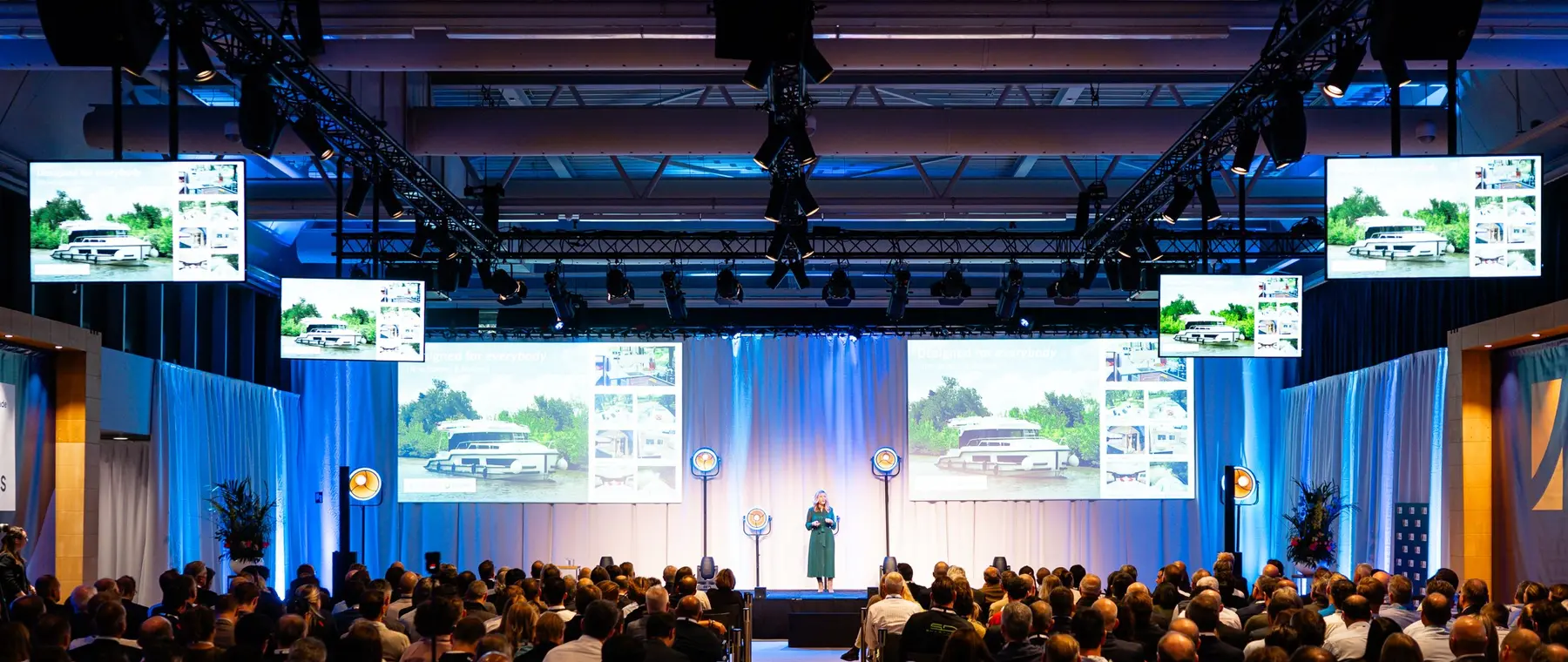
The symposium's secretariat is MARIN, which publishes info@marin.nl and telephone +31 317 493911 for enquiries. The organiser lists the meeting for Monday 16 and Tuesday 17 November, while Metstrade's official Monday schedule identifies the Emerald Room at Entrance G of RAI Amsterdam. Confirm the current conference registration conditions and access arrangements independently of a general exhibition admission. Metstrade itself runs from 17 to 19 November. At the time of this report the symposium is still ahead, and its published programme is the basis for the presentation details. The photograph below the headline comes from the official Metstrade press image library and depicts an earlier Metstrade opening event, not proceedings at the forthcoming symposium. The technical conference is interesting for the LYG market because it connects the design questions owners eventually encounter in their own boats with the research and analysis that precede equipment and vessel development.
Sources and photograph
Source documentation: https://hiswasymposium.com/programme/, https://hiswasymposium.com/, https://www.metstrade.com/what-to-expect/monday. Photograph: Metstrade opening event, RAI Amsterdam (archive photograph) — Metstrade / RAI Amsterdam official press library. Archival photograph of an earlier exhibition, not the forthcoming symposium. Press enquiries: pressmetstrade@rai.nl.
Explore
HISWA Yacht Design Symposium 2026 — event dates, venue, programme and official registration information.