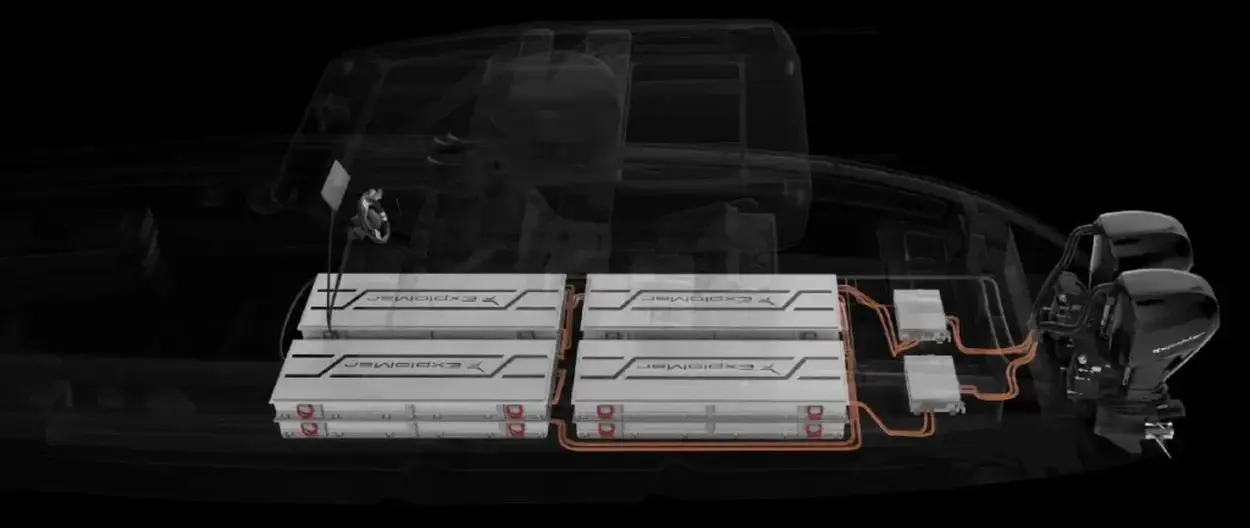
Electric propulsion specialist ExploMar is showcasing a family of 600-horsepower twin-outboard packages as part of its current marine powertrain range, including combinations of two WAVE 300 motors and different battery capacities for boats approximately eight to fifteen metres long. The manufacturer's official website lists systems with 360, 540 and 480 kilowatt-hours of battery storage, with the 480kWh version using a different semi-solid battery arrangement from the nickel-manganese-cobalt packs described for the other configurations. ExploMar participated in METSTRADE 2026 in Amsterdam from 17 to 19 November, where the company promoted its wider high-power electric outboard programme. These systems should not be confused with a new 400HP concept discussed in separate trade reporting or with ExploMar's existing 300HP WAVE model, which Luxury Yacht Guide has previously covered. The website's published figures are manufacturer specifications, not independent demonstrations of speed, range or charging time aboard a named yacht. For owners of smaller luxury performance boats and high-powered yacht tenders, the 600HP packages are noteworthy because they illustrate how electric propulsion can be specified as an integrated motor, battery and control system rather than as a direct replacement for two petrol engines.
What the manufacturer's 600HP page establishes
The ExploMar website describes three 600HP system configurations. Its first combines two WAVE 300 outboards with four SI-90 battery modules, producing a stated 360kWh capacity and a published total system weight of 2,596 kilograms. A second pairs two WAVE 300 motors with six SI-90 modules for 540kWh, with the supplier listing a weight of 3,676 kilograms. A third combines the twin motors with two HEDB 240 semi-solid battery units for 480kWh and a listed weight of 2,436 kilograms. The manufacturer refers to its Smart Captain control system in each package. These are the figures printed on the product page, and buyers should confirm the scope of each weight measurement and the applicable battery specifications. The page does not establish that every configuration is available for immediate delivery worldwide.
A system rather than a single outboard
The term 600HP could suggest one enormous motor, but the company's product presentation is explicitly based on two 300HP WAVE outboards working together. That difference matters to the boat's designer because twin installations have specific space, control and mounting requirements. The total power should also be understood as the manufacturer's quoted horsepower rating, not as a verified continuous output at every operating speed. The batteries and control hardware form part of the system. Owners considering an electric upgrade should examine the complete propulsion package instead of comparing a motor nameplate with the rating of an existing combustion engine. The boat's displacement, hull form and duty cycle will determine what performance is practical.
Why the eight-to-fifteen-metre range matters
ExploMar's first 360kWh configuration is associated with boats approximately eight to twelve metres long, while the larger battery options are described for vessels in the eight-to-fifteen-metre range. This overlaps the smaller end of Luxury Yacht Guide's 12-to-24-metre audience and is also relevant to performance tenders carried by larger yachts. It would be misleading to imply that the published package is intended to propel every 20-metre yacht or can be specified by length alone. A heavy displacement boat and a light planing craft may need very different power arrangements even when their dimensions are similar. Designers must review weight, available hull space and the intended speed profile before deciding whether the system belongs in a given project.
Energy storage creates the main trade-off
A larger battery generally offers the potential to store more energy, but it also adds mass and occupies space. ExploMar's 540kWh option weighs substantially more than the quoted 360kWh package, illustrating the physical cost of increased capacity. The 480kWh semi-solid arrangement is presented with a lower published system weight than the 360kWh nickel-manganese-cobalt option, a comparison that deserves detailed examination of exactly what components the manufacturer includes. A buyer should not assume that the weights are directly comparable without reviewing the complete specifications. Different batteries may also have different charging, thermal management and service requirements. A sensible design begins with the owner's required journey length and operating conditions rather than simply choosing the largest available capacity.
What the estimated energy-use figure means
The manufacturer lists a value of 3.75kWh per kilometre as an estimated consumption figure on the 600HP product page. That is not an independently measured constant for all boats using the equipment. Energy demand depends on hull resistance, displacement, speed, sea state, wind and loading. At higher speeds, a planing craft may experience a very different consumption pattern from one travelling slowly. Owners should not use the catalogue estimate as a guaranteed range calculation. Instead, the builder should obtain performance predictions for the intended hull and establish the assumptions behind them. Even a technically accurate test on one model may be a poor guide to another vessel with different dimensions or weight distribution.
Power and speed are not interchangeable
A 600HP rating does not establish a specific maximum speed without information about the boat and the propulsion configuration. Hull design and propeller selection influence how effectively power is converted into motion. Weight from battery systems can also affect planing behaviour and trim. ExploMar's website shows powertrain components but does not provide a universal speed guarantee for every compatible craft. Buyers should request actual performance data from representative hulls and a projected operating profile for their own project. A sea trial of a comparable boat may offer useful insight, but it should not be treated as conclusive evidence for an entirely different design. Luxury owners benefit from judging a power system by real use, not by a headline horsepower figure.
The difference between tender and primary yacht propulsion
Some owners may consider electric propulsion for a performance tender used to reach beaches, explore bays or carry guests ashore. Others are interested in a dedicated small luxury sport boat that is driven entirely by its electric system. Those uses impose different requirements. A tender may operate for shorter periods and recharge from shore facilities or a larger support vessel, while a primary cruising craft may need dependable power over longer journeys. A battery package that suits repeated short trips may be less appropriate for an itinerary involving extended passages. The boat's role should determine the required endurance and reserve, followed by the choice of motors and batteries.
Twin drives and manoeuvring
Two outboards can provide useful manoeuvring options when their controls and mounting arrangement are properly designed. The exact behaviour of an electric twin-drive system depends on its control architecture and any supported steering functions. ExploMar promotes a Smart Captain platform, but the short 600HP page does not provide enough detail to claim particular joystick, docking or automatic positioning features in every configuration. Owners should ask which functions are included and how the motors respond to different commands. Failure modes also need to be understood: the operator should know what happens if one motor or associated electrical component becomes unavailable. Convenient low-speed control is desirable, but predictable operation and clear safeguards are essential.
The Smart Captain control concept
The manufacturer identifies Smart Captain as its integrated control system and presents it as part of the overall electric propulsion architecture. This suggests coordination among propulsion and energy components, yet buyers must examine the specific functions rather than assume that a marketing name guarantees every desirable feature. A yacht's helm should display relevant information such as power availability and system condition in a form the operator can understand. It should also provide clear warnings and appropriate fallback procedures. The correct interface depends on the configuration supplied and its integration with other onboard equipment. A sophisticated control system is valuable when it simplifies normal operation without concealing technical information that the skipper needs to make safe decisions.
Charging infrastructure matters as much as motor output
A large battery installation cannot be evaluated without considering how and where it will be charged. Not every marina supplies the electrical capacity needed for rapid replenishment of hundreds of kilowatt-hours. Charging time will depend on available infrastructure, the onboard equipment and the battery's permitted charging rate. ExploMar's 600HP catalogue summary does not establish a universal recharge time, so such a figure should not be invented. Owners should examine their usual berths and destinations before choosing a package. The boat may require a particular shore connection, electrical installation or operating plan. A high-capacity battery can offer practical benefits, but only if its charging arrangements fit the owner's itinerary.
The effect of weight on boat design
The published package weights are significant, particularly for boats at the lower end of the eight-to-fifteen-metre range. A naval architect must consider where those components will be located and how their mass affects flotation, trim, stability and performance. Battery placement also influences access for servicing and potential cooling needs. A design intended from the outset for electric propulsion may offer more flexibility than a retrofit of a hull built around petrol engines and fuel tanks. Removing a fuel system can create space, but the net balance depends on the complete installation. Owners should request a detailed weight and centre-of-gravity study rather than assume that an electric replacement will fit where an existing engine package sits.
Battery chemistry requires precise questions
ExploMar distinguishes the SI-90 nickel-manganese-cobalt modules from an HEDB 240 semi-solid battery option. The public catalogue identifies different storage capacities and package weights, but it does not establish that one chemistry is safer, more durable or more environmentally responsible in every application. Those outcomes depend on cell design, thermal management, protection systems and operating conditions. Buyers should obtain technical and safety documentation for the exact battery model. The electrical designer should review fault protection, monitoring, service access and any requirements imposed by the vessel's flag or class. Marketing terms such as semi-solid should not replace evidence about the complete battery system's performance and handling requirements.
Thermal management and installation
High-power electric motors, inverters and batteries generate heat that needs to be managed within their approved operating conditions. ExploMar presents its electric propulsion products as integrated systems, but the boatbuilder must still confirm cooling demands, ventilation and physical separation of components. Different battery configurations may have different requirements. A boat operating in a hot climate could face different thermal conditions from one running in cool northern waters. Appropriate installation is essential to preserve reliability and avoid unwanted derating or faults. Owners should seek a complete equipment and installation proposal rather than relying only on the attractive images of outboards and batteries presented on the website.
The environmental discussion needs context
Electric propulsion avoids exhaust emissions at the point of use when operating solely from battery power, but the overall environmental effect depends on how electricity is generated and the impact of manufacturing and eventually handling battery components. The manufacturer promotes economic and environmental benefits, including lower energy costs in some comparisons, but these should not be generalised without knowing local electricity prices, operating speeds and usage. A large luxury tender may consume considerable energy if driven at high speed. The owner should assess the complete operating profile and local charging sources rather than assume that electric power makes every journey environmentally negligible. The strongest claims are those supported by transparent data for the actual boat.
Noise and the guest experience
Electric drives may reduce some combustion-engine noise during particular operating conditions, potentially making an outing feel more relaxed. However, propeller, wind and water noise remain, especially when a boat travels quickly. The 600HP product page does not provide comparative measured sound levels, so it would be inappropriate to describe the system as silent. The owner may want a quiet tender for visits to sheltered anchorages, but the true acoustic experience should be tested aboard a representative boat. The quality of the helm controls and vibration isolation also influences comfort. A well-integrated electric drive can support an enjoyable day, but the benefits should be demonstrated rather than simply assumed from the absence of an exhaust pipe.
Service arrangements for a high-power electric system
A large electric propulsion package contains components that may require specialist diagnosis and repair. The owner should ask how support is provided in the countries where the boat will operate and whether trained technicians are available nearby. ExploMar describes a growing international presence, but that does not establish identical service coverage in every destination. Batteries and control systems may need software updates and documented maintenance procedures. The yacht should retain serial numbers, system diagrams and emergency instructions. A successful ownership experience depends on being able to resolve problems promptly, particularly for a tender that may be essential to guests' daily movements.
Newbuild versus repower choices
A new luxury sport boat can be designed around the intended electric propulsion package, providing suitable spaces for batteries, cooling and charging equipment. A repower project faces constraints from the existing hull and structure. The yard must establish whether the transom, steering arrangement and electrical infrastructure can accept twin high-output outboards. Additional battery mass may require structural changes or affect the boat's operating trim. Removing fuel tanks does not automatically free enough space for every battery configuration. Owners should obtain a professional feasibility study before assuming that the published package is a drop-in replacement for combustion engines of similar horsepower. A careful design process protects safety and avoids unrealistic performance expectations.
ExploMar at METSTRADE 2026
The company promoted its wider high-power electric outboard programme at METSTRADE 2026, listing stand 05.501 in Amsterdam on its own website and appearing in the official exhibitor directory. Its current site includes powertrain families from smaller outputs to much larger designs, but the detailed 600HP page refers to the specific twin WAVE 300 configurations described here. The source does not prove that these three packages were all first launched in November 2026 or that a completed named luxury yacht has adopted them. Their presentation remains relevant to builders comparing electric propulsion systems during the current exhibition period. The immediate news value lies in the documented range of options and the engineering questions they raise.
What a buyer needs before choosing a package
An owner interested in a 600HP electric tender or sport boat should request a complete configuration quotation, including the definition of system weight, exact battery chemistry, charging equipment, protection systems and performance predictions for the intended hull. The builder should calculate realistic range at the speeds the owner actually expects to use. A demonstration of helm controls and an independently documented sea trial can help establish whether the product meets the desired experience. The buyer must also consider service support and whether the chosen charging infrastructure is available along the itinerary. ExploMar's catalogue provides meaningful starting figures, but selecting a sophisticated electric powertrain requires much more than matching a horsepower number.
A specific choice within a growing electric market
ExploMar's 600HP twin-outboard packages show the scale of energy storage now being marketed for performance boating, with configurations ranging from 360kWh to 540kWh and a separate 480kWh semi-solid option. These figures make the company's offering concrete enough for builders to evaluate while leaving important performance and cost questions unresolved. For suitable smaller luxury yachts and tenders, an integrated motor, battery and control package may offer new design possibilities. The right decision will depend on safe installation, practical charging and credible operating data. The announcement is most useful when treated as the beginning of a technical comparison rather than proof that high-powered electric propulsion already solves every challenge faced by a yacht owner.
Primary sources: ExploMar first-party 600HP electric outboard systems page, documenting the three WAVE 300 TWIN battery configurations, and the official ExploMar METSTRADE 2026 exhibitor listing. All estimated consumption, configuration and weight figures are manufacturer-provided; no independent range or speed is claimed.
Sources and image credits
Reporting based on ExploMar first-party 600HP electric outboard package catalogue listing, with three verified battery configurations, ExploMar official METSTRADE 2026 exhibitor listing, Stand 05.501.
Lead rendering: ExploMar 600HP twin WAVE 300 motor and 480kWh semi-solid battery manufacturer configuration image. ExploMar first-party original 600HP / 480kWh semi-solid-battery package product illustration from the company’s official 600HP systems page. Original official image source.