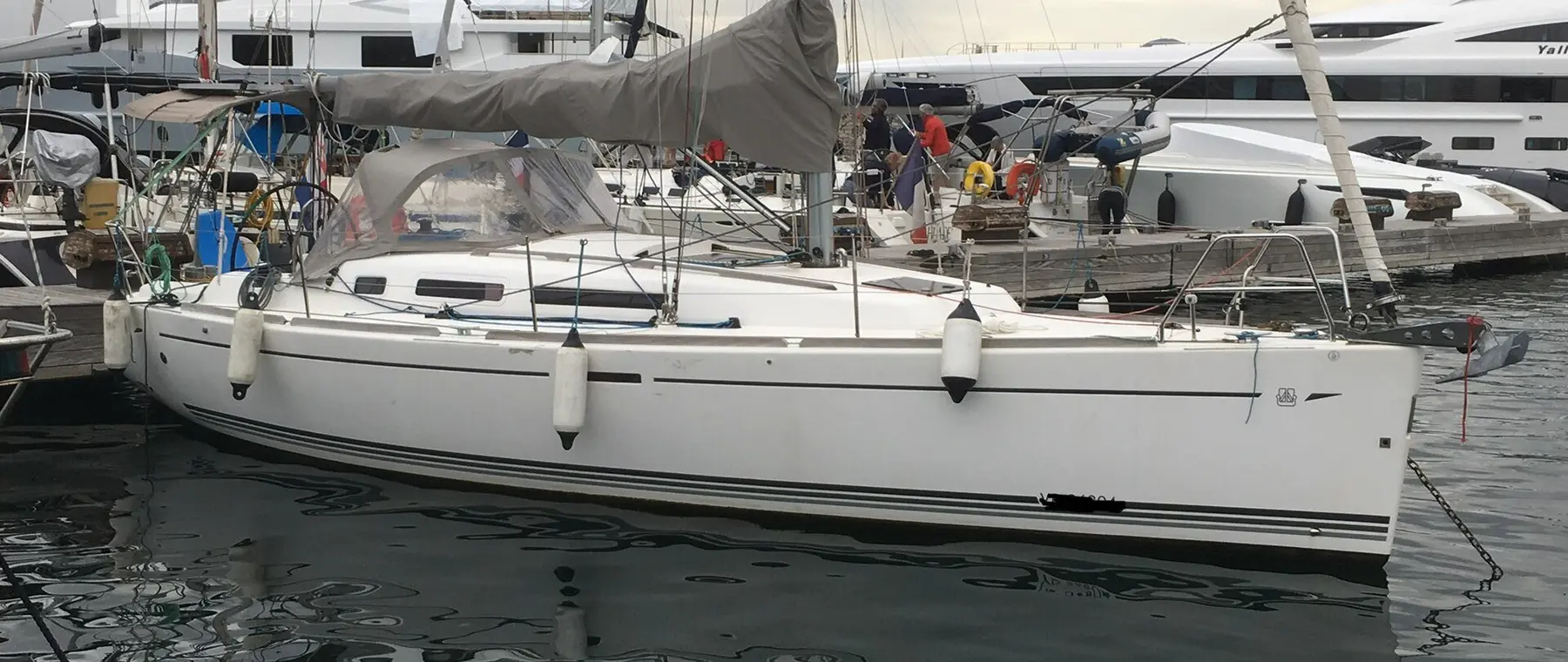
Dufour Yachts has published a detailed account of day-to-day cruising aboard its 44-foot sailing yacht, using a passage along the Breton coastline to illustrate how the boat's layout works under sail and at anchor. Released on 5 November 2026, the official feature covers helm positions, storage, sailing performance, bathing access and living arrangements. For buyers considering a sailing yacht around fourteen metres, the value lies in the practical observations behind the sales imagery. The manufacturer's story is presented as its own sailing narrative, not an independent sea trial or a guarantee that every outing will produce the same speeds.
A day on the Breton coast as a design test
The account follows a couple beginning the day at anchor, going ashore before preparing the boat to sail to the next anchorage. This scenario is useful because it includes ordinary tasks that often disappear from product brochures. Before the yacht can get under way, people need to store equipment, prepare the deck and secure items in the accommodation. The ease of those operations can influence satisfaction more than a single attractive photograph of a saloon.
A cruising yacht needs to function in several different modes: quiet accommodation at anchor, a boat under power leaving a harbour, a sailing vessel under way and a place for guests to eat or swim. Design details that help in one mode can complicate another. The Dufour 44 feature places these transitions near the centre of its narrative. That approach does not prove the boat is perfect for every owner, but it invites more useful questions about how the spaces are actually occupied.
Two cockpit lockers provide practical storage
The official account identifies two large side cockpit lockers used to store running gear alongside items such as diving and fishing equipment. This matters because a yacht's deck can become cluttered quickly when several people are aboard. Secure storage allows frequently used equipment to remain accessible without creating an obstruction in the cockpit or companionway. A buyer should examine the size and shape of the lockers and consider how wet gear is drained or protected.
Volume alone is not the only consideration. Deep lockers can be difficult to use if heavy objects sit beneath light ones, while spaces close to mechanical systems may require particular care. A good inspection asks whether items can be reached with the boat moving and whether lockers remain secure when heeled. The Dufour narrative confirms the presence and intended use of the spaces, but not the exact amount of equipment every owner can carry.
Separate showering arrangements add everyday convenience
Dufour describes an aft bathroom and a private shower in the owner's cabin, allowing two people to use washing facilities separately. In a yacht of this size, privacy can make a significant difference during a holiday with guests. It also helps separate everyday routines, so that people do not need to occupy one space sequentially for every task. The feature is more practical than a purely decorative statement about luxury.
An owner should still assess water capacity, hot-water provision and the ventilation of wet spaces. A private shower is only as useful as the systems supporting it. The manufacturer's account illustrates how the accommodation may be used after time ashore, but does not disclose a verified daily water budget for a particular crew. Anyone planning extended anchoring without marina services should calculate requirements using their own habits and the exact installed systems.
Two helm stations serve a working cockpit
When the couple prepare to depart, Dufour's narrative places the helmsman at one of two helm stations. A twin-wheel layout can provide different positions for observation and handling, particularly when sailing with the boat heeled. It also shapes how guests move between the cockpit and side decks. The company describes clear access routes that allow people to carry out different tasks without obstructing one another.
A layout that feels intuitive at the dock should also be examined under sail. The helmsman needs to see the sail plan and surrounding traffic, while the crew may need to handle lines or reach the bow. Handholds, nonslip surfaces and the position of controls matter as much as the basic number of wheels. The promotional account is a useful starting point but does not replace a demonstration in realistic conditions.
The hull's form links space and sailing
Dufour highlights the yacht's wide, chined hull and describes it as combining living volume with stability under sail. Modern cruising hulls often seek to provide broader accommodation without sacrificing useful handling characteristics, but the outcome depends on displacement, sail plan and other design decisions. A chined hull is not automatically faster or more stable than every alternative. Buyers should look for the boat's measured sailing behaviour across a range of conditions.
The official passage account describes a breeze building during the morning, with gusts approaching twenty knots. Sailing off the wind under a Code 0, the yacht reportedly reached approximately ten knots, with peaks of eleven knots while surfing waves. These are figures from a specific manufacturer-described outing, not guaranteed cruising speeds or independently verified measurements. The distinction is essential if a prospective owner is trying to predict average passage times.
Sail choice changes how the boat performs
The Code 0 mentioned in the narrative is a light-air or reaching sail that can add performance in suitable conditions. Its use demonstrates how sailing capability depends on the choices and experience of the crew rather than just engine horsepower or hull length. A buyer considering one should ask where it is stored, how it is deployed and which additional fittings are required. The sail may be optional depending on the yacht's specification.
Different sails also create different levels of work. A couple cruising shorthanded may value systems that simplify handling, while a larger crew can manage a more demanding sail inventory. The owner's likely operating pattern matters when selecting options. The Dufour feature gives a glimpse of one sailing setup, but it does not establish that every yacht delivered has the same sails or that the boat will reach similar speed without the right wind and crew.
Anchoring involves more than a quiet bay
After the morning sail, the manufacturer's narrative describes approaching an anchorage, lowering the sails and using a large anchor locker. It also references a bowsprit and storage for the Code 0, spinnaker and fenders. This sequence reveals how much organisation is required before a yacht can become a place to relax. Crew need to handle equipment safely, select a suitable anchoring position and ensure that gear is properly secured.
A spacious anchor locker can be useful, but safe anchoring depends on equipment condition, seabed, weather and local regulations. No marketing feature can establish that a yacht is safe to anchor in every location. Owners should learn the actual chain and windlass specification and verify their chosen setup. The Dufour account is a narrative example of ordinary cruising tasks; it is not a substitute for seamanship training or the vessel's operating manual.
Bathing platform transforms the stern at anchor
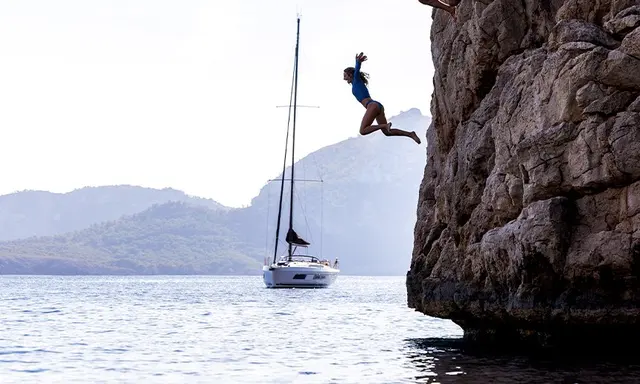
The article describes a large bathing platform that lowers when the yacht is stationary and allows the swim ladder to be deployed. A platform close to the water makes swimming and boarding from a tender more convenient. It can also create a pleasant place to sit near the sea. For many private owners, this area is among the most heavily used parts of a boat during summer cruising.
Moving platforms require operating procedures and adequate clearance. Guests should not assume that the platform can be used while the yacht is moving or that a particular tender can be secured without appropriate equipment. A buyer needs to understand weight limits, mechanisms and the ease of boarding when conditions are not perfectly calm. The manufacturer's account confirms the intended function; practical suitability should be assessed with the exact boat.
Interior circulation matters during a longer stay
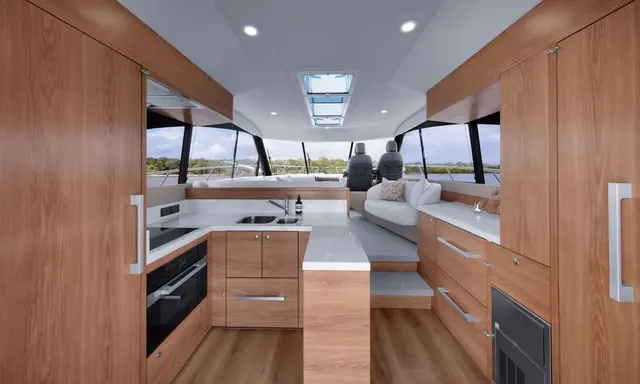
The Dufour 44's value as a cruising yacht depends on how accommodation works when the crew are tired, meals need to be prepared or weather keeps everyone below. A bright saloon can be appealing, but usable storage, ventilation and secure movement are equally important. The official day-in-the-life description emphasises the change from sailing to life at anchor, when the yacht becomes a place to share food and relax.
Owners should study the arrangement of the galley in relation to the companionway, table and cabins. Is it easy to prepare a meal with the boat heeled? Are shelves and lockers adequately secured? Can guests move to the heads without disturbing sleeping occupants? These questions are difficult to answer from a single model photograph but become obvious during a structured inspection. The manufacturer's narrative encourages attention to these everyday uses.
A yacht can serve both a couple and their guests
The story follows a couple enjoying time aboard before sharing part of their day with friends. This pattern is common for owner-operated cruising yachts, where the vessel may be used alone for a short trip and then for more social weekends. The required accommodation can change markedly between those situations. A design that handles both can be appealing, but the success of the arrangement depends on the owners' priorities.
For a buyer, the sensible questions include how many people will sleep aboard regularly, how much privacy is required and how the yacht will be provisioned. More berths are not always better if they reduce storage or make shared areas cramped. The boat should be evaluated for the crew that will actually use it. Dufour's description is one illustrative cruising narrative rather than proof that the interior will suit every family or sailing programme.
What buyers can learn from the published day afloat
Unlike a basic specification sheet, a narrative of leaving anchor, sailing and arriving at a new bay helps owners imagine a sequence of tasks. The Dufour 44 story references side lockers, two wheels, Code 0 handling, an anchor locker and a bathing platform. These are concrete features worth investigating. A prospective buyer can turn each into a question for a dealer or checklist item during a sea trial.
The owner should also seek information beyond the feature: draft, displacement, engine specification, freshwater capacity, battery systems and any options needed for the intended cruising territory. The manufacturer's story does not provide independently audited maintenance costs or a representative average passage speed. A thorough purchase process combines an understanding of the layout with technical documents and an appropriate survey.
Why the model matters to the middle-size market
A 44-foot cruising yacht occupies an attractive part of the market for people who want substantial accommodation without moving into the operating demands of a much larger vessel. It can be a step up from a compact weekender and may be considered by owners interested in shorthanded coastal passages. That does not make it easy to operate without training, nor does it guarantee suitability for every offshore route. Skills, equipment and conditions remain decisive.
Dufour's published feature adds a useful layer to the conversation by showing how the yacht is intended to work across a typical day. The account is promotional, but its specific details are more informative than generic descriptions of comfort. Buyers who value sailing as much as life at anchor can use the story to focus their subsequent inspection on circulation, controls and storage rather than aesthetics alone.
What the November release establishes
The confirmed development is Dufour's 5 November 2026 publication of a detailed account of the Dufour 44's cruising use on the Breton coast. It describes twin helm stations, side cockpit lockers, Code 0 sailing, a chined hull, anchoring arrangements and a lowering bathing platform. It also reports specific conditions and speeds during the company's own sailing narrative. None of these observations should be mistaken for an independent technical test of every production yacht.
For private luxury-yacht buyers, the story offers a practical way to evaluate a sailing model in the 12–24-metre market. The strongest purchasing conclusions will come from seeing the actual boat under way, confirming the options and considering the owner's intended use. A detailed official account can help prepare those questions, but it is most useful when reported with clear attribution and realistic limits.
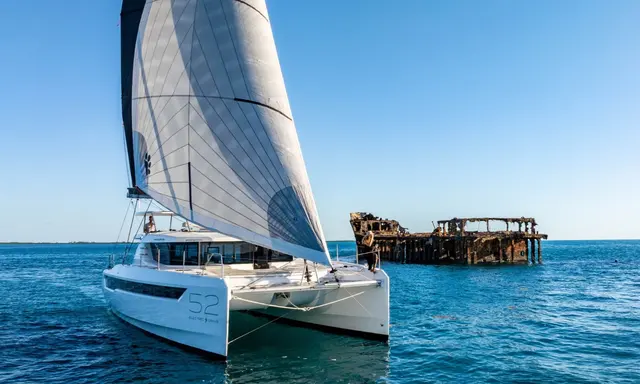
Official source: Dufour Yachts, Dufour 44: a day aboard a 44-foot sailboat, dated 5 November 2026. The lead image is a separately licensed archival sailing photograph, not a depiction of this specific manufacturer-described voyage.
Sources and image credits
Reporting based on Dufour Yachts official 5 November 2026 Dufour 44 coastal cruising feature.
Lead photograph: Dufour 44 Reveals Life Aboard the New Cruising Yacht — licensed historical context (2026). Licensed archival Dufour yacht photograph, not the new Dufour 44 or the manufacturer-described 2026 Brittany sailing trip. Photographer: Jjerome78. Licence: CC BY-SA 4.0; via Wikimedia Commons. Licensed contextual photograph.
Creative Commons photograph attribution · Image licence terms.