Two titles decided in one afternoon
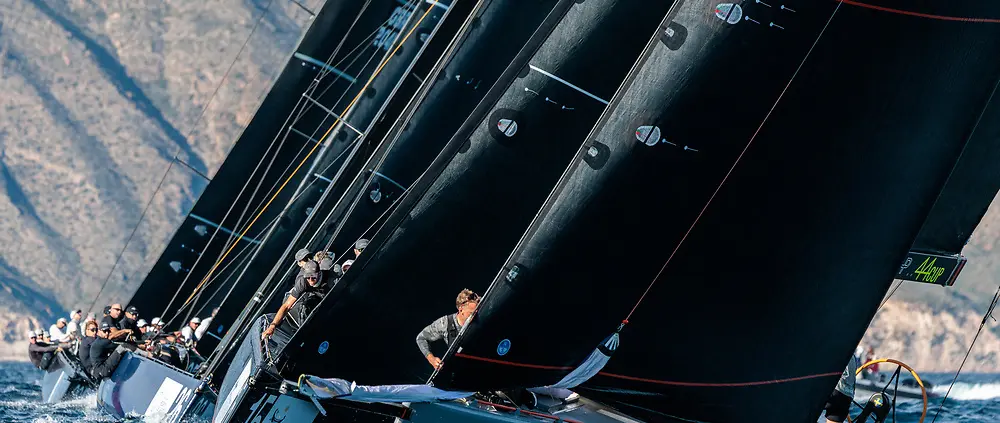
The final day of the 2026 44Cup brought two different contests to their conclusions off Cartagena on Sunday, 15 November. Team Charisma, helmed by Sam Poons, won the Spanish regatta with 44 points, overturning the advantage held by John Bassadone's Peninsula Racing, which finished on 46. Chris Bake's Team Aqua completed the event podium on 50 points. In the separate season standings, Markus Törnqvist's GeMera Racing claimed the overall championship, two points clear of Aleph Racing, which took second on countback ahead of Team Aqua. The class association confirmed the outcomes in its final-day dispatch. They settle the questions left open by the Saturday racing report: whether Peninsula could convert its lead into a home-region victory, and which of the closely matched teams would emerge with the annual title. Neither question could be answered from the preceding day's leaderboard. The distinction between a victory at Cartagena and the championship over the five-event season is central to understanding the result.
A radically different final-day racecourse
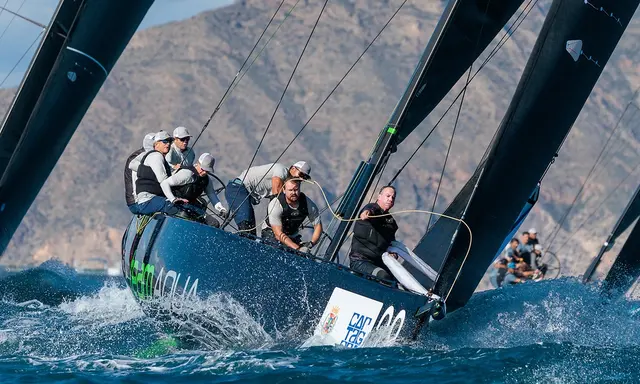
The racing on Sunday took place in a southwesterly breeze initially reported at eight knots and subsequently increasing to 12, with a considerably reduced sea state compared with the first three days. The earlier conditions following Storm Charles had put substantial emphasis on coping with waves and maintaining control at speed. The concluding races required a different balance of steering, sail trim and tactical timing. A high-performance one-design yacht cannot rely simply on a large advantage in installed power or a generous sail area to compensate for an unfavourable start. When competitors have closely comparable equipment, small changes in wind pressure or the angle at which a boat reaches the weather mark can become decisive. The final day's relatively lighter conditions also changed the calculation at mark roundings, where loss of momentum could be costly. The contrast illustrates why the ability to adapt across several types of weather matters more in a multi-day programme than the ability to dominate in just one.
Peninsula's early advantage was substantial
Peninsula Racing opened the final day by winning the first race, its third individual race victory of the regatta. The team had favoured the left side of the initial upwind leg and successfully converted that decision into a lead at the first mark. Charisma followed in second. At that stage Peninsula's margin had grown to seven points, an apparently reassuring advantage with two races remaining. In a nine-boat fleet, however, a single result near the back of the order can erase that margin if a close rival finishes at the front. The regatta's final sequence demonstrates exactly that vulnerability. The first race also featured congestion at the second weather mark involving Team Aqua and Black Star Sailing Team; Aleph and Artemis had to take avoiding action, and the class report recorded penalties for Aleph and Black Star. Such incidents matter both because of the immediate loss of places and because they can alter a team's position in the subsequent championship calculation.
Charisma converted steady finishes into victory
Charisma's Sunday results were second, second and first, a sequence worth only five finishing points in aggregate. Those results left Peninsula under progressively increasing pressure. After a seventh place in the penultimate race, Bassadone's team still had a three-point advantage before the last start. In the deciding contest Charisma again reached the front while Peninsula became caught within the fleet. Peninsula recovered to sixth, but the difference between first and sixth was sufficient to reverse the three-point lead and produce Charisma's two-point winning margin. The arithmetic explains why the result was not dependent on an unusually complicated scoring interpretation. The reversal resulted from actual finishing positions. For owners considering the RC44 environment as an example of competitive yacht management, the relevant lesson is that a consistent series of strong finishes can create an opportunity without the crew needing to take disproportionate risks from the outset. The final race then rewards the ability to execute when that opportunity becomes real.
An owner-driver transition in the winning team
The winning helmsman was Sam Poons, with his father Nico supporting the team from ashore. The class association described Cartagena as Sam's first event in full racing conditions and reported the contribution of tactician Hamish Pepper, who highlighted the team's starts, pace and synchronisation. This aspect of the victory has significance beyond the trophy. The RC44 combines an owner-driver format with the expertise of professional racing sailors, and the transfer of responsibility at the helm can expose how well a team communicates and distributes its technical workload. The person steering must coordinate with the tactician while relying on the crew to preserve sail shape and speed through manoeuvres. A younger driver who has developed the necessary familiarity can therefore benefit from an established team's precision without simply becoming a passenger in the process. The organiser did not provide a complete account of the team's training programme, and the result should not be treated as proof of any particular training technique. It nevertheless demonstrates a successful transition in a demanding competitive setting.
The annual leaderboard followed a separate logic
Before the final day, Aleph Racing, GeMera Racing and Team Nika were level on points for the year, while Team Aqua was only one point behind. During the second race Aleph took its first Cartagena race win, moving into the season lead on a tie with GeMera and with Aqua one point behind. That left the championship exceptionally sensitive to the last race. The final starting sequence proved important: GeMera achieved a strong start and soon led, while Aleph found itself at the back. GeMera ultimately finished second, securing the annual title. Aleph placed seventh in the event and retained second overall on countback from Aqua. Readers following the annual standings should distinguish those season positions from the Cartagena results themselves. GeMera was fourth at Cartagena, despite winning the year's championship. This outcome is possible because the annual competition rewards performance over multiple regattas rather than simply promoting the winner of the last gathering.
GeMera's championship without an event victory
One of the most revealing facts in the class association's account is that GeMera had not won an individual event during the season but had reached the podium at each of the preceding regattas, with the Cartagena fourth place completing its championship campaign. Its last-day scores of fourth, third and second were sufficiently strong to settle the annual contest in its favour. The team was competing in only its second season on the circuit, having finished third the previous year. Tactician Francesco Bruni also celebrated his first annual 44Cup victory after a long involvement with the class. This provides a useful counterpoint to the spectacle of Charisma's last-race win. A campaign can be constructed around reducing poor results and maintaining competitive finishing positions across different venues. A single event victory brings recognition, but consistency can have greater value under a season-long points system. The result also underlines the importance of treating every race as worth recovering even when the opening minutes have not gone to plan.
The practical implications for owners of racing yachts
An owner considering a comparable one-design campaign faces decisions extending far beyond acquisition of the yacht. Maintaining reliable sails, rigging and deck systems is only part of the preparation. Crew continuity, the ability to evaluate weather and current, communication through starts and mark roundings, and the recovery of positions after errors all influence a result. Cartagena demonstrated the pressure of compressed racing schedules, especially when several potential champions remain in contention. The first day's heavy conditions and the lighter final day's breeze represented contrasting tests of the same boats and crews. The value of an established circuit is that these challenges can be evaluated repeatedly against competitors operating within the same class. A yacht's performance is then more readily separated from the influence of entirely different designs. The results do not remove the physical or financial demands of a professional-supported campaign, but they help illustrate what the competitive element of luxury performance sailing entails.
Cartagena's role and the next season
The fifth and final event of the 2026 circuit was supported by the Ayuntamiento de Cartagena, the regional government of Murcia and the Cartagena port authority. The new destination for the circuit offered both difficult offshore conditions and a closely contested conclusion. The host city's involvement is relevant to yacht owners and event organisers because the quality of the sailing waters is only one part of delivering an international regatta. Shore access, berthing, technical support, event logistics and the coordination of the race programme are equally significant. The association has now closed the 2026 championship and is looking ahead to the circuit's twentieth anniversary in 2027. For the moment the confirmed results belong to two distinct teams: Charisma, which won the Cartagena regatta, and GeMera Racing, which won the season. The final scores provide the definitive answer to the uncertainty before Sunday and an appropriate close to a fiercely competitive year in the owner-driver class.
Sources and photograph
Source documentation: https://www.44cup.org/news/youngsters-come-from-behind-to-win-44cup-cartagena-and-2026-season. Photograph: 44Cup Cartagena final day, 15 November 2026 — Nico Martinez / 52 SS / 44Cup; copyright retained by the photographer, official event press centre editorial image.. Official race photograph supplied through the organiser’s designated press centre, limited to editorial coverage of the event. Copyright remains with the credited photographer.