November update for inland cruising operators
The US Army Corps of Engineers reported on 6 November 2026 that its maintenance teams had isolated and drained the lock chamber at Allegheny River Lock and Dam 4 in Natrona, Pennsylvania, to undertake a major package of repairs. The work concerns navigation infrastructure used by pleasure craft as well as commercial traffic. For a private motor yacht making an extended inland voyage, the consequences of a prolonged lock closure can be more significant than the closure of an individual marina: there may be no alternative route through that stretch of water. The Corps' report describes work in progress rather than a completed refurbishment. Its current expectation is to finish the project by December 2026. That is a project forecast, not an unconditional reopening date. Owners planning a voyage should obtain the current navigation notices and operating arrangements before committing to an itinerary, rather than interpreting the November announcement as permission to pass through the chamber.
An ageing structure with a single route through
The Natrona facility entered service in 1927. It is situated roughly 24 miles upstream of Pittsburgh and has one navigation chamber, 56 feet wide and 360 feet long, alongside a fixed-crest dam. The dimensions are interesting for the operator of a relatively large inland cruising yacht, but they are not the only considerations that determine whether a passage is possible. The controlling depth, approach conditions, any temporary operating instructions and the vessel's air draft also matter. In normal circumstances a navigation lock links pools at different elevations; the dam itself is not a navigable alternative. At a single-chamber facility the loss of the operating chamber can interrupt access beyond it. This is one reason the maintenance issue is relevant to an owner who has no direct connection to the industrial customers transporting goods on the river. Cruising routes share the same essential infrastructure, even though the reasons for using the waterway differ.
Damage caused by winter ice
The immediate repair concerns the lower gate sealing arrangement. Original construction used a timber sill against which the gates close, and a severe freeze earlier in 2026 damaged that component. According to the Corps, ice moving along the river caused deterioration that allowed leakage through the closed gate system. The problem did not initially make the lock unusable, but it increased the demand on the equipment responsible for controlling the chamber's water level. There were already concerns about the condition of some valves. A lock can still appear to be working while its tolerance of further equipment failures is declining. The November project therefore addresses both the damaged barrier and components that support the water-level changes needed during a lockage. It is better understood as a reliability intervention than a cosmetic improvement. For the private skipper, the lesson is that a facility's previous operation is not proof that it will remain available during the next planned passage.
Creating a dry engineering workspace
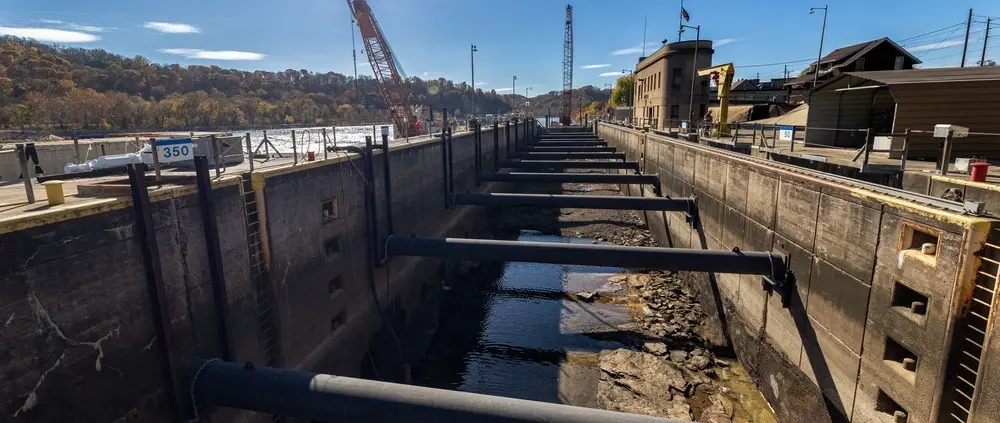
Repairing components beneath the normal water surface meant that the contractors and specialist Corps personnel first had to separate the chamber hydraulically from the river. The reported installation included sixteen temporary bulkheads, thirteen supporting struts and two needle-dam installations. These arrangements created the conditions for pumping out the water, exposing structural elements that usually cannot be inspected directly. Specialist marine maintenance teams worked with floating equipment and divers. The Corps' photograph of 3 November shows temporary structural members across the drained chamber. It illustrates what the closure actually involves rather than providing a picture of the facility in normal operation. This distinction is particularly valuable when assessing the published project timetable: the repair itself is only one stage. The temporary isolation systems have to be removed and the operating components restored before the lock can return to navigation service. No independently verified date for that return is established by the photograph.
The replacement sealing arrangement
The planned replacement uses steel and concrete rather than the earlier timber component, with a rubber sealing element secured mechanically. The engineering objective is a barrier less vulnerable to impact damage while retaining the ability to control water leakage when the gates close. This work illustrates the importance of the interfaces between a structure and its mechanical equipment. The gates, the chamber and the filling and emptying arrangements are parts of one hydraulic system, not interchangeable independent facilities. Changing one seal can affect the requirements placed on the other equipment during normal operation. Modernising the sealing arrangement should therefore be considered in the context of system performance. It would be premature to infer a quantified reduction in lockage time or an improvement in permitted vessel dimensions, neither of which the November report establishes. The substantive benefit sought is the continued availability of an existing navigation link and a lower risk of disruptive mechanical failure.
Additional maintenance during the closure
The project team is using the access provided by the dry chamber to renew all eight emptying valves, together with associated moving components. This is a significant expansion beyond the damaged sill alone. A closure that is already necessary for one operation offers a chance to address other items that would be difficult to reach with the chamber in service. On a private yacht, owners routinely face similar choices during a haul-out: whether to defer secondary jobs or undertake them while the craft is already out of the water. The scale here is very different, but the principle of grouping maintenance when access is expensive is familiar to the industry. The Corps also reports that its stock of replacement parts allowed it to accelerate preparation for the project. The availability of compatible spares is a practical constraint at older facilities. Replacing obsolete or worn components while the chamber is available can reduce the chance that a second prolonged interruption will follow shortly after the first.
Coordination across the river system
One striking element of the maintenance operation is the coordination required upstream. The Corps adjusted releases from eight reservoirs to reduce river flows temporarily during hazardous diving operations. Work around the dam involves conditions quite unlike those experienced by an ordinary yacht lying alongside a marina pontoon. Divers and equipment operators must contend with water movement and the consequences of disturbing a barrier that separates different water levels. The decision to manage upstream flows illustrates how individual navigation structures operate as elements of wider river infrastructure. For vessel operators this reinforces the importance of assessing the complete route, not simply a list of desired destinations. River levels and currents are dynamic. A cruising schedule should leave time to respond to revised operating notices, adverse weather, restrictions at other facilities or an unexpected delay. No maintenance notice or previous transit establishes the safety of a future passage under different conditions.
What yacht owners should check before a passage
A skipper contemplating travel on the Allegheny should confirm that the relevant lock has reopened and that the vessel can meet all current requirements for transit. Verify not only published dimensions but any local instructions governing communication with lock personnel, waiting areas, traffic sequencing, line handling and approach. Ensure that adequate positions for waiting or turning have been identified in advance. A larger private motor yacht may have different manoeuvring characteristics from smaller recreational craft, so the skipper must plan around the actual vessel's draft, beam, propulsion response and crew competence. Where a journey depends on access beyond the chamber, a confirmed alternative stopping point can prevent an extended delay from becoming a provisioning problem. No attempt should be made to pass a closed lock or approach temporary maintenance equipment without the facility operator's instructions. The November engineering release is valuable context, but it is not an operational navigation chart or substitute for current official directions.
The next milestone
The Corps anticipates that the specialist maintenance fleet will complete its assignment during December. Returning the structure to service involves reinstating the gates, bringing water back into the chamber and removing the isolation equipment. The important next news for the cruising community will be an authoritative notification that the facility has resumed normal or specified restricted operations. Until that notification is available, the responsible course is to regard the published project timetable as provisional. There is no evidence in the November engineering report of an enlargement of the existing chamber or a new marina development. It concerns preservation of an essential navigation asset. The owner of a luxury inland cruising vessel should view that work in the same way as a commercial operator: a reliable network of navigable waterways is a prerequisite for predictable journeys. The present project demonstrates how the long-term condition of a single piece of hydraulic infrastructure can affect a substantial stretch of otherwise attractive cruising water.
Sources and photograph
Source documentation: https://www.dvidshub.net/image/10076271/corps-dewaters-century-old-allegheny-river-lock-chamber-critical-repairs, https://www.dvidshub.net/news/578805/corps-dewaters-century-old-allegheny-river-lock-chamber-critical-repairs. Photograph: Structural supports inside the dewatered Allegheny River Lock 4 chamber, 3 November 2026 — U.S. Army Corps of Engineers photograph by Andrew Byrne, public domain via DVIDS. Official public-domain U.S. Army photograph, credited to the named photographer; The appearance of U.S. Department of War (DoW) visual information does not imply or constitute DoW endorsement. See DVIDS copyright information.