A three-way contest for the Cartagena trophy
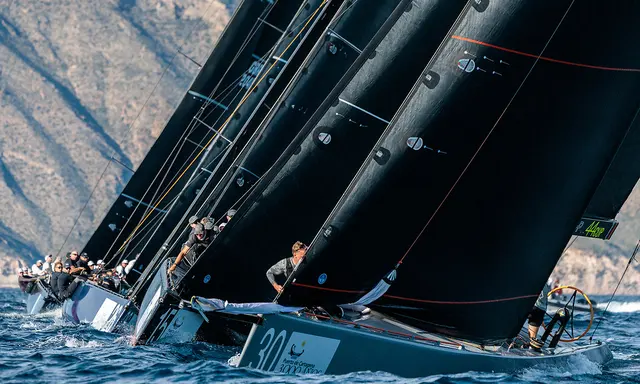
The final scheduled day of the 2026 44Cup Cartagena opened on Sunday with the leading three boats separated by just two points after Saturday's racing. The RC44 Class Association reported on 14 November that John Bassadone's Peninsula Racing retained the lead but Vladimir Prosikhin's Team Nika had drawn within a point. Chris Bake's Team Aqua was a further point back. The result was a particularly compelling position for the closing races of the international owner-driver circuit, in which nine carbon-fibre one-design yachts are competing off Spain's Mediterranean coast. The event is being held from 11 to 15 November at a venue new to the series. This report concerns the standings after the third day of racing and the competitive questions facing the teams before the concluding races; it does not announce a final winner. For owners of performance sailing yachts, Cartagena has offered an unusually demanding illustration of what happens when tacticians and crews must adapt to both changing wind strength and an unsettled sea.
Competition in a changing sea state
The conditions on Saturday evolved sufficiently quickly to challenge teams that might otherwise have expected a more familiar Mediterranean racing day. The organiser reported that the boats left shore in approximately eight knots of southwesterly breeze, with less wave disturbance initially than on previous days. By the conclusion of the first contest, stronger wind was already developing, accompanied by increasing waves. This transition is significant in a light, responsive racing yacht. The combination of sail selection, manoeuvring technique and the ability to accelerate after a turn can change substantially during an afternoon. What works in an early race is not necessarily the optimum configuration for the next one. Even within a single fleet of ostensibly equal boats, careful interpretation of the sea state becomes a competitive differentiator. A crew that responds quickly to the developing conditions may recover positions even when it has not selected the most advantageous side of the course. Conversely, an effective starting strategy can be compromised by difficulties maintaining momentum in a wave pattern that is different from the one anticipated ashore.
Team Nika's recovery changes the picture
Nika's performance represented a substantial shift from its position after the opening day. The team began Saturday having won the preceding day's last race and extended that sequence by taking Saturday's first two contests. Across the three races of the day it accumulated seven points, the strongest performance in the fleet, according to the official report. The achievement narrowed an earlier nine-point gap behind the leader to a single point by the end of day three. That is a good illustration of the cumulative effect of consistency in a low-point scoring system. Winning one individual race can have an important psychological effect, but eliminating expensive finishes is at least as consequential when assessing a series as a whole. In the second Saturday race, Nika was able to control the contest from relatively early on. The preceding race required a much closer fight, with Peninsula Racing still positioned to challenge for victory on the final section of the course. The repeated ability to operate near the front changed the shape of the overall event.
The value of one additional manoeuvre
The finish of Saturday's opening race provided a good example of the interaction between navigation geometry and boat handling. Peninsula Racing had established the leading position approaching the final windward rounding, with Team Nika in pursuit. The two crews subsequently chose different sequences of manoeuvres on the downwind section. Nika was able to time its final change of direction more favourably and reach the finish ahead of Peninsula, which needed an additional gybe. Sailors familiar with displacement cruising yachts may think of a gybe chiefly as a way of changing the tack on which the boat is sailing. In a highly competitive racing fleet, the same operation also creates a cost in momentum, working loads and the time needed to return the yacht to its optimum sailing configuration. A tactical advantage measured in seconds may disappear if the manoeuvre is executed poorly. The event demonstrated that the decision to manoeuvre, the execution itself and subsequent acceleration are inseparable parts of a successful tactical plan.
Peninsula's ability to recover
The regatta leader faced another particularly challenging situation in the second race. After incurring a penalty early in the contest, Peninsula fell to the rear of the fleet but subsequently worked its way back to fourth. The official account identifies that recovery as an important part of the day's results. In a fleet of only nine boats, there is still a substantial sporting difference between crossing the line last and recovering several places. While a race victory would have increased Peninsula's advantage, limiting the cost of a difficult race helped preserve its position at the head of the regatta. From an owner's perspective, this is an important reason to examine more than the headline victories when judging crew performance. A professional racing programme needs to develop the capacity to respond constructively when the original plan is interrupted. Whether a mistake occurs during a starting approach, a mark rounding or a sail-handling sequence, the quality of subsequent decisions influences the accumulated result. Cartagena illustrates the competitive importance of resilience without suggesting that an early penalty is harmless.
Team Aqua retains its opportunity
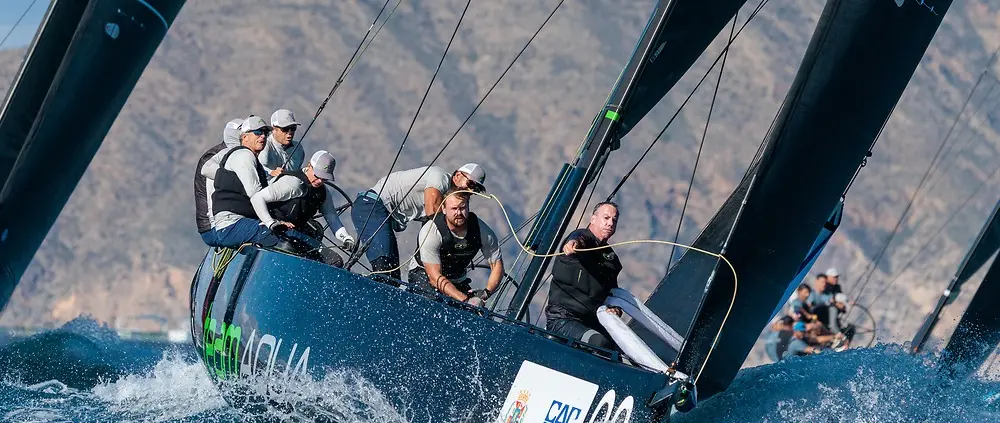
Team Aqua's Saturday performance included victory in the third race and was sufficiently consistent across the remainder of the day to keep the team firmly in the title discussion. The third race involved a further increase in sea-state complexity. Aqua was initially outside the leading group at the first windward mark but used an early downwind manoeuvre to establish an advantageous position and eventually take control. The result underlined the limited value of interpreting early mark positions as definitive outcomes. On a course with repeated windward and leeward legs, the geometry of the next section and the placement of competing boats can change the tactical opportunities. A crew occupying a relatively modest initial position must still be ready to capitalise when its chosen lane becomes favourable. The overall competition now presents three different perspectives: defending a narrow advantage, pursuing a leader only one point away, and remaining close enough in third to profit from mistakes by either of the first two boats.
A competition within the owner-driver format
The close racing in Cartagena is also a reminder of the character of the RC44 itself. The class was conceived as a competitive sailing platform in which owners can take the helm while sailing with experienced professional crews. Identical yacht design and controlled class rules reduce the opportunity to gain an advantage through simply commissioning a substantially different hull. They do not remove the importance of preparation, sail handling, rig adjustment, crew selection, tactical communication and the owner's proficiency at the wheel. The class's 44-foot boats occupy the lower part of the Luxury Yacht Guide length range but represent a specialist application of high-performance yacht engineering. Their design priorities differ markedly from those of a family cruising yacht of comparable overall length. For prospective owner-drivers, this distinction matters. A programme dedicated to short-course international racing requires a team and logistical structure that is very different from the arrangements needed for comfortable Mediterranean cruising. The closeness of the leaderboard demonstrates how strongly the sporting result can depend upon execution rather than merely vessel size.
The season and event titles are separate questions
The official Saturday report also draws attention to the concurrent competition for the season championship. Aleph Racing and GeMera Racing are closely positioned in that calculation, and improvements in their standings at Cartagena could influence the annual result. This creates a separate tactical concern from the race for the individual regatta trophy. Teams may need to consider the effect of their final-day finishes on more than one set of standings. For an observer, it is important not to conflate the ranking for Cartagena with the ranking for the year's entire series. The absence of a final-day result in Saturday's report means both contests were still unresolved at the time of that update. The organiser indicated that seven teams retained a mathematical opportunity to win the concluding regatta. Such a situation gives the last scheduled day significance beyond a duel between the first two boats and creates the possibility of further movement as separate races are completed.
A new Mediterranean venue for the class
Cartagena offers an established maritime environment in which the competition can be presented to spectators without losing its character as an international sailing event. The class has organised the regatta in cooperation with local sailing and maritime organisations, supported by the municipality, the regional government and the port authority. The organiser's venue information places the yachts at the North Dock. Public visibility of the fleet is significant for a city seeking to build its reputation as a sailing destination. A visiting owner interested in performance yacht programmes can observe a concentrated group of specialist teams, logistics staff and international support organisations in one place. The wider marine economy benefits from understanding the requirements of such events, including suitable berthing, access for technical personnel, transport links and shore facilities. Cartagena's first appearance on the circuit is therefore noteworthy independently of the sporting outcome. The next confirmed milestone is the official publication of the final race results and the season championship classification; those will determine whether Peninsula's narrow lead survived Sunday's competition.
Sources and photograph
Source documentation: https://www.44cup.org/news/three-boats-within-two-points-of-leader-heading-into-44cup-cartagenas-final-day, https://www.44cup.org/events/44cup-cartagena, https://www.44cup.org/44Cup/about-the-boat, https://www.44cup.org/news/local-heroes-still-lead-at-half-way-stage-of-44cup-cartagena. Photograph: RC44 racing off Cartagena, 13 November 2026 — Nico Martinez / 44Cup, copyright retained by Nico Martinez; image distributed in the official 44Cup press centre and used only in editorial coverage of the Cartagena event.. Official race photograph supplied through the organiser’s designated press centre, limited to editorial coverage of the event. Copyright remains with the credited photographer.