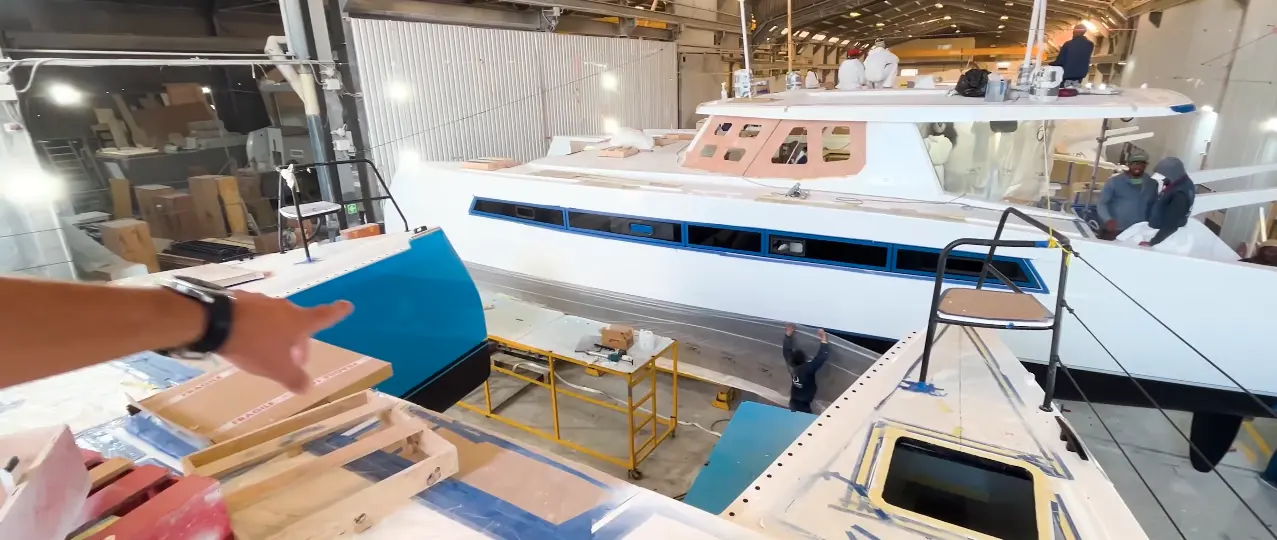
Full carbon becomes the biggest structural change
Balance describes the move to full carbon-fibre construction in key versions of the 464 and 502 as the largest upgrade in the new models. Carbon is used through the core structure, bulkheads and major reinforcement areas, replacing heavier materials where the engineering benefit is greatest.
Reducing structural mass matters on a cruising catamaran because every kilogram saved before launch becomes payload available for water, fuel, batteries, equipment and owners' gear. Lower weight can also improve acceleration and sailing responsiveness without requiring a larger rig or more aggressive hull shape.
The 464 Carbon Core saves about a tonne
The 14.19-metre Balance 464 is offered in Carbon Cross and Carbon Core forms. Balance says the Carbon Core version saves about 1,000 kilograms by using carbon fibre through the interior core structure, including cabin soles, partition panels, primary beams, bulkheads, daggerboards, trunks and rudders.
That is a substantial difference on a yacht whose equipped displacement begins around 10.8 tonnes. The weight saving is intended to improve stiffness and performance while preserving the liveability expected from a trans-oceanic cruising catamaran, rather than turning the yacht into a stripped-out race boat.
The 502 applies the same philosophy at 15.25 metres
The Balance 502 measures 15.25 metres overall and uses carbon reinforcement with an optional full-carbon substructure. The builder quotes an equipped launch displacement range of roughly 11.8 to 13 tonnes, while maintaining a 143-square-metre working sail area and high-aspect-ratio daggerboards.
Balance says the 502 is designed to remain manageable by a short-handed crew while carrying meaningful cruising payload. That combination is important because lightweight performance designs can become less attractive to long-range owners if they lose their advantage as soon as stores, spares and domestic equipment are brought aboard.
Hybrid propulsion is being integrated alongside the structural work
Both models can be specified with Balance's VersaDrive arrangement, combining diesel engines with electric drive and power-generation capability. On the 464, the company says the system can reduce fossil-fuel consumption while charging a 48-volt lithium bank at up to 15 kilowatts per engine.
The Cape Town production update therefore shows two development tracks arriving together: lighter carbon-intensive structures and more integrated electrical propulsion. For LYG buyers, the important point is that the technologies are being engineered into new production models rather than added later as isolated aftermarket systems.
Official sources: balancecatamarans.com; balancecatamarans.com; balancecatamarans.com.