Wind measurement while the yacht is moving
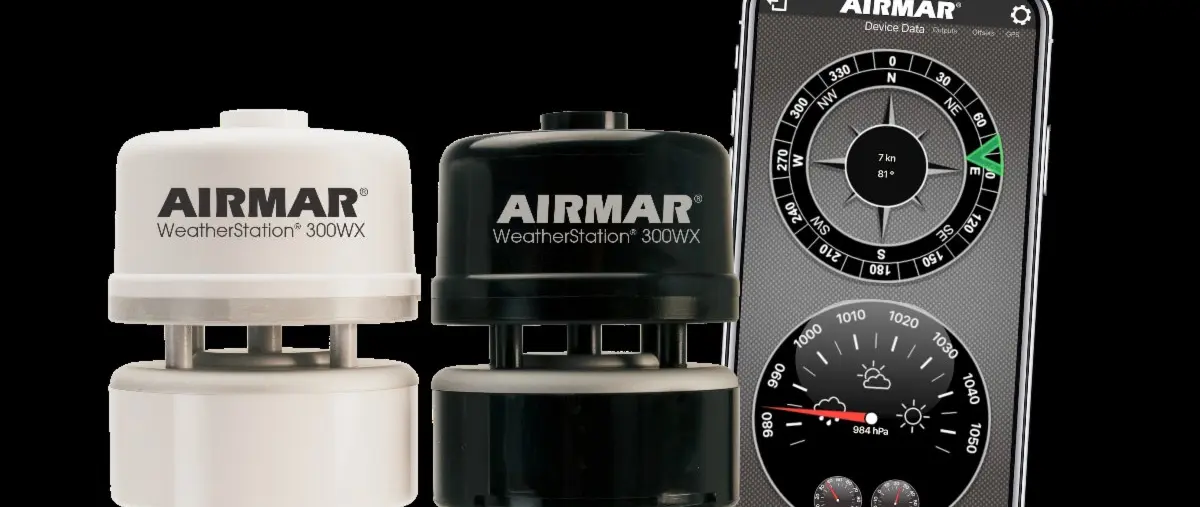
AIRMAR's updated 300WX WeatherStation uses ultrasonic technology to calculate wind conditions without rotating vanes or cups. In its 2026 specification, the company emphasises Dynamic True Wind, which combines apparent wind readings with GNSS speed, stabilised heading and onboard motion sensing to estimate wind speed and direction as the boat moves.
That distinction matters aboard a yacht, because an instrument that measures only the airflow across its housing cannot directly explain the weather relative to the water or land. Good wind information supports sail handling, docking plans and awareness of changing conditions, although any single electronic sensor must be interpreted alongside observation and forecasts.
More weather information in one compact housing
The 300WX collects barometric pressure, temperature, humidity where fitted, wind, GNSS position and motion data. Its three-axis compass, accelerometer and rate gyro help compensate for the motion of the platform beneath it. The manufacturer quotes wind-speed accuracy of 1.5 knots RMS at a 20-knot test condition and a direction accuracy of 2.5 degrees RMS.
Published accuracy numbers represent defined test conditions rather than universal results at every masthead position. A yacht's radar arch, sails and superstructure can distort local airflow, particularly when the instrument is installed close to obstructions. Location and alignment are therefore as important as the nominal capability of the sensor.
Bluetooth and several communication choices
AIRMAR has added Bluetooth access to its CAST app for configuration, calibration and firmware work without dismantling the instrument. The new range also supports NMEA 2000, NMEA 0183, J1939 and ISOBUS interfaces, broadening the selection for integrators. The marine buyer should check the precise part number and network protocol to avoid selecting a variation meant principally for industrial applications.
The instrument consumes less than one watt at 12 volts under the stated specification, which can be useful when many low-voltage devices share a yacht's network. Its quoted protection rating differs by configuration: the housing with a humidity sensor is not identical to the fully sealed IP67 version. The correct physical unit must be ordered for the intended exposure.
An upgrade that needs installation planning
On a yacht between 12 and 23.99 metres, it may be possible to feed weather information into existing navigation screens, but compatibility depends on the display's accepted messages and its network arrangement. A marine electrician should consider cable routing, lightning exposure, mounting strength and protection against inadvertent changes in configuration.
The WeatherStation's 2026 developments bring useful flexibility to a mature category of marine equipment. They do not remove the requirement to maintain safe navigation procedures or to verify suspicious readings against other information. The product's value is reliable context for decisions, not the illusion of weather certainty. A useful pre-installation checklist includes the mast or arch position, intended NMEA messages, cable length, sensor orientation and the way the device will receive firmware support over several years of ownership.