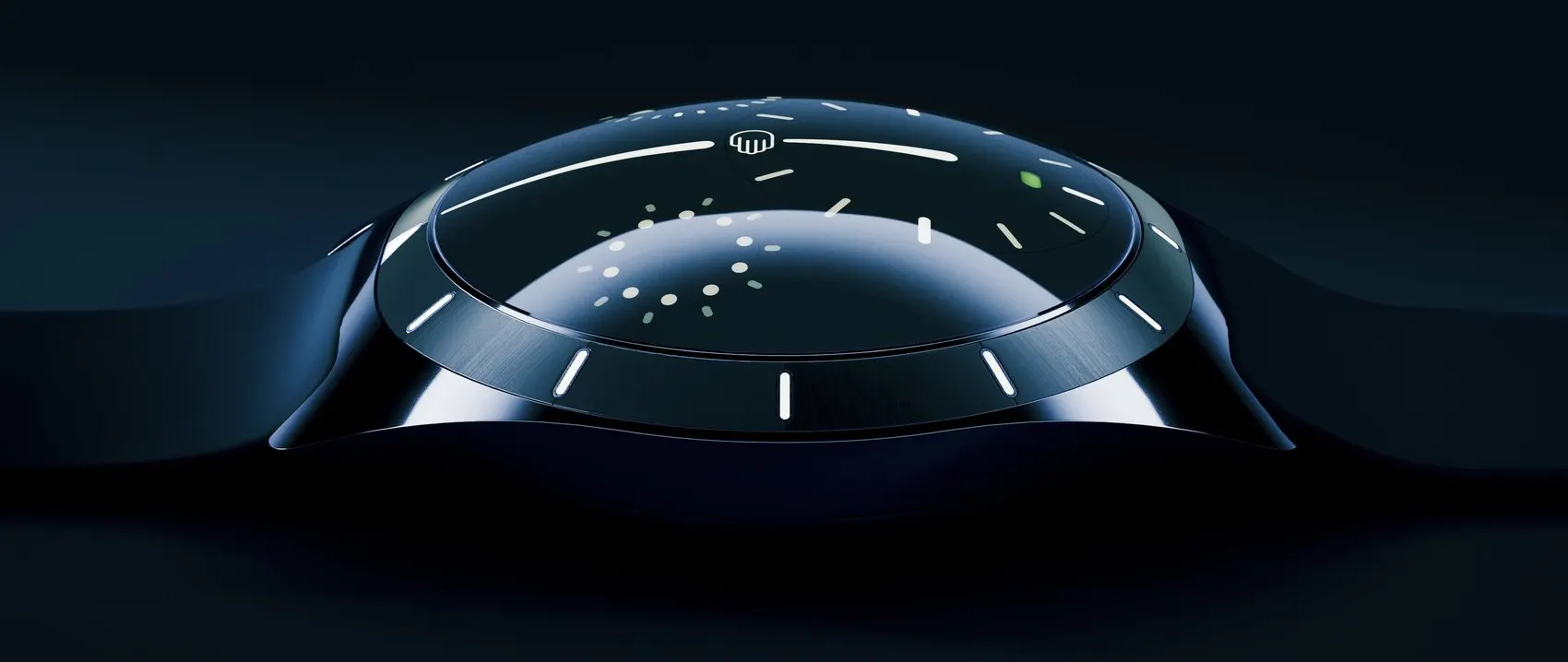
Ressence's TYPE 10 DN, presented in October 2026, brings together the Belgian watch company's oil-filled display architecture and its own RW-04 automatic movement. The Dark Night version is described in the official press material as a production of 100 pieces, and the manufacturer lists a price of €60,000 including VAT on its product page. Its collection page displays the model as sold out at the time of this review; availability through individual authorised retailers has not been established. For collectors who appreciate mechanical watches that depart from conventional hands and dials, the TYPE 10 offers a particularly interesting combination of an internally developed calibre, an unusual optical environment and a carefully integrated titanium exterior.
Two distinct environments within a single watch
The TYPE 10 contains two separate sealed chambers. The mechanical movement operates in air, while the display assembly occupies a chamber containing 2.95 millilitres of silicone-based oil. This separation allows the watch to retain a mechanical regulating and driving mechanism while presenting its indications through an oil-filled optical system.
A significant aspect of the arrangement is that the movement and display cannot simply be connected by an ordinary shaft passing through the separating boundary. Ressence uses magnetic transmission to convey motion between the two environments. This avoids the need for a direct mechanical connection through the partition. The manufacturer's description provides an explanation of the architecture rather than a complete assessment of every component's durability. The resulting watch is distinctive because the technical separation of the chambers is largely concealed behind an appearance of continuity.
The RW-04 movement
The in-house RW-04 calibre is specified as an automatic movement with 252 components, two barrels and a power reserve of sixty hours. It operates at 28,800 vibrations per hour. Ressence identifies the TYPE 10 as the first oil-filled model powered by this movement, a meaningful development in the company's continuing work on its own mechanical architecture.
A watch's autonomy is relevant to collectors who alternate between different timepieces. The quoted reserve indicates the intended operating duration from a fully wound state under the manufacturer's applicable conditions, rather than the exact duration that every wearer will experience after removing the watch. The presence of two barrels is part of the movement's engineering specification; it should not be taken as evidence of a particular torque curve without further technical information. The importance of the new calibre is its integration with the display system developed for the TYPE 10.
The ROCS 10 module
Ressence calls its display mechanism ROCS 10 and identifies 196 components within the oil-filled assembly. The movement drives this module through the magnetic transmission. The display includes three eccentric biaxial satellites inclined at different angles, allowing indications to move in a way that distinguishes it from a conventional dial carrying centrally mounted hands.
The manufacturer lists hours, minutes, a second time zone, a 120-second runner and a colour-based oil temperature indication among the available information. The second time zone is especially interesting for owners who regularly travel between locations. It provides a means of retaining a reference to another time while using the principal display for daily life. Anyone unfamiliar with Ressence's system should examine the official instructions rather than assume that it reads exactly like another dual-time wristwatch.
The optical character of the oil-filled display
One of the principal reasons to use oil within the display is its effect on the visual relationship between the indications and the covering crystal. Ressence's architecture creates the impression that the information lies unusually close to the outside of the watch, rather than at the bottom of a conventional case. The optical effect is integral to the appearance of the design rather than an additional decorative feature.
For someone who spends considerable time around water, the appearance of surfaces at different angles is familiar. Reflection and refraction can alter how an object is perceived when it is viewed from a different position. The oil-filled watch addresses a related optical question within a very small enclosure. Its actual legibility should nevertheless be assessed by the individual wearer under the conditions in which it will be used. The visual character of the watch is not a claim of professional underwater instrumentation capability.
Managing changes in oil volume
The technical specification identifies an expansion membrane designed to compensate for changes in the volume of the oil. This is a significant practical element of the architecture because a sealed fluid-filled chamber must accommodate the physical effects of variations in temperature. The separate temperature indication allows the wearer to obtain information about the oil's state through a colour-based display.
The interaction between the fluid and the surrounding structure is one reason that an oil-filled mechanical watch represents a distinct engineering problem from an ordinary dry dial. It is not appropriate to infer permissible operating temperatures or maintenance requirements solely from the presence of a compensating membrane. Owners should obtain the current operating guidance from the manufacturer. A particular consideration for a collection carried aboard a yacht is the variation between a climate-controlled interior and an exposed exterior environment.
Twenty-four segments around the perimeter
The bezel is formed from twenty-four individual titanium segments. Ressence explains that alternating surfaces receive different treatments, including luminous inserts and linearly brushed areas. The direction of the brushing changes by thirty degrees between successive relevant sections, producing changes in appearance as light falls across the circumference.
This is a useful example of how a relatively restrained overall colour palette can still contain considerable visual detail. The character of the surface depends on its treatment and the changing direction of reflected light rather than on the introduction of several contrasting colours. A collector examining the watch may notice differences between its appearance in diffuse indoor light and in direct sunlight. The individual segments form a deliberate part of the product's exterior architecture and should not be regarded merely as a conventional bezel divided by printed markings.
Titanium, coating and strap integration
The manufacturer specifies a 41.5-millimetre case made from Grade 5 titanium with a hard diamond-like carbon coating. The watch weighs 82 grams and is supplied with an integrated rubber strap and a titanium buckle finished in a corresponding coating. The Dark Night design uses closely related dark tones across the case, dial and strap.
The use of a relatively light metal is particularly interesting in a watch of this complexity. Its stated total weight includes the complete watch as described by the manufacturer rather than a calculation derived from the case dimensions alone. The integrated strap also contributes to the way the exterior is perceived as a continuous object. A prospective owner should consider the way the strap fits their wrist and establish the arrangements for future replacement. The availability of a specific proprietary strap may be more relevant to long-term ownership than its appearance in the original photographs.
Setting without a conventional crown
The TYPE 10 uses a caseback arrangement for winding and setting rather than a conventional crown projecting from the side of the case. A sapphire crystal on the reverse allows the wearer to see the movement, while the exterior retains the uninterrupted outline intended by the designer.
This provides a practical example of how the control arrangement of a watch can influence its visual identity. A conventional crown is both a functional component and a familiar part of the profile of a mechanical timepiece. Relocating that function changes the way the watch is handled. Owners should familiarise themselves with the manufacturer's specific winding and setting instructions. It is particularly important to establish how the second time zone and other indications are adjusted before taking the watch on an extended trip.
Water resistance and service considerations
The product specification gives water resistance as five atmospheres. This should be understood as the manufacturer's rating for the completed watch, not as an invitation to use it as a diving instrument. The practical requirements of exposure to water should be established from the accompanying instructions and service guidance.
Ressence describes an established maintenance service and a two-year warranty for its watches. The complexity of the separate sealed chambers makes specialist support particularly relevant. An owner acquiring a piece for a collection that travels internationally should establish where servicing can be arranged and how the watch is to be transported if specialist work is required. The condition of seals and the appropriate maintenance procedures need to be addressed through the manufacturer's service network rather than through assumptions based on more conventional mechanical watches.
The position of the Dark Night edition
The official Ressence press centre identifies the TYPE 10 DN as a hundred-piece edition, while its collection description provides additional context for the movement and exterior. The product page lists the price and full technical specification. The collection's sold-out designation does not establish the availability or pricing of individual pieces through the secondary market.
Luxury Yacht Guide has not independently tested the mechanism, assessed its accuracy or confirmed retailer stock. The accompanying official image is sourced from the TYPE 10 collection launch. For a collector, the watch's significance is the relationship between the RW-04 calibre, the oil-filled ROCS display and a physical design in which the separate components are intended to appear as one coherent object.
Explore related Luxury Yacht Guide lifestyle reporting
- A 1790 Marine Chronometer Anchors Phillips' Geneva Watch Sale
- Phillips New York Watch Auction Brings 88 Collector Pieces Together
- Steel Patek 1436 and Rolex Stelline Lead Phillips Geneva Watch Auction
- Seinfeld’s Vic Elford Rolex Daytona Heads to Phillips Auction
Primary reporting and image credit
Primary manufacturer and organiser source(s): https://ressencewatches.com/collections/type-10/products/type-10-dn. Ressence; official TYPE 10 DN collection launch imagery from the manufacturer’s TYPE 10 page. Image is used only for correctly attributed factual editorial coverage and never represented as open-licence stock photography.