A two-day Geneva auction with very different kinds of rarity
Phillips in Association with Bacs & Russo will hold The Geneva Watch Auction: XXIV on 7 and 8 November 2026, placing more than 220 timepieces before collectors at the Hotel President. The headline selection reaches from mid-century Patek Philippe and Rolex to highly individual work by modern independents. The variety makes the sale more than a contest for one expensive watch: it offers a survey of the different reasons a collector may value historical significance, condition, a distinctive retailer signature or exceptional handcraft.
The auction house has identified a steel Patek Philippe Ref. 1436 split-seconds chronograph and a yellow-gold Rolex Ref. 6062 Stelline as two central attractions. Both combine rarity with unusually strong preservation claims, although those claims remain descriptions of the offered lots rather than guarantees about eventual selling prices. Estimates are pre-sale guidance, and results will not be known until bidding closes in November.
Phillips has held previews of highlights in Dubai, New York, Singapore, Hong Kong, Riyadh and London, with Geneva viewing scheduled for 4–7 November. That international programme has given potential bidders several opportunities to inspect selected objects ahead of the sale. A collector considering a high-value vintage watch should still confirm which specific lots will be available at each viewing and request the individual condition report.
The stainless-steel Patek Philippe Ref. 1436
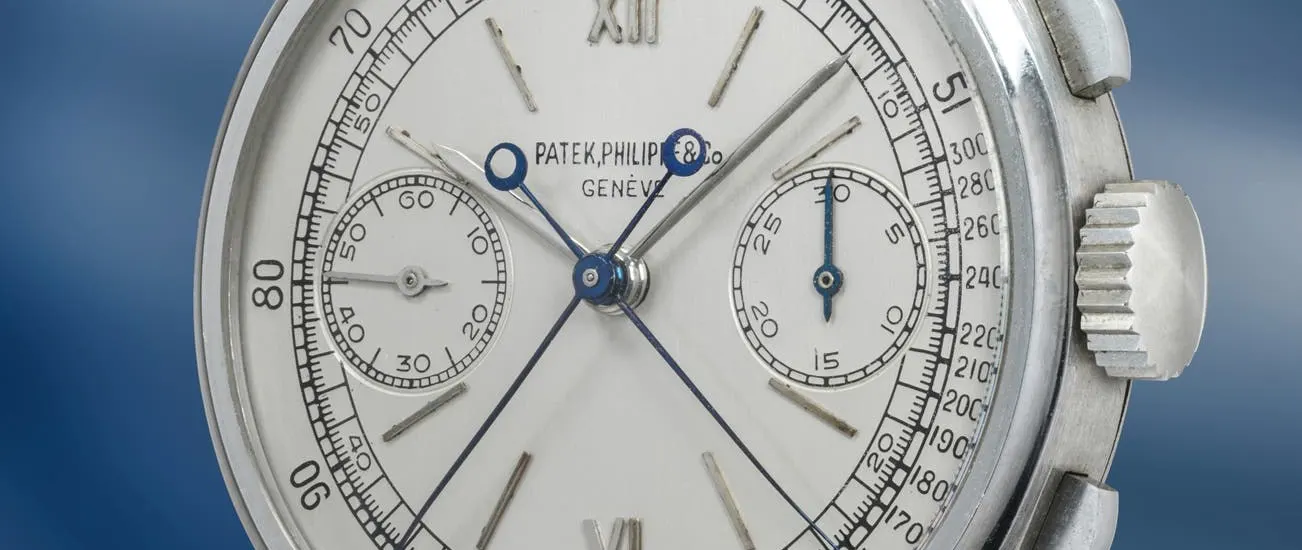
Lot 95 is a Patek Philippe Ref. 1436 dating to 1945, estimated at CHF2 million to CHF4 million. Its split-seconds chronograph allows intermediate timing while the main chronograph continues running, a mechanically demanding feature whose appeal goes beyond decorative complexity. Phillips describes the example as one of only two known stainless-steel watches of the reference retaining both original case and original dial configurations.
Steel is important here because it is not simply a cheaper alternative to a precious-metal case. In the vintage high-complication market, the relative scarcity of a particular metal and the integrity of its surviving examples can overturn ordinary assumptions about material value. Phillips says this watch retains the heavy proportions of its lugs and shows no service marks inside the caseback; an archive extract confirms its production in 1945 and subsequent sale in 1949.
Those details explain why collectors focus so heavily on the precise combination of case, dial and mechanism. Two watches bearing the same reference number may command very different assessments if one has been extensively refinished, altered or supplied with later components. The quoted upper estimate is not a prediction of investment return; the real question is what the documented originality is worth to a buyer with the expertise and resources to maintain the piece.
A Rolex Stelline discovered in Japan
Lot 129, a yellow-gold Rolex Ref. 6062 from around 1952, carries a pre-sale estimate of CHF600,000 to CHF1.2 million. Its dial has the eight star-shaped hour markers that give the Stelline variant its familiar nickname. The reference combines a triple calendar and moon-phase indication with the Oyster case, placing considerable mechanical information within an otherwise recognisable Rolex silhouette.
Phillips says the example came to light in Japan and was acquired from its original owner. The auction house draws particular attention to the preservation of the dial, the shape of the case and the surviving Super Oyster crown. Such details are material because a collector buying a watch several decades old is purchasing an individual survivor, not a factory-new version of the model.
The Rolex and Patek offerings also illustrate two different forms of complication. A split-seconds chronograph is concerned with precise intervals, while a full calendar with moon phase brings different information to a daily watch. Comparing them by price alone would miss the deeper differences in engineering, production history and the design traditions that made both references collectible.
Retail signatures, enamel and independent craftsmanship
Elsewhere in the selection, Phillips has highlighted a yellow-gold Patek Philippe Ref. 2497 from 1953 bearing the signature of New York retailer Gumbiner. With an estimate of CHF250,000–500,000, it is presented as the only known example of its reference carrying that particular retailer name. Such a signature can add a further layer of commercial history, but its authenticity and condition require the same close examination as the rest of the dial.
The catalogue also includes a Patek Philippe Ref. 605HU world-time pocket watch with a cloisonné enamel dial showing North America, estimated at CHF300,000–600,000. Its relevance is distinct from the steel chronograph: a miniature map, the work associated with Louis Cottier's world-time system and archive-backed production details come together in one object. The complexity here lies as much in artistic execution and presentation as in the mechanism.
Phillips is also offering two F.P. Journe Chronomètre à Résonance watches connected with special editions for the Tokyo boutique and retailer Les Ambassadeurs. The former is a titanium and pink-gold Tokyo anniversary edition from 2007; the latter is an early platinum piece with an engraved pink-gold dial. Their presence gives collectors a way to compare the distinctive technical and aesthetic identity of one independent maker across very different commissioned variants.
From marine chronometry to modern collecting
One of the most historically intriguing entries is Ferdinand Berthoud's Marine Chronometer No. 46, completed in 1790 and estimated at CHF100,000–200,000. Phillips notes its detachable gimballed mounting, which allowed the instrument to serve at sea, and the prominent place it occupied in Berthoud's published work on longitude and time measurement. For a yachting audience, it provides a direct connection between the art of horology and the older problem of reliable navigation at sea.
That connection is especially revealing because modern collectors often encounter timepieces as luxury accessories, yet precise portable timekeeping also has a long scientific and maritime history. A marine chronometer should not be judged by the conventions of a twentieth-century wristwatch. Its significance may lie in the quality of its escapement, the documents that connect it to a maker and the historical purpose for which it was constructed.
Potential bidders should account for buyer's premiums, taxes, shipping, insurance and future servicing rather than treating an estimate as an all-in cost. They should also ask specialists about dial work, case treatment, replacement parts, movement condition and the evidence supporting provenance. Phillips' Geneva Watch Auction: XXIV is scheduled for 7–8 November; until the hammer falls, these are catalogue highlights and collecting considerations, not realised prices or claims that any particular watch will outperform the market.