Geneva's November jewellery calendar is offering something more textured than a conventional parade of large diamonds. Christie's has assembled a single-owner collection in which modern high jewellery, ingenious transformable designs and exquisite eighteenth-century decorative objects will appear together. The live sale on 10 November 2026 at the Four Seasons Hotel des Bergues is accompanied by an online selection running from 5 to 17 November, placing craftsmanship and collecting history at the centre of the occasion.
Christie's identifies 123 objects for the room auction and a further 152 for the online component, drawn from a collection brought together by one family over four decades. The appeal is not simply the combined number of pieces, but the uncommon conversation between different periods: Van Cleef & Arpels ruby settings, Cartier lacquer work, Graff gemstones and hand-finished gold boxes that predate the modern jewellery house. For a luxury collector, the links between material, technique and provenance are the real story.
Jewels designed to transform
Among the strongest examples of jewellery as engineering is Van Cleef & Arpels' diamond and coloured-diamond 'Louvre' necklace, which incorporates a central flower ornament that can be exchanged for other compatible brooches. Christie's assigns the necklace an estimate of CHF 200,000–300,000. The value of the idea extends beyond an additional styling option: a transformable piece asks its maker to solve weight, connection, security and balance without compromising how the jewel moves against the body.
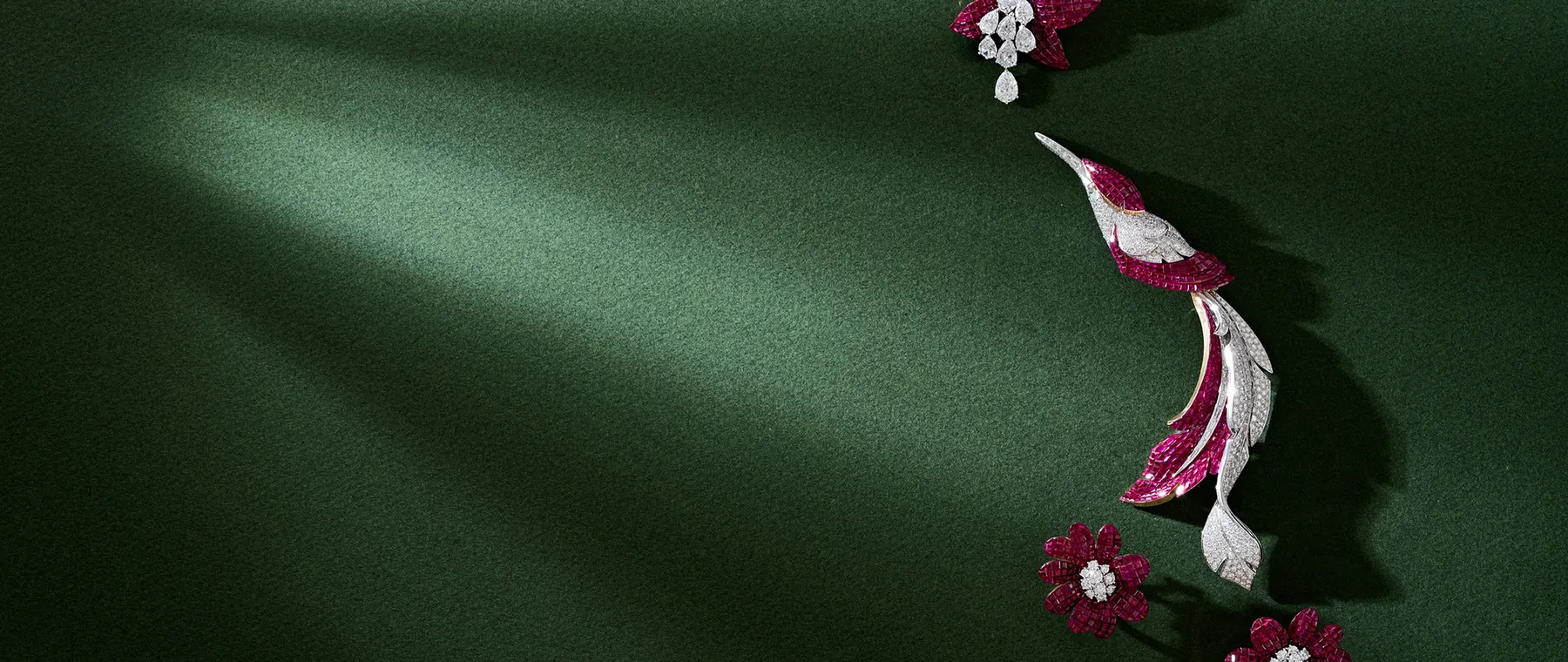
The auction house also highlights Van Cleef & Arpels' Mystery Set creations, including the ruby-and-diamond 'Oiseau Mystérieux' brooch of 2006. Its catalogue estimate is CHF 500,000–800,000. The Mystery Set technique was patented by the house in 1933 and seeks an uninterrupted field of gems with little visible mounting hardware; a technically challenging approach because individual stones still have to be supported accurately and securely.
Jewellery of this sophistication rewards close examination in person. Photographs reveal overall colour and the drama of a design but rarely convey the joins that let a brooch detach, the quality of a setting's finish or the subtleties of an older repair. A collector considering bidding should ask to inspect the condition report and arrange a professional viewing, with particular attention to the functionality of moving components.
Transformability also complicates the question of completeness. A necklace originally conceived with interchangeable elements may be sold with some ornaments but not others, so its described configuration matters more than an evocative design name. Catalogue photographs, lot notes and any accompanying maker documentation are the starting points for establishing precisely what will change hands, rather than an assumption based on examples held in other collections.
Important stones, with careful distinctions
One of the sale's major contemporary highlights is a David Morris ring with a 14.63-carat fancy orangy-pink diamond, assigned a presale estimate of CHF 1.3m–2.1m. Another is a pair of Graff earrings featuring cushion-shaped emeralds each described by Christie's as weighing just over 17 carats; the pair is estimated at CHF 750,000–1.2m. These are auction-house estimates, not sale results or independently established market prices.
Fancy-coloured diamonds and emeralds invite markedly different lines of enquiry. For a diamond, a buyer will be concerned with laboratory grading, colour description, treatment disclosures and whether the mounting affects assessment. Emeralds add questions about clarity enhancement, fissures and sensitivity to cleaning methods. An attractive photograph should never displace independent scrutiny of the documents attached to the specific lot.
The broad collection also includes a Bulgari Trombino ring featuring a Burmese ruby, a Graff necklace with a heart-shaped diamond pendant and carefully composed sapphire pieces. Different stones and makers create different reasons for collecting: rare colour, provenance, an exceptional design period or simply a jewel that an owner intends to wear regularly. There is little merit in treating the highest estimate as a substitute for personal taste.
Timing matters for international collectors. Those arriving for Geneva's November auctions may wish to see several houses' exhibitions, but each has its own registration rules, bidding deadlines and payment or export conditions. Christie's gives a viewing period of 5–10 November for this collection at the Four Seasons Hotel des Bergues, allowing an opportunity to consider objects before the live bidding begins.
The quiet power of Art Deco objects
The collection's other compelling chapter is the group of miniature luxury objects associated with Cartier and the Art Deco period. Some are cases with technically intricate hinges, compartments and lacquer decoration rather than wearable gems. Their appeal is the density of craftsmanship in a small surface: an object can make a stronger statement through precise inlay and proportion than through sheer carat weight.
A Cartier Art Deco laque burgauté, coral, diamond and wood table cigarette case is estimated at CHF 80,000–120,000. Laque burgauté incorporates delicate shell or mother-of-pearl into lacquer, producing controlled iridescence. The technique's historical importance deserves to be separated from the object's former use; the contemporary buyer may regard it principally as a decorative artefact or a case study in materials.
Another Cartier case from 1927 combines lacquer, rock crystal and nephrite with a highly detailed decorative plaque. Christie's places its estimate at CHF 120,000–200,000, and attributes the mother-of-pearl marquetry panel as likely by the craftsman Vladimir Makovsky. 'Likely' is an important qualifier: specialists' attribution is evidence-led but can be less definite than a documented commission or signed maker's mark.
Seen alongside later Van Cleef & Arpels work, these Art Deco objects illuminate a continuity in luxury craftsmanship. Both the hidden setting of a gemstone and the small mechanical closure of a vanity case depend on exact tolerances and choices a casual viewer may miss. The luxury here is not only the materials consumed, but also the time and skill required to make complex assemblies appear effortless.
Eighteenth-century craftsmanship in the same room
Older gold boxes deepen the sale's historical range. Christie's identifies a German gold and mother-of-pearl snuff box from about 1750, associated with Berlin or Dresden, and a Louis XV Japanese-lacquer example by the Parisian goldsmith François-Thomas Germain dating to 1755. The Germain box carries an estimate of CHF 80,000–120,000 and offers a link to eighteenth-century European fascination with Asian lacquer techniques.
Such objects raise preservation questions different from those of a modern diamond ring. Lacquer, delicate inlay and aged metal surfaces are sensitive to cleaning and display decisions, and historic restorations may themselves form part of an item's story. Before an acquisition, buyers should seek a clear condition report, ask what has been conserved and consider specialist storage rather than treating the piece like a robust contemporary accessory.
For a yacht-based collection, the practical differences become particularly relevant. Salt-laden air, vibration, changes in temperature and security considerations make a permanent onboard display more challenging than storage in a controlled residence. A carefully chosen object might travel for a private occasion, but transport, insurance and security planning should be agreed in advance with appropriate specialists and the vessel's management team.
How to experience the Geneva sale
Christie's official sale overview gives the live auction location as the Four Seasons Hotel des Bergues, Quai des Bergues 33, Geneva. The live auction is scheduled for Tuesday 10 November at midday CET; the separate online session runs between 5 and 17 November. Visitors should confirm any viewing appointment, identification and bidding procedures directly with Christie's before travelling.
The auction house's 23 October editorial presentation includes individual lots and estimates, while its catalogue provides the operative lot descriptions and conditions. Estimates exclude some transaction costs and cannot guarantee the final price; buyers need to account for buyer's premium, taxes, transport, insurance and any applicable import or export requirements.
For a collector accustomed to choosing art, jewellery and personal objects for life aboard, this sale offers a useful reminder that rarity is not limited to a gemstone's colour or weight. It may lie in the quiet precision of an invisible setting, a forgotten lacquer method or a cleverly constructed piece that has already survived several generations. Geneva provides a chance to examine those qualities together, long before the hammer determines the price.
For confirmed dates, viewing details and the official auction links, see our Christie's Geneva Exceptional Jewels event listing. The live sale takes place on 10 November 2026.