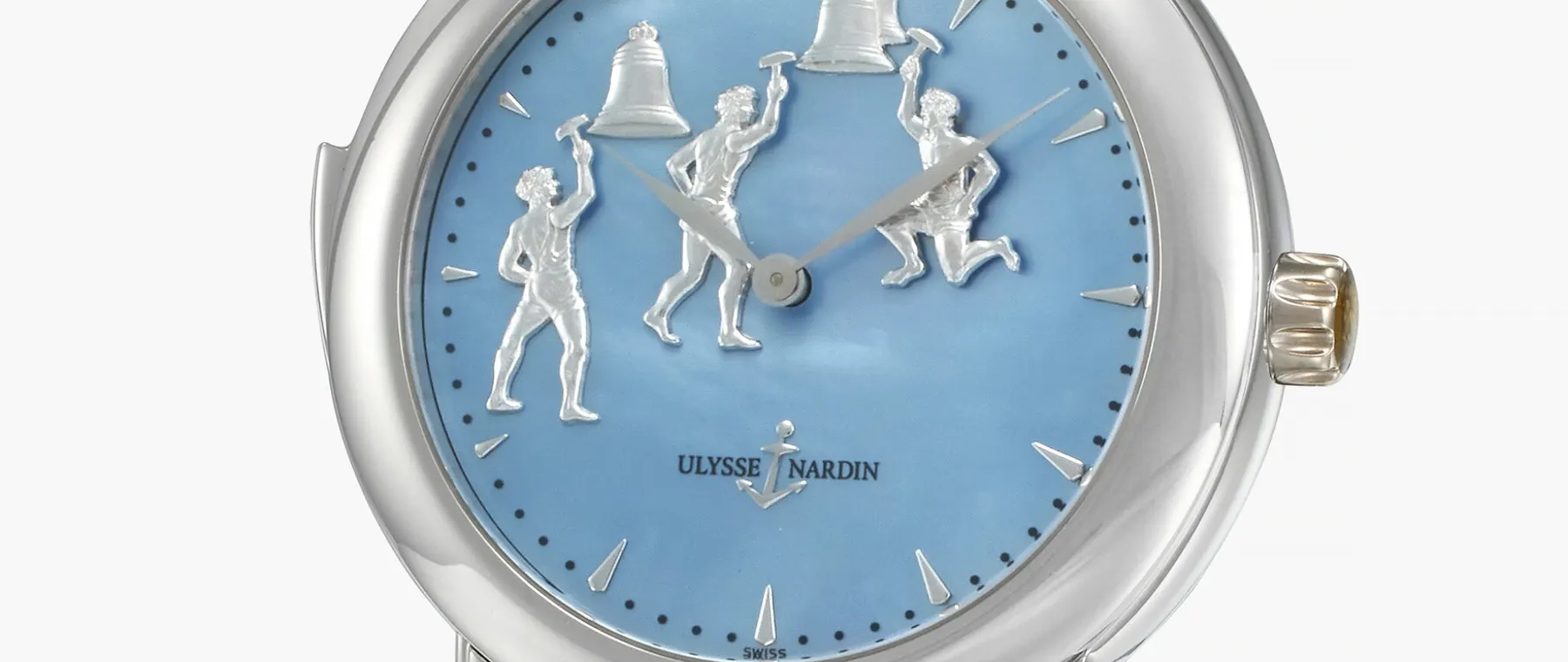
For a yacht owner drawn to the history of marine chronometers, a remarkable lot in Sotheby’s forthcoming Geneva watches sale connects navigation heritage with theatrical modern watchmaking. The Ulysse Nardin Triple Jack Minute Repeater, a platinum wristwatch dating to around 2005, is listed as lot 25 in the auction house’s November 2026 Important Watches catalogue. Its appearance is intriguing because this is not simply a complication that tells the time: three miniature figures on its mother-of-pearl dial move when the repeater sounds.
Sotheby’s identifies this example as reference 739-80, case number 6, and gives an estimate of CHF 40,000–80,000. That range is the auction house’s pre-sale expectation, not an achieved price or an independent market valuation. The Important Watches sale is scheduled for 8–9 November in Geneva, with the lot page showing the 8 November session beginning at 09:00 GMT. Prospective buyers should consult the live catalogue for bidding times and any revisions.
A small mechanical performance
The term jacquemart describes an animated figure traditionally associated with a clock that strikes the hours. Ulysse Nardin brought this old public-clock spectacle to a wristwatch dial, where tiny figures can act out the chiming sequence. In the Triple Jack, the figure to the left marks the hours, the two figures on the right take part during the quarter-hour chimes, and the outermost figure accompanies the minutes, according to Sotheby’s detailed lot description.
That choreography is why the watch deserves closer attention than its headline estimate might suggest. A minute repeater already demands complex mechanical coordination to convert the indicated time into audible signals; coupling those signals with precisely timed animated figures adds a layer of visual storytelling. The wearer is invited to experience time through movement and sound as well as through hands on a dial, a distinction that gives this model its unusual character.
The dial’s mother-of-pearl surface provides a shifting visual background beneath the sculpted figures. Its changing reflections are particularly suited to a mechanism that is not static: the decorative material and the automata serve one concept. Sotheby’s lists a 40-millimetre platinum case, a sapphire display back secured with six screws, and the manually wound Ulysse Nardin calibre UN-73. The catalogue also specifies an 18-karat white-gold folding clasp.
From a marine chronometer maker to animated complications
The maritime association is historical and substantial, although this particular wristwatch is a collector’s object rather than a shipboard navigation instrument. Ulysse Nardin traces its origins to Le Locle in 1846 and describes a long record of producing marine chronometers for navies and maritime institutions. Those instruments belonged to an era in which precise timekeeping was indispensable to calculating longitude at sea; accuracy was a navigational requirement, not merely a measure of luxury.
The maison’s account of its own history marks 1983 as the beginning of Rolf W. Schnyder’s revival of the business and records the influential work of watchmaker Ludwig Oechslin. In 1989, the brand introduced the San Marco minute repeater with animated jacquemarts on its dial, a key precedent for the Triple Jack. Sotheby’s catalogue likewise points to that line of development, making the historical connection corroborated by both the auction house and the manufacturer rather than resting on an unsupported anecdote.
Sotheby’s further explains that the UN-73 movement developed from minute-repeating work associated with complications specialist Christophe Claret. It would be misleading to treat that development history as proof that this particular example contains every feature of the earlier San Marco; the significance is continuity in a highly specialised branch of mechanical watchmaking. The Triple Jack illustrates how the company used demanding complications to reinterpret an identity once centred on practical chronometry.
What the catalogue confirms about lot 25
The listing describes the watch as signed on its case, dial and movement, with a Ulysse Nardin numbered guarantee card, product literature, a wooden resonance box, a presentation box and outer packaging. These accompanying items are important details for a collector assessing the completeness of the offering, but an inventory in an auction catalogue is not a substitute for an individual inspection or a formal condition report. Sotheby’s asks potential bidders to sign in to obtain its condition information.
There is also a practical restriction in the lot notes. A display strap incorporating material from a protected species is expressly excluded from the sale; Sotheby’s says a branded calf-leather replacement will accompany the watch instead. The auction house separately flags restrictions affecting the movement of lots containing controlled materials, a reminder that acquisition, shipping and import compliance can matter as much as winning a bid for an international collector.
The CHF 40,000–80,000 estimate covers an inherently specialised object. It should not be compared directly with a standard three-hand sports watch, nor read as a guarantee of a sale within that band. Rarity, condition, provenance, buyer’s premium and competing collectors’ interest can change the final expenditure materially. The published estimate excludes an account of those personal costs, which bidders must calculate from the applicable conditions of sale.
Why the watch resonates with yachting collectors
There is a natural appeal in a watchmaker that made its name solving the problems of timing at sea. A superyacht owner may encounter antique marine chronometers in a study, museum or specialist auction, while modern grand-complication wristwatches usually emphasise visual invention and hand finishing. The Triple Jack occupies the bridge between those worlds: its manufacture’s marine identity is genuine, but the mechanism celebrates time as performance rather than claiming a modern navigation function.
The result is a conversation piece that can be appreciated without exaggerating its purpose. Its chiming figures recall the civic clock towers of Europe, its mother-of-pearl dial creates an unexpectedly delicate stage, and its platinum case places that stage inside a restrained precious-metal frame. The craftsmanship is the story, as much as the specifications. Interested readers should treat the auction photograph and official catalogue as the authoritative visual and technical records for this particular watch.
Geneva preview and collector considerations
Sotheby’s is bringing the watch to its Important Watches Geneva sale on 8–9 November 2026. The official catalogue identifies the Triple Jack as lot 25 and provides the current bidding and session information. The event also belongs to a busy week in Geneva’s watch-collecting calendar, but buyers should keep the different auction houses, dates and catalogues distinct when arranging inspections or bidding registration.
The most useful next step for a serious collector is to review the individual Sotheby’s lot record, request the current condition documentation and confirm shipping restrictions before committing. The broader official November Geneva catalogue supplies the auction context, while Ulysse Nardin’s historical timeline explains the mechanical lineage. Together they make a more reliable basis for understanding this watch than an estimate or a striking image alone.