A marine timekeeper brings the age of longitude to Geneva
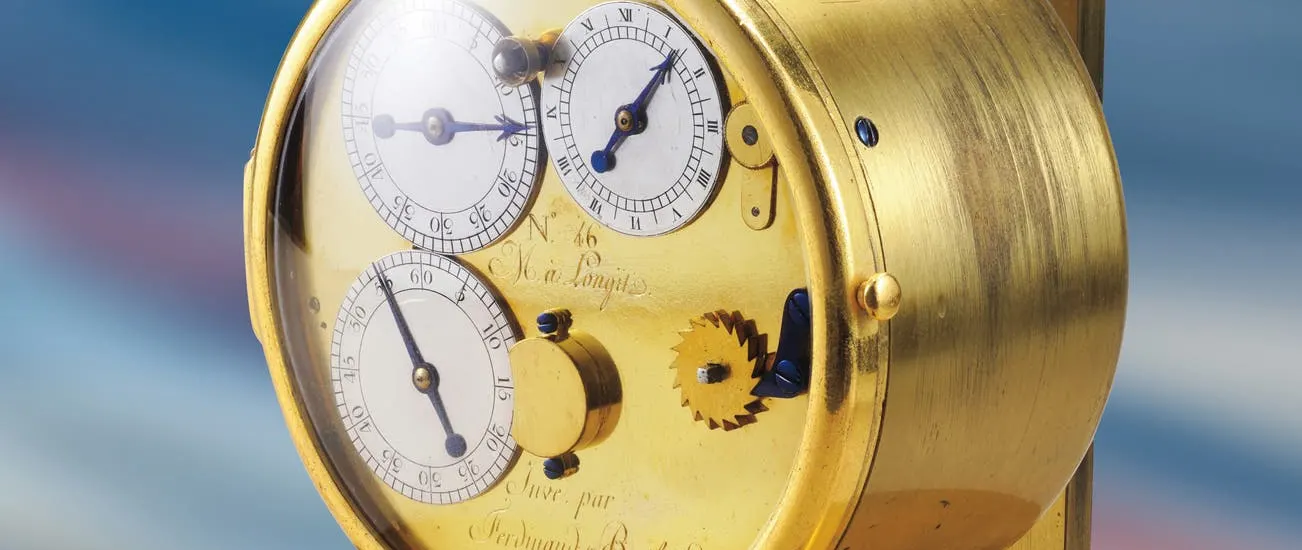
An object made to solve one of the great problems of ocean navigation is returning to public view through Phillips' Geneva watch auction on 7 and 8 November 2026. Ferdinand Berthoud's marine chronometer No. 46, completed in 1790, is an unexpectedly resonant centrepiece for collectors who move between fine watches, historic vessels and contemporary yachting. Its importance lies not in decorative scale but in the precision it was designed to maintain while a ship moved, temperature shifted and the reliable measurement of time had direct consequences for navigation.
The instrument appears as lot 91 in Phillips' catalogue, where the auction house describes a brass marine chronometer made by Berthoud's pupil Vincent Martin under the master's specifications. Its announced estimate is CHF 100,000 to CHF 200,000, a guide established before bidding rather than a prediction of a final price. The lot is also accompanied by historical books that document Berthoud's thinking. That pairing of machine and written evidence gives prospective purchasers an unusually direct route into the intellectual world behind an 18th-century precision instrument.
Although the wider auction includes extraordinary wristwatches, the Berthoud chronometer deserves particular attention in a maritime publication. It was intended to work at sea, and its detachable gimballed support allowed different modes of use rather than confining it to a traditional shipboard enclosure. The ability to move between a stable marine mounting and more portable service made No. 46 a distinctive engineering proposition at the time. It invites readers to consider why a working instrument can sometimes carry more history than the most elaborate decorative object.
Why keeping time was vital to determining longitude
A navigator can establish latitude from celestial observations, but longitude poses a different challenge: it depends upon knowing the difference between local time and the time at a reference meridian. A reliable marine chronometer makes that comparison possible when paired with competent observation and calculation. No. 46 belongs to a period in which watchmakers were still working to keep precision timekeepers stable through movement, changes in temperature and the practical demands of a long sea passage.
Berthoud approached the problem as an experimental engineer and writer, not only as a craftsman. Phillips identifies a detached pivoted detent escapement, a fusée and maintaining-power arrangement, anti-friction rollers and a steel-and-copper temperature-compensation system among the instrument's features. These details should not be treated as decorative terminology: each addresses some aspect of regulating or transmitting energy as consistently as possible. The mechanics show how much calculation and physical experimentation were invested in securing trustworthy time at sea.
The chronometer's movement was not a miniature version of the digital displays now found on a yacht bridge. It was an analogue mechanical solution developed before electronic navigation, and its limitations demanded care from a trained operator. That context is part of its appeal. The object is evidence of the long engineering path that eventually led from sea-going chronometers to radio navigation, satellite positioning and the integrated helm equipment familiar today. Its historical significance does not require claiming that it can replace a modern navigation system.
The documentary record is almost as remarkable as the instrument
One of the strongest features of lot 91 is the surviving documentary association. Phillips states that the first 22 pages of Berthoud's 1792 treatise on longitude watches describe No. 46, and that the chronometer was later chosen for the frontispiece of his 1802 history of measuring time. Copies of both works are included with the lot. In a collecting field where provenance may be inferred through serial numbers and period advertisements, contemporary technical explanation is a compelling source of evidence.
The physical watch is listed as having a 72-millimetre diameter, with a modern recreation of a brass stand among its accessories. It is important to distinguish that later stand from the period chronometer itself. Buyers assessing condition and completeness should examine Phillips' detailed lot report, the instrument's documented components and the descriptions of accompanying books rather than assuming that every displayed mounting or accessory was made in 1790.
The catalogue recounts how Vincent Martin, who worked in the French naval-watchmaking tradition at Brest, made the chronometer following Berthoud's instructions. This offers a glimpse of the relationship between a leading designer and the skilled specialists able to execute experimental work. For a modern yacht owner, it echoes the less visible collaboration behind complex projects, where naval architects, engineers, craftspeople and technicians must all translate an owner's brief into equipment that performs reliably.
Patek Philippe, Rolex and the wider collecting landscape
The Geneva sale is not exclusively a historical-instrument auction. Phillips' September preview and current online catalogue describe a major selection of vintage and modern watches, including an exceptionally rare Patek Philippe reference 1436 split-seconds chronograph in stainless steel. The auction house lists the 1945 watch with a CHF 2 million to CHF 4 million estimate, reflecting its particular specification and the reported survival of very few examples with original steel cases and dials. An estimate should never be mistaken for an achieved auction result.
Another prominent piece is a yellow-gold Patek Philippe reference 2497 with the rare retailer signature Gumbiner, while the Rolex reference 6062 'Stelline' brings its celebrated star-marker dial to the sale. Phillips places the reference 2497 at CHF 250,000–500,000 and the Stelline at CHF 600,000–1.2 million in its September presentation. Each proposition appeals to a different collecting instinct: exceptional technical rarity, unusual retail history, preservation of an iconic dial or evidence of long-standing original ownership.
The contrast with Berthoud's No. 46 makes the auction particularly interesting. Modern collectors may favour immediately recognisable brands, whereas a specialist historical chronometer asks for familiarity with escapements, archival literature and the development of sea navigation. Neither approach is inherently more serious. A well-formed collection often becomes more persuasive when its owner understands the wider progression of timekeeping, beyond the appeal of a famous name or a single record-setting price.
What a thoughtful collector should verify before bidding
Prospective buyers should begin with original catalogue documentation, request a current condition report and make an appointment for inspection through Phillips if practical. A mechanical instrument from 1790 raises questions different from those presented by a modern wristwatch: originality of parts, the history of restoration, operation of the escapement and the handling of delicate components can all affect how the piece should be conserved. A catalogue image cannot settle those questions by itself.
Auction estimates also exclude some important elements of the eventual financial commitment. Buyers need to review the auctioneer's conditions of sale, premium, tax position, transport arrangements and any import or export requirements relevant to their own jurisdiction. An object may be historically significant without being suitable for regular operation, and maintenance or conservation should not be planned without appropriate expert advice. The objective is to protect both the instrument and the evidence it carries.
For readers who love the meeting point between craftsmanship and the sea, the value of the Geneva sale extends beyond the winning bid. Berthoud's No. 46 recalls the era when accurate time was itself advanced maritime technology, and the surviving treatises provide an unusually rich account of that pursuit. The Geneva Watch Auction: XXIV event page contains the forthcoming dates; the official Phillips lot listing is the source for updated catalogue descriptions and sale terms.